The Tech Edvocate

Top Menu

  • Advertisement
  • Apps
  • Home Page
  • Home Page Five (No Sidebar)
  • Home Page Four
  • Home Page Three
  • Home Page Two
  • Home Tech2
  • Icons [No Sidebar]
  • Left Sidbear Page
  • Lynch Educational Consulting
  • My Account
  • My Speaking Page
  • Newsletter Sign Up Confirmation
  • Newsletter Unsubscription
  • Our Brands
  • Page Example
  • Privacy Policy
  • Protected Content
  • Register
  • Request a Product Review
  • Shop
  • Shortcodes Examples
  • Signup
  • Start Here
    • Governance
    • Careers
    • Contact Us
  • Terms and Conditions
  • The Edvocate
  • The Tech Edvocate Product Guide
  • Topics
  • Write For Us
  • Advertise

Main Menu

  • Start Here
    • Our Brands
    • Governance
      • Lynch Educational Consulting, LLC.
      • Dr. Lynch’s Personal Website
      • Careers
    • Write For Us
    • The Tech Edvocate Product Guide
    • Contact Us
    • Books
    • Edupedia
    • Post a Job
    • The Edvocate Podcast
    • Terms and Conditions
    • Privacy Policy
  • Topics
    • Assistive Technology
    • Child Development Tech
    • Early Childhood & K-12 EdTech
    • EdTech Futures
    • EdTech News
    • EdTech Policy & Reform
    • EdTech Startups & Businesses
    • Higher Education EdTech
    • Online Learning & eLearning
    • Parent & Family Tech
    • Personalized Learning
    • Product Reviews
  • Advertise
  • Tech Edvocate Awards
  • The Edvocate
  • Pedagogue
  • School Ratings

logo

The Tech Edvocate

  • Start Here
    • Our Brands
    • Governance
      • Lynch Educational Consulting, LLC.
      • Dr. Lynch’s Personal Website
        • My Speaking Page
      • Careers
    • Write For Us
    • The Tech Edvocate Product Guide
    • Contact Us
    • Books
    • Edupedia
    • Post a Job
    • The Edvocate Podcast
    • Terms and Conditions
    • Privacy Policy
  • Topics
    • Assistive Technology
    • Child Development Tech
    • Early Childhood & K-12 EdTech
    • EdTech Futures
    • EdTech News
    • EdTech Policy & Reform
    • EdTech Startups & Businesses
    • Higher Education EdTech
    • Online Learning & eLearning
    • Parent & Family Tech
    • Personalized Learning
    • Product Reviews
  • Advertise
  • Tech Edvocate Awards
  • The Edvocate
  • Pedagogue
  • School Ratings
  • Viaim Opennote Review: The AI Note-Taker That Disappears Into Your Daily Routine

  • A Visitors Guide to Long Beach (CA), United States

  • A Visitor’s Guide to Fresno (CA), United States

  • A Visitors Guide to New Orleans (LA), United States

  • A Visitors Guide to Sacramento (CA), United States

  • A Visitors Guide to Lyon, France

  • JisuLife Ultra2 Portable Fan: A Powerful Multi-Function Cooling Solution

  • A Visitors Guide to Viña del Mar, Chile

  • A Visitors Guide to Århus, Denmark

  • A Visitors Guide to Bakersfield (CA), United States

Tech Advice
Home›Tech Advice›Sony Memory Stick

Sony Memory Stick

By Matthew Lynch
July 20, 2023
0
Spread the love

The Sony Memory Stick, a versatile and revolutionary storage device, has left an indelible mark on the digital world. Introduced in 1998, the Memory Stick was designed to store digital information for various electronic devices such as cameras, camcorders, and gaming consoles. In this article, we will explore the evolution of Sony’s flagship storage medium and its impact on the industry.

1. The Birth of Sony Memory Stick:

In October 1998, Sony introduced the first-generation Memory Stick with a storage capacity of 4 MB. This original model was designed to be compact and portable, measuring 50 x 21.5 x 2.8 mm. The first devices to support this new storage format included Sony’s own Cyber-shot digital cameras and Handycam camcorders.

2. Expanding the Memory Stick Family:

Sony quickly realized that there was a growing demand for higher storage capacities. In response, the company expanded the Memory Stick family with multiple iterations over the years.

– Memory Stick Duo: Introduced in 2003, this smaller version of the original Memory Stick measured 31 x 20 x 1.6 mm and offered more compatibility with portable devices.

– Memory Stick PRO: Launched in 2003, this variation provided high-capacity storage options (up to 32 GB) and faster read/write speeds (up to 160 Mbps).

– Memory Stick Micro (M2): Released in 2006, the M2 was even smaller than the Duo at just 15 x 12.5 x 1.2 mm and supported capacities up to 16 GB.

3. Enter the Pro Duo:

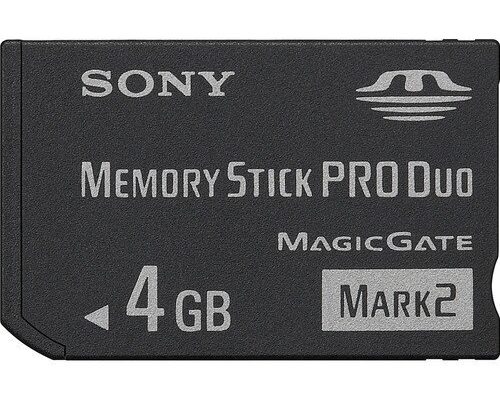
In 2004, Sony combined elements from both its Memory Stick Duo and PRO lines to create the Memory Stick PRO Duo. The new design retained the same size as a standard Duo but provided faster speeds and larger capacities of up to 32 GB. This memory stick became popular among PSP (PlayStation Portable) users for game storage.

4. High Capacity and Speed: Memory Stick PRO-HG Duo:

By 2008, Sony introduced the Memory Stick PRO-HG Duo, capable of supporting a whopping 60 Mbps data transfer rate. With storage capacities ranging from 1 to 32 GB, these memory sticks were commonly used in high-definition camcorders and DSLR cameras, ensuring the efficient transfer of high-quality images and videos.

5. Memory Stick XC Series:

Sony unveiled the Memory Stick XC series in 2009, which promised an increase in capacity up to a stunning 2 TB. However, this variant never gained significant traction due to the simultaneous rise in popularity of the SDXC card format.

Conclusion:

While it’s true that the Sony Memory Stick’s dominance has waned with the increasing popularity of newer formats like the SD card and MicroSD, it remains a noteworthy milestone in the development of digital storage solutions, especially during its heyday in the early-to-mid-2000s. With its various iterations offering benefits such as portability, increased capacity, and faster transfer speeds, Sony’s Memory Stick paved the way for today’s convenient and portable digital storage options.


Previous Article

SIM Card

Next Article

Storage vs. Memory

Matthew Lynch

Related articles More from author

  • Tech Advice

    The Best VPNs that Maintain a Strict No-Logging Policy

    October 19, 2023
    By Matthew Lynch
  • Tech Advice

    Best Mobile Credit Card Readers of 2023

    August 9, 2023
    By Matthew Lynch
  • Tech Advice

    Online Banking Security: How To Protect Your Online Banking Information

    August 9, 2023
    By Matthew Lynch
  • Tech Advice

    iPhone 15 Pro Overheating? Apple is (Finally) on the Case

    October 19, 2023
    By Matthew Lynch
  • Tech Advice

    Stamp Prices Are Going Up Again: Here’s How to Save on Postage

    July 11, 2023
    By Matthew Lynch
  • Tech Advice

    What Is a Market Maker? Understanding the Role of Market Makers in the UK

    September 7, 2023
    By Matthew Lynch

Search

Login & Registration

  • Register
  • Log in
  • Entries feed
  • Comments feed
  • WordPress.org

Newsletter

Signup for The Tech Edvocate Newsletter and have the latest in EdTech news and opinion delivered to your email address!

About Us

Since technology is not going anywhere and does more good than harm, adapting is the best course of action. That is where The Tech Edvocate comes in. We plan to cover the PreK-12 and Higher Education EdTech sectors and provide our readers with the latest news and opinion on the subject. From time to time, I will invite other voices to weigh in on important issues in EdTech. We hope to provide a well-rounded, multi-faceted look at the past, present, the future of EdTech in the US and internationally.

We started this journey back in June 2016, and we plan to continue it for many more years to come. I hope that you will join us in this discussion of the past, present and future of EdTech and lend your own insight to the issues that are discussed.

Newsletter

Signup for The Tech Edvocate Newsletter and have the latest in EdTech news and opinion delivered to your email address!

Contact Us

The Tech Edvocate
910 Goddin Street
Richmond, VA 23231
(601) 630-5238
[email protected]

Copyright © 2025 Matthew Lynch. All rights reserved.