Science and Technology in Civilization V
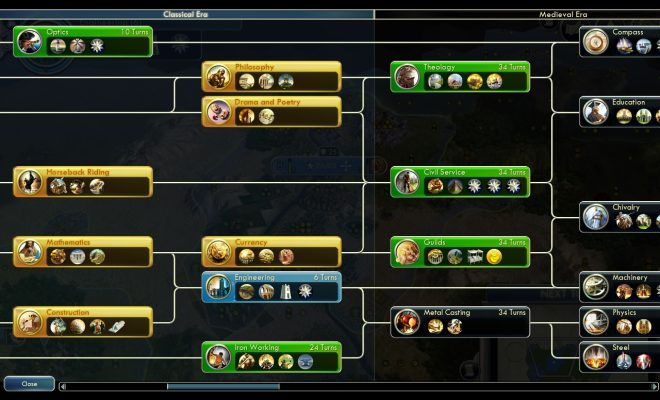
Science and technology form the backbone of progress in Civilization V. From the discovery of pottery in the ancient era to the development of future tech in the information age, the pursuit of scientific knowledge drives the evolution of your civilization.
At its core, science in Civilization V is a resource that accumulates each turn, primarily generated by population and buildings. This science is then invested into researching technologies on the tech tree. Each technology unlocks new units, buildings, or abilities, allowing your civilization to advance and adapt to new challenges.
The tech tree in Civilization V is vast and complex, offering multiple paths to progress. It’s divided into eras, from Ancient to Future, with each era bringing more advanced and powerful options. The non-linear nature of the tech tree allows for diverse strategies. For instance, a player might rush Writing for early wonders, or prioritize Bronze Working for early military units.
Balancing short-term needs with long-term goals is a key aspect of managing your scientific progress. While beelining for a crucial technology might seem tempting, it can leave you vulnerable in other areas. Successful players often develop a flexible research strategy that adapts to the game’s changing circumstances.
Several factors can boost your civilization’s science output. Libraries, Universities, and Research Labs all provide significant science bonuses. The Academy improvement, built by Great Scientists, provides a substantial science boost to its city. Certain Wonders, like the Great Library or Porcelain Tower, can dramatically accelerate your scientific progress.
Trade routes, introduced in the Brave New World expansion, can also boost science output. By establishing trade routes with more technologically advanced civilizations, you can gain science bonuses, helping you catch up if you’ve fallen behind.
The role of Great Scientists is crucial in scientific strategy. These units can be used to build Academy improvements for long-term science boosts, or triggered for an immediate large amount of science, often used to rush important technologies.
Espionage, introduced in the Gods & Kings expansion, adds another dimension to scientific gameplay. Spies can be sent to other civilizations’ cities to steal technologies, allowing you to catch up if you’ve fallen behind or to gain technologies you’ve skipped.
Research agreements are a diplomatic option that can boost scientific progress. Two civilizations can agree to invest gold in joint research, providing both with a science boost after a set number of turns. This can be particularly useful when aiming for a science victory or when trying to catch up to more advanced rivals.
The science victory condition is achieved by completing the Apollo Program, then building and launching the various spaceship parts. This typically requires a strong focus on scientific development throughout the game, culminating in a race to complete the spaceship before rivals can achieve their own victory conditions.
It’s worth noting that even if you’re not aiming for a science victory, technological development remains crucial. Advanced units are needed for military victories, while many of the buildings and wonders key to cultural or diplomatic victories are unlocked through scientific research.
Balancing scientific development with other aspects of your civilization is a key challenge in Civilization V. While it’s possible to focus entirely on science, neglecting military or cultural development can leave you vulnerable to more well-rounded opponents.
In conclusion, science and technology in Civilization V represent more than just a path to one type of victory. They are the engines of progress, unlocking new possibilities and shaping the development of your civilization from ancient times to the space age. Whether you’re aiming to be the first to Alpha Centauri or simply trying to stay competitive in a complex world, mastering the scientific systems of Civilization V is crucial to success.