Quantum Studios Just Fired 15% of Its Creative Staff — Here’s Why You Should Be Worried
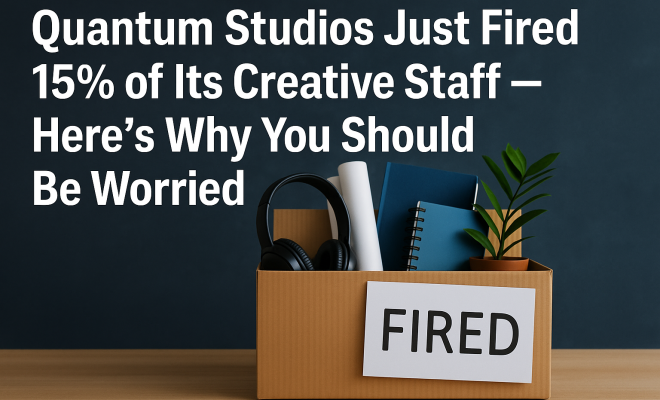
The gaming industry is no stranger to disruption. We’ve seen seismic shifts from arcade cabinets to home consoles, from cartridges to digital downloads, and from single-player sagas to sprawling online worlds. But a recent announcement from Quantum Studios, a heavyweight in AAA game development, feels different. It’s less a shift and more a tremor, hinting at an earthquake that could redefine the very bedrock of creative work in gaming. Quantum Studios just laid off a substantial 15% of its creative and art department staff, openly citing the “unprecedented efficiency” of its new AI-powered content generation suite as the driving force behind the decision. If you work in game development, or even just care about how your favorite games get made, this news should give you pause. It’s not just about one studio; it’s a stark, real-world example of how the rapid advancements in AI in game development are beginning to reshape the landscape, and frankly, it’s a little chilling.
The Quantum Studios Precedent: A Troubling Bellwether
Let’s not mince words: Quantum Studios’ move isn’t just a corporate restructuring; it’s a declaration. By explicitly linking mass layoffs to AI’s capabilities, they’ve ignited a firestorm of debate across social media, developer forums, and industry analyst desks. For years, we’ve heard whispers and predictions about AI’s potential to automate creative tasks. We’ve seen impressive demos, read theoretical papers, and even dabbled with some of the early tools. But seeing a major player like Quantum Studios actually pull the trigger on significant job cuts, directly attributing it to AI, transforms a hypothetical threat into a very tangible reality. This isn’t about optimizing a workflow; it’s about replacing human roles with algorithms, and that carries profound implications for everyone involved in game creation.
The 15% figure isn’t trivial. It represents a significant portion of a studio’s artistic talent—concept artists, texture artists, 3D modelers, animators, and potentially even level designers whose work might now be partially automated. What does this mean for the individuals who lost their jobs? And what does it mean for those who remain, now working alongside AI tools that can generate assets at a speed and scale previously unimaginable? The emotional impact on the industry is palpable, sparking a wave of anxiety about job security and the future relevance of highly specialized creative skills.
The Promise and Peril of AI in Game Development
To understand the full scope of this situation, we need to look at both sides of the coin. On one hand, the “unprecedented efficiency” Quantum Studios speaks of isn’t hyperbole. Modern AI tools, particularly those leveraging generative adversarial networks (GANs) and large language models (LLMs), are genuinely revolutionary. They can churn out variations of textures, character models, environmental assets, sound effects, and even basic quest structures at speeds that human artists simply cannot match. Imagine needing a hundred different variations of a rusted metal texture for an abandoned cityscape. A human artist might spend days, even weeks, on that task. An AI can generate them in minutes.
This efficiency holds immense promise for developers looking to cut costs, accelerate production pipelines, and iterate faster. Smaller indie studios, often resource-strapped, might find AI tools a lifeline, allowing them to achieve a level of visual fidelity or content volume previously reserved for AAA budgets. For larger studios, it could mean reallocating human talent to more complex, strategic, or truly innovative tasks that AI can’t yet handle. However, this promise comes with a dark shadow. The peril is precisely what we’ve seen at Quantum Studios: the direct displacement of jobs. If a machine can do the work of several junior artists, or even a seasoned one for certain tasks, where do those artists go?
Generative AI: The New Workhorse
The specific type of AI likely responsible for Quantum Studios’ efficiency gains is generative AI. These systems learn from vast datasets of existing content—be it images, 3D models, or text—and then generate new, original content based on those learned patterns. For game development, this translates into tools that can:
- Generate 3D Models: From basic props to complex environmental structures, AI can create meshes and apply textures with remarkable speed. Imagine an AI that can take a simple text prompt like “fantasy tavern interior, rustic wood, glowing fireplace” and output a fully modeled scene.
- Create Textures and Materials: AI can generate PBR (Physically Based Rendering) ready textures, normal maps, and displacement maps, saving countless hours for environment artists. It can also upscale low-resolution textures without significant quality loss.
- Automate Animation: While still evolving, AI-powered animation tools can generate realistic movements from motion capture data, extrapolate animations, or even create entirely new sequences based on desired actions.
- Populate Worlds: AI can intelligently place foliage, rocks, debris, and non-player characters (NPCs) across vast landscapes, adhering to environmental logic and artistic styles.
- Generate Dialogue and Quests: LLMs are becoming adept at crafting believable dialogue, generating quest objectives, and even writing lore snippets, though human oversight remains crucial for narrative cohesion and quality.
These capabilities aren’t just incremental improvements; they represent a fundamental shift in how assets are created, potentially reducing the need for large teams dedicated to repetitive or highly standardized artistic tasks. (See: AI's impact on creative industries.)
The Changing Skill Set: Adapt or Be Left Behind?
This situation immediately brings up the uncomfortable question: what skills will be truly valuable in a future dominated by AI in game development? The answer, many industry observers suggest, lies in adaptation. It’s no longer enough to be a skilled artist or programmer; you now need to be a skilled artist or programmer working effectively with AI. This means learning new tools, understanding AI’s capabilities and limitations, and developing a different kind of creative problem-solving. For more context, see Sam Altman’s OpenAI Reign.
Think of it like this: when Photoshop first emerged, traditional illustrators didn’t disappear, but many had to learn digital tools to stay competitive. Similarly, while AI might handle the grunt work of asset generation, human creativity will likely shift towards curation, direction, refinement, and injecting the unique artistic vision that AI still struggles to originate. Artists might become “AI whisperers,” guiding the algorithms with precise prompts and then finessing the output to meet specific aesthetic and gameplay requirements. Programmers might focus more on designing and integrating these AI systems, ensuring they work seamlessly within the game engine and development pipeline. The emphasis moves from pure creation to intelligent orchestration and quality control.
New Roles Emerge: The ‘AI Wrangler’ and Beyond
While some roles face direct threats, others might emerge or evolve significantly. We could see a rise in roles like:
- AI Prompt Engineer/Artist: Specialists in crafting precise textual or visual prompts to guide generative AI tools to produce desired assets. They understand the nuances of various models and how to coax the best results from them.
- AI Pipeline Integrator: Engineers focused on integrating AI tools into existing development workflows, ensuring data flow, compatibility, and efficiency.
- AI Ethics and Bias Auditors: As AI generates more content, ensuring it doesn’t perpetuate harmful biases (e.g., in character representations, environmental stereotypes) will become crucial.
- Creative Directors with AI Expertise: Leaders who can effectively leverage AI as a tool to realize their vision, understanding both its power and its constraints.
- Quality Assurance for AI-Generated Content: Specialized QA testers who can identify subtle imperfections, inconsistencies, or ‘uncanny valley’ effects in AI-generated assets.
These roles demand a blend of traditional creative or technical skills with a deep understanding of artificial intelligence, machine learning, and data science principles. It’s a challenging transition, but one that presents new opportunities for those willing to embrace change.
The Human Element: What AI Can’t (Yet) Replicate
Despite the impressive capabilities of AI, there are fundamental aspects of game development that remain firmly in the human domain—at least for now. These are the areas where true innovation, empathy, and unpredictable creativity reside. AI can synthesize existing styles, but can it invent an entirely new artistic movement? Can it craft a narrative twist that genuinely moves players, or design a puzzle that feels uniquely satisfying and fair?
Consider the emotional core of a game. A compelling story, nuanced character development, the feeling of triumph or despair—these often stem from deeply human experiences and insights. While AI can generate dialogue, the spark of genius that makes a line memorable, or a character truly resonant, often comes from a writer’s personal touch. Similarly, while AI can create environments, the carefully considered placement of every prop, the subtle lighting that evokes a specific mood, or the clever level design that guides a player intuitively—these are often the product of experienced human designers who understand player psychology and flow.
The Unquantifiable Aspects of Artistry
True artistry involves intuition, cultural understanding, and the ability to inject personality and soul into creations. AI operates on algorithms and data; it lacks genuine consciousness or lived experience. This means: (See: AI in game development research.)
- Original Vision: AI excels at variations on a theme, but struggles to originate truly novel artistic styles or game concepts from scratch.
- Emotional Resonance: Crafting stories, characters, and worlds that evoke deep emotional responses requires an understanding of the human condition that AI simply doesn’t possess.
- Problem Solving Beyond Data: When faced with truly unprecedented design challenges, human creative problem-solving, which often involves lateral thinking and intuition, remains superior.
- Nuance and Subtlety: The fine details, the almost imperceptible touches that elevate good art to great art, often require a human eye and hand.
- Team Collaboration and Communication: Game development is inherently a collaborative process, relying on human interaction, negotiation, and shared vision. AI is a tool, not a teammate.
The hope is that by offloading the repetitive tasks to AI, human creatives can focus more intensely on these higher-level, uniquely human contributions, ultimately leading to richer, more innovative games. But the fear is that studios, in the pursuit of efficiency, might devalue these intangible qualities.
Economic Realities and the Race for Efficiency
Let’s be brutally honest: the decision by Quantum Studios, and likely many others to follow, is rooted in economic reality. Developing AAA games is incredibly expensive and time-consuming. Budgets routinely soar into the hundreds of millions of dollars, and development cycles can span five years or more. Publishers and investors are constantly seeking ways to de-risk these massive investments, accelerate time-to-market, and reduce costs. For more context, see AI Self-Regulation.
AI offers a tantalizing solution to these pressures. If a studio can generate a significant portion of its art assets with a smaller, more specialized team, the savings in salaries, benefits, and overhead can be substantial. In a competitive market where every percentage point of profit matters, the allure of “unprecedented efficiency” is powerful. Quantum Studios’ announcement isn’t just about technology; it’s about business strategy in an industry under immense financial strain. This move, while controversial, serves as a stark reminder that even creative industries are not immune to the relentless pursuit of cost optimization and productivity gains, especially when a powerful new technology like AI in game development enters the fray.
The Broader Industry Impact: A Ripple Effect?
Industry analysts are watching Quantum Studios closely, predicting this could be the harbinger of a broader trend. If a major player can demonstrate significant cost savings and efficiency gains through AI integration, other studios will inevitably feel pressure to follow suit to remain competitive. This could lead to a ripple effect, where layoffs and shifts in hiring practices become more widespread across the industry. We might see:
- Increased demand for AI specialists: Companies will scramble to hire AI engineers, machine learning experts, and prompt designers.
- Restructuring of creative departments: Smaller core teams of highly skilled artists and designers might oversee AI-generated content, rather than creating every asset from scratch.
- New business models for asset creation: The rise of AI-powered asset libraries and services, where studios can license or generate custom content on demand, could become a significant market.
- Pressure on educational institutions: Universities and colleges offering game development programs will need to rapidly update their curricula to include AI literacy and practical application.
This isn’t just about job displacement; it’s about a fundamental restructuring of how games are made, who makes them, and what skills are prioritized. It’s a challenging time for aspiring game developers and seasoned veterans alike, necessitating a proactive approach to skill acquisition and career planning.
Navigating the Future: Education and Adaptation
For those feeling the chill of this news, the immediate question is: what can I do? The answer, unequivocally, is to adapt and educate yourself. The high search volumes around ‘AI game development tools,’ ‘future of game design jobs,’ and ‘online courses for AI in gaming’ are not surprising; they reflect a genuine need for guidance and new skills. This isn’t a call to become an AI researcher overnight, but rather to understand how AI tools function and how they can be integrated into existing creative workflows.
Consider: For more context, see The Cost of AI Safety. (See: Technological disruptions in gaming.)
- Learning AI-powered Art Tools: Familiarize yourself with emerging software like Midjourney, Stable Diffusion, DALL-E 3 for concept art, or specialized 3D generative AI tools. Understand how to prompt them effectively and refine their output.
- Understanding Machine Learning Fundamentals: You don’t need to be a data scientist, but a basic grasp of how machine learning works, what data biases are, and the principles behind generative models will be invaluable.
- Focusing on Higher-Order Creative Skills: Double down on storytelling, unique art direction, innovative gameplay mechanics, player psychology, and critical design thinking—areas where human intuition still reigns supreme.
- Networking and Community Engagement: Stay connected with the game development community, share knowledge, and learn from others who are navigating this transition.
- Embracing a Hybrid Skill Set: The most resilient professionals will likely be those who can blend traditional creative or technical skills with a strong command of AI tools and methodologies.
This shift isn’t about humans vs. machines; it’s about humans learning to wield powerful new tools effectively. Those who resist will find themselves at a disadvantage, while those who embrace the learning curve might discover new frontiers of creativity and efficiency.
The Ethical Imperative: Beyond Efficiency
Finally, we cannot ignore the ethical considerations. The decision by Quantum Studios, while economically driven, raises profound questions about the value of human labor, the definition of creativity, and the potential for a more homogenized, algorithmically-driven artistic output. Is a game produced largely by AI truly a work of art in the same sense as one meticulously crafted by human hands?
There’s also the question of job security and the societal impact of widespread automation in creative fields. If game development, once a beacon of creative employment, starts shedding jobs at scale, what message does that send to aspiring artists and designers? Furthermore, what about the potential for AI to replicate existing biases in its training data, leading to less diverse or inclusive game worlds? These aren’t easy questions, and the industry, as a whole, will need to grapple with them as AI in game development becomes increasingly sophisticated.
Quantum Studios’ announcement isn’t just a headline; it’s a wake-up call. It forces us to confront a future where the lines between human creation and machine generation are blurring rapidly. While the immediate focus is on job displacement, the broader conversation needs to shift towards how we can best integrate AI to augment human creativity, rather than simply replace it. The challenge is immense, but so too is the potential for an exciting, albeit different, future for game development. The onus is now on studios, developers, and educators to chart a path that harnesses AI’s power while preserving the invaluable human spark that makes games truly magical.
Trending Now
Frequently Asked Questions
Why did Quantum Studios lay off 15% of its staff?
Quantum Studios laid off 15% of its creative staff due to the implementation of an AI-powered content generation suite, which the company cited as a reason for achieving 'unprecedented efficiency' in their operations.
What impact does AI have on the gaming industry?
AI is significantly reshaping the gaming industry by automating creative tasks, leading to concerns about job security for artists and developers, as demonstrated by Quantum Studios' recent layoffs.
Is AI replacing jobs in game development?
Yes, AI is beginning to replace certain roles in game development, as evidenced by Quantum Studios' decision to cut jobs directly linked to the capabilities of AI in content creation.
What does the Quantum Studios layoffs mean for the future of gaming?
The layoffs at Quantum Studios signal a potential shift in the gaming industry, indicating that AI could continue to disrupt traditional creative roles, which may lead to more job cuts and changes in how games are developed.
How should game developers respond to AI advancements?
Game developers should stay informed about AI advancements and consider adapting their skills to work alongside new technologies, ensuring they remain relevant in an industry increasingly influenced by AI.
Have you experienced this yourself? We'd love to hear your story in the comments.