House-Sized Asteroid 2026 GD Approaches Earth: No Threat
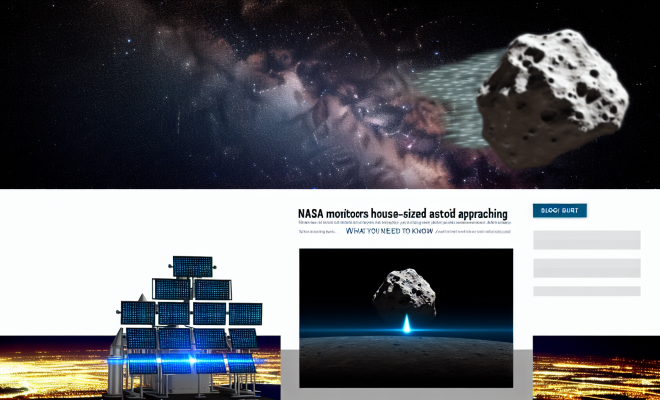
On April 9, 2026, a house-sized asteroid designated as 2026 GD will make its close approach to Earth, flying at a distance of approximately 156,000 miles. This distance is notably closer than the average lunar orbit, which typically averages around 238,855 miles from our planet. While the news may raise eyebrows and concerns about potential threats from space, NASA has assured the public that there is no cause for alarm.
Details of the Asteroid’s Approach
The asteroid 2026 GD measures roughly 54 feet in diameter, making it comparable in size to a house. Such near-Earth objects (NEOs) are monitored closely by NASA’s Planetary Defense Coordination Office (PDCO). The PDCO identifies, tracks, and characterizes asteroids and comets that come within 30 million miles of Earth’s orbit. They conduct this monitoring to ensure that any potential threats are dealt with proactively.
NASA’s Assurance on Safety
Despite the relatively close distance of 2026 GD, NASA scientists emphasize that the asteroid does not pose any danger to our planet. In a statement, they noted that the asteroid’s trajectory has been assessed thoroughly, and its path does not intersect with Earth. This is a crucial aspect of monitoring NEOs: scientists continuously calculate their orbits to assess any future collision risks.
Understanding Near-Earth Objects
Asteroids like 2026 GD are remnants from the early solar system, composed of rock and metal, and can vary widely in size. While many are small and harmless, larger asteroids have the potential to cause significant damage if they were to collide with Earth. This makes ongoing monitoring essential.
The Importance of Planetary Defense
NASA’s efforts in planetary defense have gained increased attention in recent years, especially following the discovery of several large asteroids that have passed near Earth. The agency has developed various initiatives aimed at enhancing our understanding of these celestial objects and improving our ability to predict their paths.
- Monitoring Systems: NASA uses advanced telescopes and radar systems to track NEOs. These systems allow scientists to determine the size, shape, and trajectory of asteroids.
- Asteroid Impact Scenario Planning: In the event of a potential impact, NASA has developed strategies for deflection and mitigation, including the use of kinetic impactors to change an asteroid’s orbit.
- Public Awareness Campaigns: NASA aims to educate the public about asteroids and the importance of monitoring them, reducing misconceptions and fears surrounding space threats.
The Bigger Picture: NEOs and Their Risks
While 2026 GD presents no immediate threat, it is a reminder of the importance of vigilance in tracking NEOs. The reality is that larger asteroids, if on a collision course with Earth, could have devastating consequences. Historical events, such as the asteroid impact that contributed to the extinction of the dinosaurs 66 million years ago, underscore the potential risks associated with these objects.
What Happens Next?
As April 9, 2026, approaches, NASA will continue to monitor 2026 GD closely. The agency will provide updates on the asteroid’s trajectory and any new findings that arise from ongoing observations. For the general public, this event serves as an opportunity to engage with science and learn more about the universe we inhabit.
Conclusion
In summary, while the approach of asteroid 2026 GD is an intriguing event, it is not a cause for concern. NASA’s ongoing planetary defense efforts ensure that we are well-equipped to handle potential threats from space. As technology advances and our understanding of NEOs grows, we can remain hopeful that our planet is safeguarded against celestial hazards.
For those interested in space and planetary science, the close approach of 2026 GD is a fascinating case study in the importance of monitoring near-Earth objects and the efforts taken to protect our planet. As we continue to explore the cosmos, events like this remind us of the delicate balance between our Earth and the vast universe beyond.