
The Tech Edvocate

Top Menu

  • Advertisement
  • Apps
  • Home Page
  • Home Page Five (No Sidebar)
  • Home Page Four
  • Home Page Three
  • Home Page Two
  • Home Tech2
  • Icons [No Sidebar]
  • Left Sidbear Page
  • Lynch Educational Consulting
  • My Account
  • My Speaking Page
  • Newsletter Sign Up Confirmation
  • Newsletter Unsubscription
  • Our Brands
  • Page Example
  • Privacy Policy
  • Protected Content
  • Register
  • Request a Product Review
  • Shop
  • Shortcodes Examples
  • Signup
  • Start Here
    • Governance
    • Careers
    • Contact Us
  • Terms and Conditions
  • The Edvocate
  • The Tech Edvocate Product Guide
  • Topics
  • Write For Us
  • Advertise

Main Menu

  • Start Here
    • Our Brands
    • Governance
      • Lynch Educational Consulting, LLC.
      • Dr. Lynch’s Personal Website
      • Careers
    • Write For Us
    • The Tech Edvocate Product Guide
    • Contact Us
    • Books
    • Edupedia
    • Post a Job
    • The Edvocate Podcast
    • Terms and Conditions
    • Privacy Policy
  • Topics
    • Assistive Technology
    • Child Development Tech
    • Early Childhood & K-12 EdTech
    • EdTech Futures
    • EdTech News
    • EdTech Policy & Reform
    • EdTech Startups & Businesses
    • Higher Education EdTech
    • Online Learning & eLearning
    • Parent & Family Tech
    • Personalized Learning
    • Product Reviews
  • Advertise
  • Tech Edvocate Awards
  • The Edvocate
  • Pedagogue
  • School Ratings

logo

The Tech Edvocate

  • Start Here
    • Our Brands
    • Governance
      • Lynch Educational Consulting, LLC.
      • Dr. Lynch’s Personal Website
        • My Speaking Page
      • Careers
    • Write For Us
    • The Tech Edvocate Product Guide
    • Contact Us
    • Books
    • Edupedia
    • Post a Job
    • The Edvocate Podcast
    • Terms and Conditions
    • Privacy Policy
  • Topics
    • Assistive Technology
    • Child Development Tech
    • Early Childhood & K-12 EdTech
    • EdTech Futures
    • EdTech News
    • EdTech Policy & Reform
    • EdTech Startups & Businesses
    • Higher Education EdTech
    • Online Learning & eLearning
    • Parent & Family Tech
    • Personalized Learning
    • Product Reviews
  • Advertise
  • Tech Edvocate Awards
  • The Edvocate
  • Pedagogue
  • School Ratings
  • The Reckless Ben Controversy: An Outrageous Fight for Justice

  • Outrageous: The Sydney Sweeney Ad Controversy You Didn’t See Coming — And Why It’s Working

  • The AI CRM War: Why Salesforce Just Made a $2 Billion Bid for a Startup

  • OpenAI’s Navier-Stokes ‘Solution’ Ignites Firestorm: Did They Steal It?

  • Blizzard’s Boldest Bet: Why a StarCraft Shooter in 2030 Could Redefine Gaming

  • Volatile: Why Top AI Bosses Just Triggered a Massive AI Stocks Decline

  • ‘Godfather of AI’ backs Anthropic chief’s call to slow down development

  • Why Millions Are Flocking to Trade Schools as AI Reshapes the Job Market

  • Unmasking the Bizarre ‘Cat in the Hat’ Trend: Why Schools Are Sounding the Alarm

  • Florida DMV Hacked: 200,000 Driver Records Exposed in Stunning Breach

How To
Home›How To›How to Use NLP: 10 Steps

How to Use NLP: 10 Steps
By Matthew Lynch
March 3, 2024
0
Spread the love

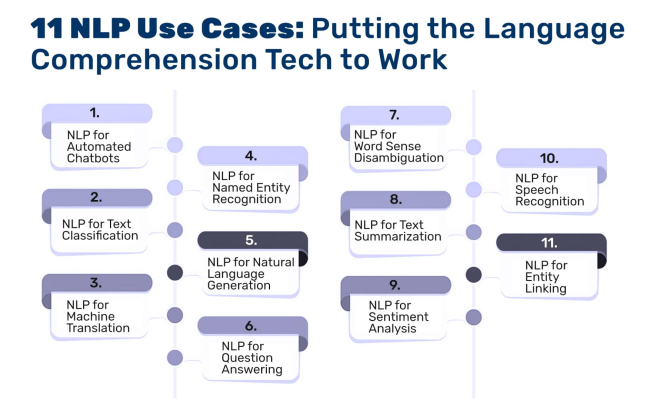
Natural Language Processing (NLP) is a subfield of artificial intelligence that focuses on the interaction between computers and humans through natural language. It enables machines to understand, interpret, and generate human-readable text or speech. Whether you’re a beginner or an experienced programmer, follow these ten steps to start utilizing the power of NLP in your projects.

1. Learn the Basics of NLP: Familiarize yourself with the principles, techniques, and applications of NLP by reading relevant books, blogs, or taking online courses. Understand how it analyzes syntax, semantics, pragmatics, and context within text data.

2. Choose a Programming Language: Select a programming language you are comfortable with (such as Python, Java, or R) to code and implement NLP algorithms. Python is widely used due to its simplicity and the availability of various NLP libraries.

3. Acquire NLP Libraries: Choose relevant NLP libraries (such as NLTK, SpaCy, or Gensim for Python) to handle tasks like tokenization, stemming, lemmatization, part-of-speech tagging, and named entity recognition.

4. Collect Text Data: Gather a dataset that you want to analyze with NLP techniques. It could be social media posts, news articles, or customer reviews. Remember data quality can directly influence the success of your project.

5. Preprocess Text Data: Clean up your dataset by removing irrelevant characters (e.g., punctuation), converting text into lowercase format (for uniformity), and handling white spaces appropriately.

6. Tokenization: Break down complex text into individual words (tokens) for easier analysis using various tokenization methods available in the libraries.

7. Feature Extraction and Representation: Convert raw text data into vectors using techniques such as Bag-of-Words (BOW), Term Frequency-Inverse Document Frequency (TF-IDF), or word embeddings (e.g., Word2Vec, GloVe).

8. Choose an NLP Model: Select an appropriate NLP model based on your objective. Models can vary from simple rule-based systems to complex machine or deep learning techniques, such as Long Short-Term Memory (LSTM) networks.

9. Train and Evaluate the Model: Split your preprocessed dataset into training and testing subsets. Train the chosen model using the training set and evaluate its performance using metrics like accuracy, precision, recall, and F1-score on the test set.

10. Fine-tune and Optimize: Iterate through various model architectures, hyperparameter tuning, or feature selection methods until you achieve satisfactory results. Finally, deploy your NLP model into a production environment or integrate it within an existing application.

In conclusion, following these ten steps will help you understand and use NLP more effectively, enhancing your projects with the power to comprehend and generate human-like language while automating tasks that would otherwise require manual effort.


Previous Article

How to Sing Screamo: 9 Steps

Next Article

The Best Gifts for Neat Freaks, According ...

Matthew Lynch

Related articles More from author

  • How To

    3 Ways to Soften a Leather Belt

    October 18, 2023
    By Matthew Lynch
  • How To

    How to Dilute Solutions: 8 Steps

    March 6, 2024
    By Matthew Lynch
  • How To

    How to Speak Simple German: 12 Steps

    January 8, 2024
    By Matthew Lynch
  • How To

    How to Purchase Water Rights: 14 Steps

    January 9, 2024
    By Matthew Lynch
  • How To

    3 Simple Ways to Repair Faux Leather

    October 9, 2023
    By Matthew Lynch
  • How To

    How to Know if You Have Laryngitis

    January 6, 2024
    By Matthew Lynch

Search

Login & Registration

  • Log in
  • Entries feed
  • Comments feed
  • WordPress.org

Newsletter

Signup for The Tech Edvocate Newsletter and have the latest in EdTech news and opinion delivered to your email address!

About Us

Since technology is not going anywhere and does more good than harm, adapting is the best course of action. That is where The Tech Edvocate comes in. We plan to cover the PreK-12 and Higher Education EdTech sectors and provide our readers with the latest news and opinion on the subject. From time to time, I will invite other voices to weigh in on important issues in EdTech. We hope to provide a well-rounded, multi-faceted look at the past, present, the future of EdTech in the US and internationally.

We started this journey back in June 2016, and we plan to continue it for many more years to come. I hope that you will join us in this discussion of the past, present and future of EdTech and lend your own insight to the issues that are discussed.

Newsletter

Signup for The Tech Edvocate Newsletter and have the latest in EdTech news and opinion delivered to your email address!

Contact Us

The Tech Edvocate
910 Goddin Street
Richmond, VA 23231
(601) 630-5238
[email protected]

Copyright © 2026 Matthew Lynch. All rights reserved.