The Tech Edvocate

Top Menu

  • Advertisement
  • Apps
  • Home Page
  • Home Page Five (No Sidebar)
  • Home Page Four
  • Home Page Three
  • Home Page Two
  • Home Tech2
  • Icons [No Sidebar]
  • Left Sidbear Page
  • Lynch Educational Consulting
  • My Account
  • My Speaking Page
  • Newsletter Sign Up Confirmation
  • Newsletter Unsubscription
  • Our Brands
  • Page Example
  • Privacy Policy
  • Protected Content
  • Register
  • Request a Product Review
  • Shop
  • Shortcodes Examples
  • Signup
  • Start Here
    • Governance
    • Careers
    • Contact Us
  • Terms and Conditions
  • The Edvocate
  • The Tech Edvocate Product Guide
  • Topics
  • Write For Us
  • Advertise

Main Menu

  • Start Here
    • Our Brands
    • Governance
      • Lynch Educational Consulting, LLC.
      • Dr. Lynch’s Personal Website
      • Careers
    • Write For Us
    • The Tech Edvocate Product Guide
    • Contact Us
    • Books
    • Edupedia
    • Post a Job
    • The Edvocate Podcast
    • Terms and Conditions
    • Privacy Policy
  • Topics
    • Assistive Technology
    • Child Development Tech
    • Early Childhood & K-12 EdTech
    • EdTech Futures
    • EdTech News
    • EdTech Policy & Reform
    • EdTech Startups & Businesses
    • Higher Education EdTech
    • Online Learning & eLearning
    • Parent & Family Tech
    • Personalized Learning
    • Product Reviews
  • Advertise
  • Tech Edvocate Awards
  • The Edvocate
  • Pedagogue
  • School Ratings

logo

The Tech Edvocate

  • Start Here
    • Our Brands
    • Governance
      • Lynch Educational Consulting, LLC.
      • Dr. Lynch’s Personal Website
        • My Speaking Page
      • Careers
    • Write For Us
    • The Tech Edvocate Product Guide
    • Contact Us
    • Books
    • Edupedia
    • Post a Job
    • The Edvocate Podcast
    • Terms and Conditions
    • Privacy Policy
  • Topics
    • Assistive Technology
    • Child Development Tech
    • Early Childhood & K-12 EdTech
    • EdTech Futures
    • EdTech News
    • EdTech Policy & Reform
    • EdTech Startups & Businesses
    • Higher Education EdTech
    • Online Learning & eLearning
    • Parent & Family Tech
    • Personalized Learning
    • Product Reviews
  • Advertise
  • Tech Edvocate Awards
  • The Edvocate
  • Pedagogue
  • School Ratings
  • Urgent Warning: How AI is Fueling Rampant Skincare Scams Right Now

  • Urgent: This Skincare Trend Is Exploiting Children — And It’s Spreading Fast

  • Seattle Times sues Microsoft and OpenAI, alleging they trained their AI on its journalism

  • Astonishing: Anthropic Axed $6 Billion Deal for Decart — Why?

  • Sega cancelled its “risky” Super Game project as it “would have to grow enormously to match the scale of the service” | GamesIndustry.biz

  • Devastating: Don’t Nod’s €8M Cash Crisis Threatens Studio Future

  • OpenAI Accused of Shocking Attempt to Hijack Euler Proof — The Truth Revealed

  • Meta Child Sexual Abuse Ads: A Disturbing Investigation Unveils Shocking Truths

  • Unveiling the Quiet Crisis: Why Two Mega-Districts Just Banned AI in Education

  • Unveiling the Controversial New Texas Curriculum: A Battle Over History and Identity

How ToUncategorized
Home›How To›How to Uninstall PostgreSQL: 11 Steps

How to Uninstall PostgreSQL: 11 Steps
By Matthew Lynch
March 21, 2024
0
Spread the love

Introduction:

PostgreSQL is a powerful, open-source object-relational database system that can handle workloads ranging from small applications to large enterprise systems. However, if you’re no longer using PostgreSQL or want to switch to a different database solution, you may need to uninstall it. Here’s a step-by-step guide on how to uninstall PostgreSQL.

Step 1: Backup Your Data

Before uninstalling PostgreSQL, make sure to backup all your important data stored in the database. You can use the ‘pg_dump’ or ‘pg_dumpall’ utility programs for this purpose.

Step 2: Stop the PostgreSQL Service

In order to safely remove PostgreSQL, first stop its service. On Windows, open the Services control panel and find “PostgreSQL” in the list. Right-click and select “Stop.” On Linux, execute the following command: ‘sudo systemctl stop postgresql’

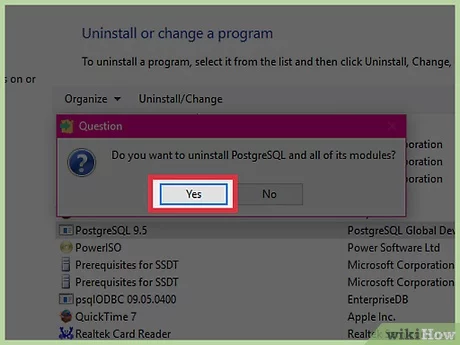
Step 3: Uninstalling PostgreSQL on Windows

Navigate to Control Panel > Programs > Programs and Features. Find “PostgreSQL” in the list of installed applications, right-click it and select “Uninstall.” Follow the prompts to complete the process.

Step 4: Uninstalling PostgreSQL on Linux

For Linux systems, use your package manager (apt or yum) with the appropriate command.

For apt (Debian/Ubuntu): ‘sudo apt-get remove postgresql’

For yum (RedHat/CentOS/Fedora): ‘sudo yum remove postgresql’

Step 5: Remove Configuration Files

After uninstalling PostgreSQL through your package manager, you should also remove configuration files left behind.

On Linux:

– Delete the PostgreSQL data directory; typically ‘/var/lib/postgresql/’

– Delete any other configuration files found in ‘/etc/postgresql/’

On Windows:

– Remove the PostgreSQL installation directory; usually ‘C:\Program Files\PostgreSQL\’

– Remove any remaining settings and data directories within ‘C:\Users\<Username>\AppData\’

Step 6: Remove User and Group (Linux)

On Linux systems, it’s a good idea to remove the PostgreSQL user and group by executing the following commands:

– ‘sudo userdel postgres’

– ‘sudo groupdel postgres’

Step 7: Remove Startup Scripts (Linux)

Some systems might still have startup scripts referencing PostgreSQL. Look for any startup scripts in ‘/etc/init.d/’ or ‘/etc/systemd/system/’ and remove them.

Step 8: Check Environment Variables

Ensure that no environment variables reference PostgreSQL or its binaries. On Linux, check your ‘/etc/environment’ file and your shell’s configuration files. On Windows, inspect your system’s Environment Variables settings via the Control Panel.

Step 9: Restart your Computer

After completing all the steps above, restart your computer to ensure all changes take effect.

Step 10: Verify Uninstallation

Once your computer has restarted, verify that PostgreSQL is no longer running by checking for any related processes in Task Manager (Windows) or running ‘ps aux | grep postgres’ command on Linux.

Step 11: Cleanup

Finally, it’s a good idea to perform a general cleanup of your system to remove any temporary files or leftover artifacts related to PostgreSQL.

Conclusion:

Following these steps will help you uninstall PostgreSQL from your system completely and safely. Make sure to backup all your important data before proceeding with the uninstallation process.


Previous Article

9 Movies Like ‘Saltburn’ to Watch Next

Next Article

This Retro Atari Handheld Comes With The ...

Matthew Lynch

Related articles More from author

  • How To

    3 Ways to Deal With a Teacher That Creeps You Out

    January 4, 2024
    By Matthew Lynch
  • How To

    3 Ways to Soften Leather Shoes

    October 19, 2023
    By Matthew Lynch
  • How To

    How to Open DLL Files: 10 Steps

    March 21, 2024
    By Matthew Lynch
  • Uncategorized

    Your Medical Data Was Just Exposed: Here’s How to Fight Back

    August 14, 2026
    By Matthew Lynch
  • How To

    5 Ways to Clean a Drain Pipe

    October 9, 2023
    By Matthew Lynch
  • How To

    3 Simple Ways to Unclog a Salivary Duct

    October 25, 2023
    By Matthew Lynch

Search

Login & Registration

  • Log in
  • Entries feed
  • Comments feed
  • WordPress.org

Newsletter

Signup for The Tech Edvocate Newsletter and have the latest in EdTech news and opinion delivered to your email address!

About Us

Since technology is not going anywhere and does more good than harm, adapting is the best course of action. That is where The Tech Edvocate comes in. We plan to cover the PreK-12 and Higher Education EdTech sectors and provide our readers with the latest news and opinion on the subject. From time to time, I will invite other voices to weigh in on important issues in EdTech. We hope to provide a well-rounded, multi-faceted look at the past, present, the future of EdTech in the US and internationally.

We started this journey back in June 2016, and we plan to continue it for many more years to come. I hope that you will join us in this discussion of the past, present and future of EdTech and lend your own insight to the issues that are discussed.

Newsletter

Signup for The Tech Edvocate Newsletter and have the latest in EdTech news and opinion delivered to your email address!

Contact Us

The Tech Edvocate
910 Goddin Street
Richmond, VA 23231
(601) 630-5238
[email protected]

Copyright © 2026 Matthew Lynch. All rights reserved.