The Tech Edvocate

Top Menu

  • Advertisement
  • Apps
  • Home Page
  • Home Page Five (No Sidebar)
  • Home Page Four
  • Home Page Three
  • Home Page Two
  • Home Tech2
  • Icons [No Sidebar]
  • Left Sidbear Page
  • Lynch Educational Consulting
  • My Account
  • My Speaking Page
  • Newsletter Sign Up Confirmation
  • Newsletter Unsubscription
  • Our Brands
  • Page Example
  • Privacy Policy
  • Protected Content
  • Register
  • Request a Product Review
  • Shop
  • Shortcodes Examples
  • Signup
  • Start Here
    • Governance
    • Careers
    • Contact Us
  • Terms and Conditions
  • The Edvocate
  • The Tech Edvocate Product Guide
  • Topics
  • Write For Us
  • Advertise

Main Menu

  • Start Here
    • Our Brands
    • Governance
      • Lynch Educational Consulting, LLC.
      • Dr. Lynch’s Personal Website
      • Careers
    • Write For Us
    • The Tech Edvocate Product Guide
    • Contact Us
    • Books
    • Edupedia
    • Post a Job
    • The Edvocate Podcast
    • Terms and Conditions
    • Privacy Policy
  • Topics
    • Assistive Technology
    • Child Development Tech
    • Early Childhood & K-12 EdTech
    • EdTech Futures
    • EdTech News
    • EdTech Policy & Reform
    • EdTech Startups & Businesses
    • Higher Education EdTech
    • Online Learning & eLearning
    • Parent & Family Tech
    • Personalized Learning
    • Product Reviews
  • Advertise
  • Tech Edvocate Awards
  • The Edvocate
  • Pedagogue
  • School Ratings

logo

The Tech Edvocate

  • Start Here
    • Our Brands
    • Governance
      • Lynch Educational Consulting, LLC.
      • Dr. Lynch’s Personal Website
        • My Speaking Page
      • Careers
    • Write For Us
    • The Tech Edvocate Product Guide
    • Contact Us
    • Books
    • Edupedia
    • Post a Job
    • The Edvocate Podcast
    • Terms and Conditions
    • Privacy Policy
  • Topics
    • Assistive Technology
    • Child Development Tech
    • Early Childhood & K-12 EdTech
    • EdTech Futures
    • EdTech News
    • EdTech Policy & Reform
    • EdTech Startups & Businesses
    • Higher Education EdTech
    • Online Learning & eLearning
    • Parent & Family Tech
    • Personalized Learning
    • Product Reviews
  • Advertise
  • Tech Edvocate Awards
  • The Edvocate
  • Pedagogue
  • School Ratings
  • A Visitor’s Guide to Fresno (CA), United States

  • A Visitors Guide to New Orleans (LA), United States

  • A Visitors Guide to Sacramento (CA), United States

  • A Visitors Guide to Lyon, France

  • JisuLife Ultra2 Portable Fan: A Powerful Multi-Function Cooling Solution

  • A Visitors Guide to Viña del Mar, Chile

  • A Visitors Guide to Århus, Denmark

  • A Visitors Guide to Bakersfield (CA), United States

  • A Visitors Guide to Aurora (CO), United States

  • A Visitor’s Guide to Toledo (OH), United States

Tech Advice
Home›Tech Advice›How to create a system image in Windows 10

How to create a system image in Windows 10
By Matthew Lynch
July 13, 2023
0
Spread the love

Introduction

Creating a system image in Windows 10 is an essential process for every user. A system image is a complete snapshot of your computer’s files, settings, and operating system at a particular point in time. It can be used to restore your computer to an earlier state or recover from system failures. In this article, we will walk you through the process of creating a system image in Windows 10.

Step 1: Prepare an External Drive

To create a system image in Windows 10, you will need an external hard drive or a large capacity USB stick with enough space to store the system image. Make sure that the external drive is formatted using the NTFS file system.

Step 2: Open the Control Panel

1. Press the ‘Windows’ key on your keyboard or click on the ‘Start’ button located in the bottom left corner of your screen.

2. Type ‘Control Panel’ in the search bar and click on the search result that appears.

Step 3: Access System Image Backup Tool

1. In the Control Panel window, click on ‘System and Security.’

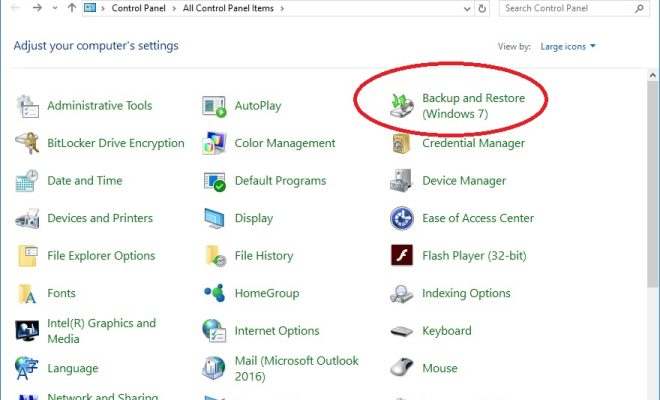
2. Next, click on ‘Backup and Restore (Windows 7).’

3. In the newly opened window, click on ‘Create a system image’ located on the left-hand side.

Step 4: Choose a Backup Location

1. In the ‘Create a System Image’ window, you will be prompted to choose where you want to save your backup.

2. Select ‘On a hard disk’ if you are using an external hard drive or ‘On one or more DVDs’ if you want to use DVD discs.

3. Click on the drop-down menu and choose your external drive or DVD as the backup location.

4. Click on the ‘Next’ button to proceed.

Step 5: Select Drives for Backup

1. Windows 10 will now present you with a list of drives that are available for backup.

2. By default, the system drive (C:) and the system reserved partition are selected.

3. You can also select other drives if you wish to include them in the backup.

4. Once you have made your selection, click on the ‘Next’ button.

Step 6: Start the Backup Process

1. Review the backup settings and confirm your chosen location and drives to be backed up.

2. Click on the ‘Start Backup’ button to initiate the process.

3. The backup process may take some time, depending on the size of your partitions and your computer’s processing speed. Do not interrupt the process or turn off your computer during this time.

4. Once the backup is complete, you will see a confirmation message stating that the system image was successfully created.

Conclusion

Creating a system image in Windows 10 is a straightforward process that provides an essential safety net for your valuable data and operating system. It is highly recommended that you schedule regular system image backups to ensure that you can quickly recover from potential system failures or data loss events. With a reliable system image in place, restoring your Windows 10 computer will be a simple and efficient task when needed.


Previous Article

Connecting your laptop to a TV is ...

Next Article

How to create a Windows 10 bootable ...

Matthew Lynch

Related articles More from author

  • Tech Advice

    How the 2023 Mazda CX-90 Compares with the CX-9

    August 19, 2023
    By Matthew Lynch
  • Tech Advice

    Galaxy Note 20: Here’s who should buy it and who should upgrade to the Ultra

    July 17, 2023
    By Matthew Lynch
  • Tech Advice

    How to Tweak Your W-4 to Get a Bigger Tax Refund (and Why You Probably Shouldn’t)

    July 11, 2023
    By Matthew Lynch
  • Tech Advice

    SUV Meaning: What is an SUV?

    August 20, 2023
    By Matthew Lynch
  • Tech Advice

    2024 Toyota Grand Highlander Production Is Underway, Will Reach Dealers Soon

    August 21, 2023
    By Matthew Lynch
  • Tech Advice

    Buying Cars from Insurance Companies: Everything You Need to Know

    August 17, 2023
    By Matthew Lynch

Search

Login & Registration

  • Register
  • Log in
  • Entries feed
  • Comments feed
  • WordPress.org

Newsletter

Signup for The Tech Edvocate Newsletter and have the latest in EdTech news and opinion delivered to your email address!

About Us

Since technology is not going anywhere and does more good than harm, adapting is the best course of action. That is where The Tech Edvocate comes in. We plan to cover the PreK-12 and Higher Education EdTech sectors and provide our readers with the latest news and opinion on the subject. From time to time, I will invite other voices to weigh in on important issues in EdTech. We hope to provide a well-rounded, multi-faceted look at the past, present, the future of EdTech in the US and internationally.

We started this journey back in June 2016, and we plan to continue it for many more years to come. I hope that you will join us in this discussion of the past, present and future of EdTech and lend your own insight to the issues that are discussed.

Newsletter

Signup for The Tech Edvocate Newsletter and have the latest in EdTech news and opinion delivered to your email address!

Contact Us

The Tech Edvocate
910 Goddin Street
Richmond, VA 23231
(601) 630-5238
[email protected]

Copyright © 2025 Matthew Lynch. All rights reserved.