The Tech Edvocate

Top Menu

  • Advertisement
  • Apps
  • Home Page
  • Home Page Five (No Sidebar)
  • Home Page Four
  • Home Page Three
  • Home Page Two
  • Home Tech2
  • Icons [No Sidebar]
  • Left Sidbear Page
  • Lynch Educational Consulting
  • My Account
  • My Speaking Page
  • Newsletter Sign Up Confirmation
  • Newsletter Unsubscription
  • Our Brands
  • Page Example
  • Privacy Policy
  • Protected Content
  • Register
  • Request a Product Review
  • Shop
  • Shortcodes Examples
  • Signup
  • Start Here
    • Governance
    • Careers
    • Contact Us
  • Terms and Conditions
  • The Edvocate
  • The Tech Edvocate Product Guide
  • Topics
  • Write For Us
  • Advertise

Main Menu

  • Start Here
    • Our Brands
    • Governance
      • Lynch Educational Consulting, LLC.
      • Dr. Lynch’s Personal Website
      • Careers
    • Write For Us
    • The Tech Edvocate Product Guide
    • Contact Us
    • Books
    • Edupedia
    • Post a Job
    • The Edvocate Podcast
    • Terms and Conditions
    • Privacy Policy
  • Topics
    • Assistive Technology
    • Child Development Tech
    • Early Childhood & K-12 EdTech
    • EdTech Futures
    • EdTech News
    • EdTech Policy & Reform
    • EdTech Startups & Businesses
    • Higher Education EdTech
    • Online Learning & eLearning
    • Parent & Family Tech
    • Personalized Learning
    • Product Reviews
  • Advertise
  • Tech Edvocate Awards
  • The Edvocate
  • Pedagogue
  • School Ratings

logo

The Tech Edvocate

  • Start Here
    • Our Brands
    • Governance
      • Lynch Educational Consulting, LLC.
      • Dr. Lynch’s Personal Website
        • My Speaking Page
      • Careers
    • Write For Us
    • The Tech Edvocate Product Guide
    • Contact Us
    • Books
    • Edupedia
    • Post a Job
    • The Edvocate Podcast
    • Terms and Conditions
    • Privacy Policy
  • Topics
    • Assistive Technology
    • Child Development Tech
    • Early Childhood & K-12 EdTech
    • EdTech Futures
    • EdTech News
    • EdTech Policy & Reform
    • EdTech Startups & Businesses
    • Higher Education EdTech
    • Online Learning & eLearning
    • Parent & Family Tech
    • Personalized Learning
    • Product Reviews
  • Advertise
  • Tech Edvocate Awards
  • The Edvocate
  • Pedagogue
  • School Ratings
  • A Visitors Guide to Portland (OR), United States

  • 7 Men’s Bruno Marc Shoes That Are the Perfect Christmas Gift

  • A Visitors Guide to Oklahoma City (OK), United States

  • A Visitor’s Guide to Tucson, Arizona, United States

  • A Visitor’s Guide to Hamilton, Canada

  • Beware of Fiverr: You Might Get Scammed

  • The Future of Artificial Intelligence: Navigating the Next Frontier

  • Best Home Backup Generators for 2026

  • Online Learning Platforms: Transforming Education in the Digital Age

  • Fastest Growing Sectors of the EdTech Market: Exploring Emerging Trends

Digital & Mobile Technology
Home›Digital & Mobile Technology›How to Configure Scroll Bars in macOS and OS X

How to Configure Scroll Bars in macOS and OS X
By Matthew Lynch
June 9, 2023
0
Spread the love

Scroll bars are an essential component of any computing experience. They help in navigating through pages, documents, and even entire applications. The macOS and OS X operating systems offer several ways to customize and configure scroll bars to suit one’s preference. In this article, we will discuss how to configure scroll bars in macOS and OS X.

Step 1 – Launch System Preferences

The first step in configuring scroll bars is to launch the System Preferences app. You can do this by clicking on the Apple menu in the top-left corner of the screen and then selecting “System Preferences.”

Step 2 – Locate the “General” Preference

Once System Preferences is open, locate and click on the “General” preference. This preference controls several settings, including the scroll bar configuration.

Step 3 – Configure Scroll Bars

In the “General” preference, you will see an option labeled “Show scroll bars.” This option provides three choices: “When scrolling,” “Always,” and “Automatically based on input device.”

– “When scrolling” will only show the scroll bar when you scroll the page or document.
– “Always” will display the scroll bar continuously.
– “Automatically based on input device” will show the scroll bar based on the input device you’re using.

Choose the option that best suits your preferences.

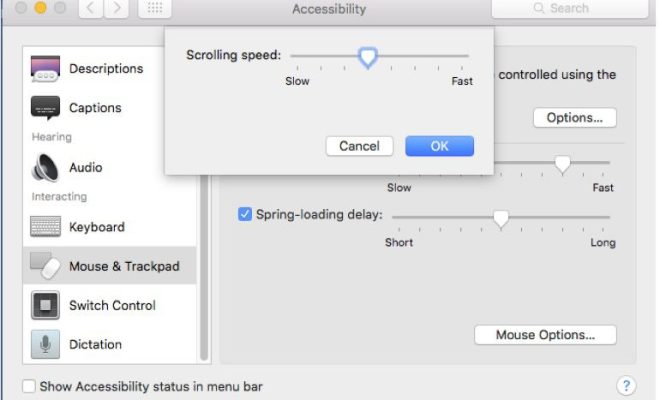
Step 4 – Adjust Scroll Bar Size

If you’d like to adjust the size of the scroll bar, you can use the slider next to the “Show scroll bars” option. The slider provides three size options: “Small,” “Medium,” and “Large.”

Step 5 – Configure Scroll Direction

Finally, you can also configure the scroll direction in the “General” preference. By default, macOS and OS X use “Natural” scrolling, which means that scrolling up on your trackpad or mouse will move the page or document up, and scrolling down will move it down. If you prefer the traditional method, where scrolling up will move the page or document down and vice versa, you can uncheck the “Scroll direction: natural” option.

Conclusion

Customizing and configuring scroll bars in macOS and OS X is a straightforward process that can significantly improve your computing experience. By following the steps outlined above, you can adjust the visibility, size, and direction of the scroll bar to suit your preferences.

Previous Article

Cities: Skylines Review: An Addictive City-Builder

Next Article

How to Check Data Usage on a ...

Matthew Lynch

Related articles More from author

  • Digital & Mobile Technology

    What Is PASV FTP (Passive FTP)?

    July 5, 2023
    By Matthew Lynch
  • Digital & Mobile Technology

    The Best iPhone 14 Chargers

    August 2, 2023
    By Matthew Lynch
  • Digital & Mobile Technology

    How to Disable or Turn Off the GeForce Overlay on Windows

    June 22, 2023
    By Matthew Lynch
  • Digital & Mobile Technology

    How to Blur Your House on Google Maps

    June 12, 2023
    By Matthew Lynch
  • Digital & Mobile Technology

    What Is the Hex Code? Everything You Need to Know

    June 23, 2023
    By Matthew Lynch
  • Digital & Mobile Technology

    What Is the Hosts File, and How Do You Edit It in Windows?

    June 6, 2023
    By Matthew Lynch

Search

Login & Registration

  • Register
  • Log in
  • Entries feed
  • Comments feed
  • WordPress.org

Newsletter

Signup for The Tech Edvocate Newsletter and have the latest in EdTech news and opinion delivered to your email address!

About Us

Since technology is not going anywhere and does more good than harm, adapting is the best course of action. That is where The Tech Edvocate comes in. We plan to cover the PreK-12 and Higher Education EdTech sectors and provide our readers with the latest news and opinion on the subject. From time to time, I will invite other voices to weigh in on important issues in EdTech. We hope to provide a well-rounded, multi-faceted look at the past, present, the future of EdTech in the US and internationally.

We started this journey back in June 2016, and we plan to continue it for many more years to come. I hope that you will join us in this discussion of the past, present and future of EdTech and lend your own insight to the issues that are discussed.

Newsletter

Signup for The Tech Edvocate Newsletter and have the latest in EdTech news and opinion delivered to your email address!

Contact Us

The Tech Edvocate
910 Goddin Street
Richmond, VA 23231
(601) 630-5238
[email protected]

Copyright © 2025 Matthew Lynch. All rights reserved.