The Tech Edvocate

Top Menu

  • Advertisement
  • Apps
  • Home Page
  • Home Page Five (No Sidebar)
  • Home Page Four
  • Home Page Three
  • Home Page Two
  • Home Tech2
  • Icons [No Sidebar]
  • Left Sidbear Page
  • Lynch Educational Consulting
  • My Account
  • My Speaking Page
  • Newsletter Sign Up Confirmation
  • Newsletter Unsubscription
  • Our Brands
  • Page Example
  • Privacy Policy
  • Protected Content
  • Register
  • Request a Product Review
  • Shop
  • Shortcodes Examples
  • Signup
  • Start Here
    • Governance
    • Careers
    • Contact Us
  • Terms and Conditions
  • The Edvocate
  • The Tech Edvocate Product Guide
  • Topics
  • Write For Us
  • Advertise

Main Menu

  • Start Here
    • Our Brands
    • Governance
      • Lynch Educational Consulting, LLC.
      • Dr. Lynch’s Personal Website
      • Careers
    • Write For Us
    • The Tech Edvocate Product Guide
    • Contact Us
    • Books
    • Edupedia
    • Post a Job
    • The Edvocate Podcast
    • Terms and Conditions
    • Privacy Policy
  • Topics
    • Assistive Technology
    • Child Development Tech
    • Early Childhood & K-12 EdTech
    • EdTech Futures
    • EdTech News
    • EdTech Policy & Reform
    • EdTech Startups & Businesses
    • Higher Education EdTech
    • Online Learning & eLearning
    • Parent & Family Tech
    • Personalized Learning
    • Product Reviews
  • Advertise
  • Tech Edvocate Awards
  • The Edvocate
  • Pedagogue
  • School Ratings

logo

The Tech Edvocate

  • Start Here
    • Our Brands
    • Governance
      • Lynch Educational Consulting, LLC.
      • Dr. Lynch’s Personal Website
        • My Speaking Page
      • Careers
    • Write For Us
    • The Tech Edvocate Product Guide
    • Contact Us
    • Books
    • Edupedia
    • Post a Job
    • The Edvocate Podcast
    • Terms and Conditions
    • Privacy Policy
  • Topics
    • Assistive Technology
    • Child Development Tech
    • Early Childhood & K-12 EdTech
    • EdTech Futures
    • EdTech News
    • EdTech Policy & Reform
    • EdTech Startups & Businesses
    • Higher Education EdTech
    • Online Learning & eLearning
    • Parent & Family Tech
    • Personalized Learning
    • Product Reviews
  • Advertise
  • Tech Edvocate Awards
  • The Edvocate
  • Pedagogue
  • School Ratings
  • A Visitors Guide to Viña del Mar, Chile

  • A Visitors Guide to Århus, Denmark

  • A Visitors Guide to Bakersfield (CA), United States

  • A Visitors Guide to Aurora (CO), United States

  • A Visitor’s Guide to Toledo (OH), United States

  • A Visitors Guide to Cincinnati (OH), United States

  • The MagicEagle Cam 5: Revolutionizing Wildlife Monitoring with Smart 4G Technology

  • A Visitors Guide to Pittsburgh (PA), United States

  • A Visitors Guide to Colorado Springs (CO), United States

  • 5 Pairs of Shoes That Will Instantly Step Your Shoe Game Up

Digital & Mobile Technology
Home›Digital & Mobile Technology›How Does a Hard Drive Work?

How Does a Hard Drive Work?
By Matthew Lynch
June 14, 2023
0
Spread the love

A hard drive is an essential component of a computer system that stores digital information. Whether you’re working on a spreadsheet, listening to music, or playing a game, you’re using data stored on the hard drive. But how does a hard drive work?

The Basics

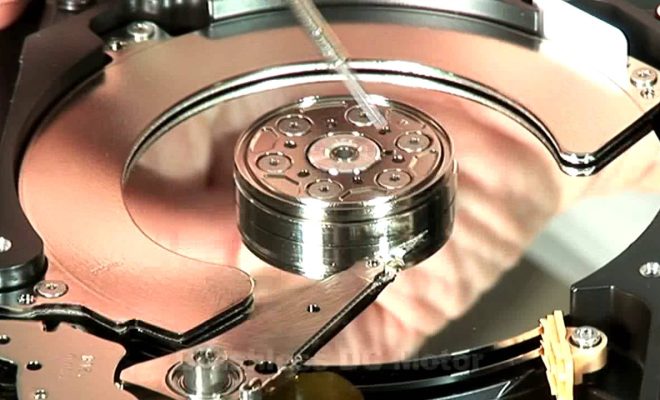
A hard drive consists of several parts, including a spinning disk, a read/write head, and a motor. The spinning disk is coated with a magnetic material that stores data in tiny areas called sectors. The read/write head is a small device that can move across the disk’s surface and read or write data to specific sectors.

The motor is responsible for spinning the disk at a constant speed. The faster the disk spins, the faster data can be read and written. Today’s hard drives spin at speeds of up to 15,000 revolutions per minute (RPM).

Reading and Writing Data

When you save a file to your hard drive, the data is written to a specific sector on the disk. When you open the file, the read/write head moves to the correct sector and reads the data, which is then sent to the computer’s processor for processing.

When you make changes to a file, the data is overwritten in the same sector. However, since the hard drive can only write to unused sectors, the original data is still physically stored on the disk. When you delete a file, the hard drive simply marks the sector as unused, allowing the data to be overwritten at a later time.

Defragmentation

Over time, data on a hard drive can become fragmented, meaning that parts of a file are stored in different sectors. This can cause slower read and write times since the read/write head has to move to different parts of the disk to access the complete file.

Defragmentation is a process that reorganizes the data on the hard drive, making it easier to read and write. The process groups related data together on the disk, reducing the amount of time it takes to access the file.

Conclusion

A hard drive is an essential component of a computer system, storing all your digital information. You save files, open them, edit them, and delete them, all thanks to the hard drive. The hard drive works by spinning a disk at high speeds and using a read/write head to read or write data to specific sectors. Understanding how your hard drive works can help you take better care of it and keep it running smoothly for years to come.


Previous Article

Quick Ways to Fix Headphone Echo in ...

Next Article

A Complete History of Internet Explorer

Matthew Lynch

Related articles More from author

  • Digital & Mobile Technology

    How to Build a New PC For Linux

    May 19, 2023
    By Matthew Lynch
  • Digital & Mobile Technology

    Does the iPad Have a SIM Card?

    June 14, 2023
    By Matthew Lynch
  • Digital & Mobile Technology

    What Is AutoCAD and What Is It Used For?

    June 15, 2023
    By Matthew Lynch
  • Digital & Mobile Technology

    Apple Watch Active vs. Total Calories: What’s the Difference?

    August 5, 2023
    By Matthew Lynch
  • Digital & Mobile Technology

    How to Take the Perfect Polaroid Picture: Tips

    June 13, 2023
    By Matthew Lynch
  • Digital & Mobile Technology

    Best Ways to Watch Movies Together Online

    August 3, 2023
    By Matthew Lynch

Search

Login & Registration

  • Register
  • Log in
  • Entries feed
  • Comments feed
  • WordPress.org

Newsletter

Signup for The Tech Edvocate Newsletter and have the latest in EdTech news and opinion delivered to your email address!

About Us

Since technology is not going anywhere and does more good than harm, adapting is the best course of action. That is where The Tech Edvocate comes in. We plan to cover the PreK-12 and Higher Education EdTech sectors and provide our readers with the latest news and opinion on the subject. From time to time, I will invite other voices to weigh in on important issues in EdTech. We hope to provide a well-rounded, multi-faceted look at the past, present, the future of EdTech in the US and internationally.

We started this journey back in June 2016, and we plan to continue it for many more years to come. I hope that you will join us in this discussion of the past, present and future of EdTech and lend your own insight to the issues that are discussed.

Newsletter

Signup for The Tech Edvocate Newsletter and have the latest in EdTech news and opinion delivered to your email address!

Contact Us

The Tech Edvocate
910 Goddin Street
Richmond, VA 23231
(601) 630-5238
[email protected]

Copyright © 2025 Matthew Lynch. All rights reserved.