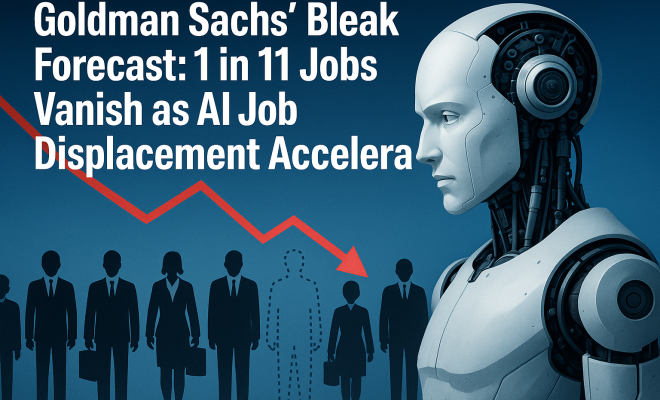
Goldman Sachs’ Bleak Forecast: 1 in 11 Jobs Vanish as AI Job Displacement Accelerates
“`html
The specter of artificial intelligence has loomed large over the workforce for years, a sci-fi trope slowly morphing into a very real, very present concern for millions. But how real is it, really? And when will the big shift truly hit? A recent analysis from investment banking giant Goldman Sachs offers a sobering, almost unsettling glimpse into our immediate future, projecting that AI could eventually displace a staggering 9% of workers in the United States and other advanced economies. That’s roughly one in eleven employees facing the very real possibility of their roles being absorbed or rendered obsolete by intelligent machines.
It’s a figure that demands attention, especially when you consider the scale: millions of livelihoods potentially altered, careers rerouted, and entire industries reshaped. While the immediate, widespread layoffs haven’t materialized en masse just yet, the report suggests a critical inflection point. The large-scale AI job displacement we’ve been anticipating might not be a slow, steady erosion but rather an accelerated phenomenon, poised to strike with particular force during a future economic downturn. This isn’t just about efficiency gains; it’s about a fundamental restructuring of how work gets done, and who gets to do it.
The Goldman Sachs Projection: A Closer Look at the Numbers
When Goldman Sachs speaks, the financial world listens, and its recent deep dive into AI’s impact on employment offers some truly compelling, if somewhat unsettling, data points. The headline figure, that 9% of workers could see their jobs displaced by AI, translates into millions of individuals across developed nations. To put that into perspective, consider the US workforce alone: over 160 million people. Nine percent of that is roughly 14.4 million jobs. That’s a significant number, representing a profound societal shift.
Beyond direct displacement, the analysis also hints at a ‘softer’ form of job reduction: slower hiring. Goldman’s experts suggest that another 3% of potential job growth could be impacted as companies opt for AI solutions over new human hires. This means that even if you don’t lose your current job, the landscape for finding a new one, or for younger generations entering the workforce, could become considerably more competitive and less expansive. It’s a double-edged sword: fewer roles eliminated outright, but fewer new opportunities created in their place.
The Productivity Paradox: Gains vs. Job Losses
It’s not all doom and gloom, at least not from a purely economic standpoint. The same Goldman Sachs report projects a potential 15% boost in productivity across developed economies thanks to AI integration. Think about that for a moment: a 15% increase in output, efficiency, and innovation. That’s a massive leap, promising faster growth, new products, and potentially higher living standards for those who can adapt.
However, this productivity surge comes with a fundamental tension. Historically, technological advancements that boost productivity have often led to job displacement in certain sectors, only to create new, often higher-skilled jobs in others. The question with AI is whether the rate of new job creation can keep pace with the rate of displacement, especially for those in roles most susceptible to automation. The challenge lies in ensuring that the benefits of this productivity boom are widely shared, rather than concentrated among a select few, leaving a significant portion of the workforce behind.
The Recession Trigger: Why AI Job Displacement Might Accelerate Later
Perhaps the most critical, and frankly, disturbing, insight from the Goldman Sachs report is the timing of this large-scale AI job displacement. While many might expect a gradual, ongoing erosion of jobs, the analysis suggests that the real acceleration is likely to occur during a future recession. Why a recession? It makes a grim kind of sense.
During economic downturns, companies are under immense pressure to cut costs, optimize operations, and maintain profitability. Investing in AI, which can be expensive upfront, becomes a far more attractive proposition when the alternative is struggling with a high human payroll. A recession provides the perfect impetus for businesses to make those difficult, long-term investments in automation and AI, effectively replacing human labor with more efficient, always-on AI systems. This means that instead of a slow, predictable shift, we might see a sudden, sharp spike in AI-driven layoffs when the next economic crunch hits, catching many off guard.
Early Warning Signs: Stagnant Employment in AI-Exposed Industries
While the full force of AI job displacement might be waiting for a recession, we’re already seeing subtle tremors in the labor market. The Goldman Sachs analysis notes that employment growth in industries particularly exposed to AI has recently lagged, running approximately 10,000 jobs below its long-term trend. This isn’t a massive wave of layoffs, but it’s a clear indicator that something is shifting.
Think about it: 10,000 fewer jobs than expected, month after month, year after year, adds up. It suggests that companies in these sectors are already quietly adjusting their hiring strategies, perhaps opting to automate certain tasks or enhance existing roles with AI tools rather than bringing on new employees. This slow, almost imperceptible contraction in growth serves as an early warning signal, a quiet precursor to the potentially larger disruptions yet to come. It’s a bit like the tide slowly receding before a tsunami. (See: impact of AI on jobs.)
The Construction Anomaly: A Counterpoint to Displacement
Interestingly, not all sectors are seeing a decline. The Goldman Sachs report highlights one surprising counterpoint to the overall trend of AI job displacement: AI-related construction hiring. This sector has, in fact, partially offset some of the broader declines. What does this tell us?
It suggests that while AI might be taking over certain white-collar, administrative, or analytical tasks, it’s simultaneously creating demand for the physical infrastructure needed to support its growth. We’re talking about the construction of data centers, server farms, and specialized facilities that house the immense computational power required for advanced AI systems. So, while some jobs are evaporating, others are being created, albeit in different, often more physically demanding, fields. This serves as a crucial reminder that the impact of AI is not uniform; it’s a complex, multi-faceted transformation that will create winners and losers across various industries and skill sets. For more context, see using AI to master high-demand skills.
Beyond Displacement: The Challenge of Reskilling and Upskilling
The conversation around AI job displacement often focuses on the jobs lost, but a critical, perhaps more hopeful, aspect is the potential for transformation. For those whose roles are most susceptible, the challenge isn’t just finding a new job, but acquiring new skills. This is where reskilling and upskilling initiatives become absolutely paramount.
Governments, educational institutions, and employers have a shared responsibility to provide accessible, effective pathways for workers to adapt. This could mean training programs in AI-adjacent fields like data science, prompt engineering, cybersecurity, or even the development and maintenance of AI systems. It also involves fostering uniquely human skills that AI struggles with: creativity, critical thinking, emotional intelligence, complex problem-solving, and interpersonal communication. The goal isn’t just to survive the AI revolution but to thrive in a transformed labor market, leveraging AI as a tool rather than being replaced by it.
White-Collar Work on the Front Lines: A Shift in Vulnerability
One of the most striking aspects of the current wave of AI, particularly generative AI models like ChatGPT, is its impact on white-collar work. Historically, automation primarily affected blue-collar jobs in manufacturing or repetitive administrative tasks. This time, it’s different. Roles involving writing, coding, data analysis, customer service, and even aspects of legal and medical work are now squarely in AI’s crosshairs.
This shift creates a unique challenge. Many white-collar professionals, often with advanced degrees and specialized training, might have felt insulated from technological disruption. The reality is that tasks within these roles that are data-driven, pattern-based, or involve synthesizing large amounts of information are precisely where AI excels. It’s not necessarily about replacing an entire job, but about automating significant portions of it, potentially leading to fewer positions needed for the same amount of output. This demographic shift in vulnerability makes the discussion around AI job displacement particularly poignant and emotionally charged.
Preparing for the Future: Actionable Steps for Individuals and Organizations
Given Goldman Sachs’ stark forecast, what can individuals and organizations do to prepare for potential AI job displacement? For individuals, continuous learning is no longer a luxury but a necessity. Identify the AI tools relevant to your industry and become proficient in using them. Focus on developing those uniquely human skills – creativity, critical thinking, empathy – that AI can’t replicate. Consider exploring fields that are either AI-resistant or AI-complementary, such as skilled trades (where human dexterity and problem-solving remain crucial), or roles in AI development, ethics, and integration.
For organizations, the challenge is two-fold: ethical implementation and workforce development. Companies need to think beyond immediate cost savings and consider the long-term societal impact of widespread AI adoption. Investing in employee training, exploring internal mobility programs, and fostering a culture of continuous learning can help ease the transition. Furthermore, strategically integrating AI means understanding its limitations as much as its strengths, ensuring that human oversight and judgment remain central to critical operations. The goal shouldn’t be to replace humans entirely, but to augment human capabilities, allowing employees to focus on higher-value, more creative, and complex tasks.
The Global Perspective: AI’s Impact Beyond Developed Economies
While the Goldman Sachs report focuses on the United States and other advanced economies, it’s crucial to consider AI’s potential impact on a global scale. Developing nations, often with larger proportions of their workforce in routine, manual, or data-entry tasks, could face even more profound challenges. These economies might lack the robust social safety nets, educational infrastructure, or capital to invest in widespread reskilling initiatives that developed nations possess. This could exacerbate existing inequalities, creating a wider gap between countries that can adapt to AI and those that struggle.
However, AI also presents opportunities for developing nations. For example, AI-powered tools could improve agricultural output, streamline healthcare delivery, or enhance educational access in remote areas. The key will be thoughtful, localized implementation, focusing on augmenting human capabilities where possible and strategically investing in new sectors that AI creates. Ignoring the global implications of AI job displacement would be a significant oversight, as a destabilized global workforce could have far-reaching economic and social consequences for everyone.
Ethical Considerations and the Future of Work
Beyond the raw numbers of job displacement, the rise of AI forces us to grapple with deep ethical questions about the nature of work itself. If a significant portion of routine, cognitive labor can be automated, what does that mean for human purpose and fulfillment? How do we ensure that the economic gains from AI don’t disproportionately benefit a small elite while leaving the majority struggling? (See: AI job displacement analysis.)
Discussions around universal basic income (UBI) gain renewed urgency in this context. While controversial, UBI proposes providing a regular, unconditional income to all citizens, potentially offering a safety net in a future where traditional employment might be scarcer. Other ethical considerations include algorithmic bias (AI systems inheriting and perpetuating human biases), data privacy, and the responsible development of AI. These aren’t just technical problems; they’re societal challenges that require broad public discourse, policy innovation, and a commitment to human well-being as AI continues to reshape our world.
The Role of Government and Policy in Mitigating AI Job Displacement
Governments have a vital role to play in navigating the turbulent waters of AI job displacement. Proactive policy measures can significantly soften the blow for workers and help economies adapt. This includes robust investments in public education, particularly in STEM fields and critical thinking, starting from early childhood. For more context, see AI governance careers.
Governments can also incentivize companies to invest in employee training and retention rather than immediate layoffs. Tax breaks for businesses that reskill their workforce, or grants for educational institutions developing AI-focused curricula, are examples. Establishing clear regulatory frameworks for AI development and deployment, focusing on ethical guidelines and transparency, will also be crucial. Furthermore, strengthening social safety nets, including unemployment benefits and retraining programs, becomes even more important during periods of rapid technological change. Ignoring these issues could lead to widespread social unrest and economic instability.
Historical Precedents: Lessons from Past Industrial Revolutions
To understand the potential trajectory of AI job displacement, it’s helpful to look at history. The First Industrial Revolution, driven by steam power and mechanization, displaced countless agricultural workers but created new factory jobs. The Second, powered by electricity and mass production, automated many skilled craft roles but spawned new industries and managerial positions. The Third, the digital revolution, saw computers automate routine data tasks but led to the explosion of the IT sector.
Each revolution brought fear of widespread unemployment, followed by a period of adjustment, job destruction, and ultimately, job creation in new areas. The key difference with AI is the speed and scope. Previous revolutions often targeted specific types of labor (manual, then routine cognitive). AI, especially generative AI, is demonstrating capabilities across a much broader spectrum of cognitive tasks, potentially impacting white-collar professions at an unprecedented pace. While history offers reassurance that new jobs will emerge, it doesn’t guarantee that the transition will be easy or that everyone will be able to adapt without significant support.
The Rise of the “Prompt Engineer” and Other AI-Adjacent Roles
One tangible example of new jobs emerging due to AI is the “prompt engineer.” Just a couple of years ago, this role barely existed, but now companies are actively seeking individuals who can skillfully craft queries and instructions to get the best possible output from generative AI models. This isn’t just about typing a question; it’s about understanding the nuances of language models, iterative refinement, and strategic thinking to leverage AI effectively.
Other AI-adjacent roles are also appearing: AI ethicists, AI trainers (who help refine models), AI integration specialists, and even AI “explainability” experts who help interpret complex AI decisions. These roles require a blend of technical understanding and uniquely human skills like critical thinking, communication, and ethical reasoning. They underscore the idea that AI isn’t just eliminating jobs; it’s fundamentally changing the nature of work, creating demand for new types of expertise that act as a bridge between human intelligence and artificial intelligence.
The Psychological and Societal Impact of AI Job Displacement
Beyond the economic numbers, we must consider the profound psychological and societal impact of AI job displacement. Losing a job, especially due to automation, can lead to significant stress, anxiety, and a loss of identity. For many, work provides not just income but also purpose, social connection, and a sense of contribution.
Widespread displacement could lead to increased societal inequality, mental health challenges, and social fragmentation if not managed effectively. It could fuel resentment towards technology and those perceived to be benefiting from it. Therefore, discussions about AI job displacement must move beyond purely economic models to encompass the human experience. Policies and corporate strategies need to prioritize supporting individuals through these transitions, not just in terms of new skills, but also in terms of mental health resources and community support systems. A humane transition is just as important as an economically efficient one.
FAQ: Addressing Common Questions About AI Job Displacement
Q1: How quickly will AI job displacement happen?
A1: While some jobs are already being impacted, the Goldman Sachs report suggests a significant acceleration during future economic downturns. It’s not necessarily a slow, steady erosion but potentially sudden, sharp spikes in layoffs when companies are under pressure to cut costs and invest in AI solutions. For more context, see hope against 2026 tech layoffs. (See: AI and workforce transformation study.)
Q2: Which types of jobs are most at risk from AI?
A2: Unlike past automation waves that primarily affected blue-collar or routine manual labor, current AI, especially generative AI, poses a risk to many white-collar jobs. This includes roles in writing, coding, data analysis, customer service, accounting, legal research, and administrative tasks. Any job with highly repetitive cognitive tasks is vulnerable.
Q3: Will AI create new jobs to replace those it displaces?
A3: History suggests that new technologies do create new jobs. We’re already seeing roles like “prompt engineer,” AI ethicist, and AI integration specialist emerge. However, the critical question is whether the rate of new job creation can keep pace with displacement, and whether displaced workers will have the necessary skills for these new roles. This requires significant investment in reskilling and education.
Q4: What can individuals do to prepare for AI job displacement?
A4: Individuals should focus on continuous learning, becoming proficient with AI tools relevant to their field, and developing uniquely human skills like creativity, critical thinking, emotional intelligence, and complex problem-solving. Exploring AI-resistant fields (e.g., skilled trades) or AI-complementary roles (e.g., AI development or ethics) is also a good strategy.
Q5: What role do governments and organizations have in mitigating the impact?
A5: Governments can invest in education, fund reskilling programs, strengthen social safety nets, and establish ethical AI regulations. Organizations should invest in employee training, explore internal mobility, and foster a culture of continuous learning. The goal should be to augment human capabilities with AI, rather than simply replace them.
Q6: Is AI job displacement a global phenomenon, or primarily limited to developed countries?
A6: While the Goldman Sachs report focused on developed economies, AI job displacement is a global concern. Developing nations, with larger workforces in routine tasks, could face significant challenges if they lack the infrastructure for widespread reskilling and social support. However, AI also offers opportunities for these nations in areas like agriculture and healthcare, if implemented thoughtfully.
Q7: What are the ethical concerns surrounding AI and employment?
A7: Ethical concerns include the potential for increased economic inequality, algorithmic bias in hiring or management, data privacy, and the broader societal impact on human purpose and well-being if meaningful work becomes scarce. Discussions around universal basic income (UBI) are often linked to these ethical considerations.
The Goldman Sachs report offers a sobering assessment, painting a picture of significant AI job displacement, potentially accelerated by future recessions. While the numbers are certainly concerning, they also serve as a powerful call to action. The future of work isn’t predetermined; it’s being shaped right now by the choices we make. By investing in education, fostering adaptability, and prioritizing a human-centric approach to technological integration, we can navigate this transformative period with greater resilience and ensure that the benefits of AI are truly realized by all.
“`
Trending Now
- read the full story
- the complete explanation
- this guide on why you’re losing money: the surprising truth about financial literacy education in america
- Why Millions Are Finally Using AI to Master High-Demand Skills
- our breakdown of 7 cybersecurity bootcamps that will catapult your career in 2024
Frequently Asked Questions
How many jobs could be lost due to AI according to Goldman Sachs?
Goldman Sachs projects that artificial intelligence could displace approximately 9% of jobs in the United States and other advanced economies, translating to around 14.4 million jobs in the US alone, highlighting a significant potential impact on the workforce.
What is the main concern about AI job displacement?
The primary concern regarding AI job displacement is the potential for millions of workers to see their roles become obsolete as intelligent machines take over tasks, leading to significant shifts in industries and livelihoods.
When is AI job displacement expected to accelerate?
The report suggests that AI job displacement may not be gradual but could accelerate during an economic downturn, indicating a critical inflection point where widespread layoffs might occur.
What does Goldman Sachs say about the future of work with AI?
Goldman Sachs emphasizes that the rise of AI represents a fundamental restructuring of work, altering how tasks are performed and who is responsible for them, beyond mere efficiency gains.
Are there other effects of AI beyond job displacement?
Yes, besides direct job displacement, Goldman Sachs notes the possibility of slower hiring rates as companies adapt to the evolving landscape shaped by AI technology, indicating broader employment implications.
Have you experienced this yourself? We'd love to hear your story in the comments.