
The Tech Edvocate

Top Menu

  • Advertisement
  • Apps
  • Home Page
  • Home Page Five (No Sidebar)
  • Home Page Four
  • Home Page Three
  • Home Page Two
  • Home Tech2
  • Icons [No Sidebar]
  • Left Sidbear Page
  • Lynch Educational Consulting
  • My Account
  • My Speaking Page
  • Newsletter Sign Up Confirmation
  • Newsletter Unsubscription
  • Our Brands
  • Page Example
  • Privacy Policy
  • Protected Content
  • Register
  • Request a Product Review
  • Shop
  • Shortcodes Examples
  • Signup
  • Start Here
    • Governance
    • Careers
    • Contact Us
  • Terms and Conditions
  • The Edvocate
  • The Tech Edvocate Product Guide
  • Topics
  • Write For Us
  • Advertise

Main Menu

  • Start Here
    • Our Brands
    • Governance
      • Lynch Educational Consulting, LLC.
      • Dr. Lynch’s Personal Website
      • Careers
    • Write For Us
    • The Tech Edvocate Product Guide
    • Contact Us
    • Books
    • Edupedia
    • Post a Job
    • The Edvocate Podcast
    • Terms and Conditions
    • Privacy Policy
  • Topics
    • Assistive Technology
    • Child Development Tech
    • Early Childhood & K-12 EdTech
    • EdTech Futures
    • EdTech News
    • EdTech Policy & Reform
    • EdTech Startups & Businesses
    • Higher Education EdTech
    • Online Learning & eLearning
    • Parent & Family Tech
    • Personalized Learning
    • Product Reviews
  • Advertise
  • Tech Edvocate Awards
  • The Edvocate
  • Pedagogue
  • School Ratings

logo

The Tech Edvocate

  • Start Here
    • Our Brands
    • Governance
      • Lynch Educational Consulting, LLC.
      • Dr. Lynch’s Personal Website
        • My Speaking Page
      • Careers
    • Write For Us
    • The Tech Edvocate Product Guide
    • Contact Us
    • Books
    • Edupedia
    • Post a Job
    • The Edvocate Podcast
    • Terms and Conditions
    • Privacy Policy
  • Topics
    • Assistive Technology
    • Child Development Tech
    • Early Childhood & K-12 EdTech
    • EdTech Futures
    • EdTech News
    • EdTech Policy & Reform
    • EdTech Startups & Businesses
    • Higher Education EdTech
    • Online Learning & eLearning
    • Parent & Family Tech
    • Personalized Learning
    • Product Reviews
  • Advertise
  • Tech Edvocate Awards
  • The Edvocate
  • Pedagogue
  • School Ratings
  • A Visitors Guide to Long Beach (CA), United States

  • A Visitor’s Guide to Fresno (CA), United States

  • A Visitors Guide to New Orleans (LA), United States

  • A Visitors Guide to Sacramento (CA), United States

  • A Visitors Guide to Lyon, France

  • JisuLife Ultra2 Portable Fan: A Powerful Multi-Function Cooling Solution

  • A Visitors Guide to Viña del Mar, Chile

  • A Visitors Guide to Århus, Denmark

  • A Visitors Guide to Bakersfield (CA), United States

  • A Visitors Guide to Aurora (CO), United States

Tech Advice
Home›Tech Advice›Gmail AI Can Now Write Emails for You on Your Phone: How It Works

Gmail AI Can Now Write Emails for You on Your Phone: How It Works
By Matthew Lynch
July 24, 2023
0
Spread the love

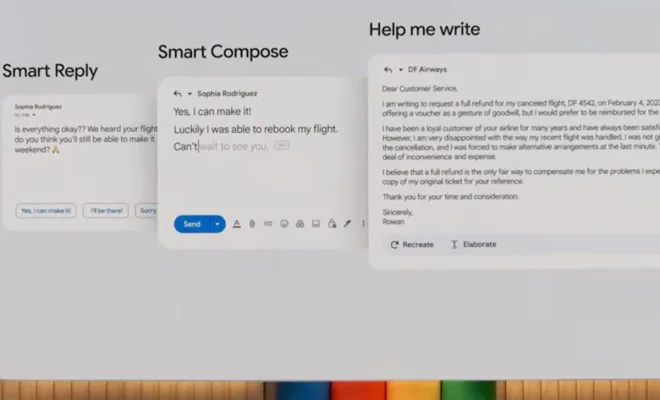
In an exciting development, Google has introduced a new artificial intelligence (AI) feature in its popular email service, Gmail. This feature utilizes AI technology to help users compose emails effortlessly on their smartphones. With this advancement, writing emails has become even more convenient and efficient. In this article, we’ll explore how the Gmail AI works and the benefits it offers.

The Power of Smart Compose

The AI-powered feature called “Smart Compose” is designed to assist users in composing emails quickly by suggesting relevant phrases and sentences as they type. It uses machine learning algorithms that analyze patterns and predict what the user intends to write next based on context.

Initially launched for desktop users in 2018, Smart Compose has now been extended to mobile devices running both iOS and Android operating systems. This expansion brings the convenience of AI-assisted composition directly to your fingertips.

Understanding How It Works

The workings behind Smart Compose involve a combination of natural language processing (NLP) techniques and predictive text models. When you start typing an email on your phone using the Gmail app, the AI analyzes your input in real-time and predicts what you might want to say next based on factors such as sentence structure, previous messages, common phrases used by others in similar situations, and more.

As you continue typing, suggested words or phrases appear dynamically above your keyboard. By simply tapping these suggestions or swiping them into place within your message draft, you can speed up the process of composing an email significantly.

Benefits of Using Smart Compose

1. Time-Saving Efficiency

One of the primary advantages of utilizing Smart Compose is its ability to save time when drafting emails from your smartphone’s smaller keyboard interface. With helpful suggestions at hand while typing long sentences or complex ideas becomes quick work – reducing potential typos or errors along the way.

2. Improved Writing Accuracy

Smart Compose’s AI algorithms are trained on vast amounts of data, making it adept at predicting and suggesting accurate phrases or sentences based on context. This can help enhance the overall quality and clarity of your email communication by offering well-crafted suggestions that align with your intended message.

3. Enhanced Productivity

By leveraging Smart Compose, you can streamline your email composition process significantly. Its predictive capabilities enable a smoother writing flow, allowing you to compose emails more efficiently without getting stuck pondering over word choices or sentence structures.

Ensuring Privacy and Customization

Google has implemented privacy measures to ensure user data protection while utilizing Smart Compose in Gmail. The AI functionality operates within the boundaries of Google’s strict privacy policies, ensuring that personal information is not accessed or misused during the predictive text generation process.

Additionally, users have control over whether they want to use Smart Compose or disable it altogether if they prefer manually composing their emails without AI assistance.

Conclusion

The introduction of Gmail’s AI-powered Smart Compose feature for mobile devices represents a significant step forward in streamlining email composition processes. By harnessing the power of machine learning algorithms, this technology offers time-saving convenience and improved accuracy when composing messages on your smartphone.

As we continue to rely heavily on mobile devices for our daily communication needs, advancements like these demonstrate how AI innovations can enhance productivity and make life easier across various digital platforms—transforming even mundane tasks such as drafting emails into efficient experiences with just a few taps on our screens.


Previous Article

Google Translate App Adds More Context in ...

Next Article

Final Fantasy 7 Remake Intergrade: Upgrades, Yuffie ...

Matthew Lynch

Related articles More from author

  • Tech Advice

    Here’s how to play your Steam library on your iPhone or iPad

    July 17, 2023
    By Matthew Lynch
  • Tech Advice

    Life Alert Medical Alert System Review

    August 9, 2023
    By Matthew Lynch
  • Tech Advice

    Is a Home Equity Loan a Good Idea? Know the Pros and Cons

    July 11, 2023
    By Matthew Lynch
  • Tech Advice

    Nest Doorbell With Battery Review: Paving the Way for Gen 2

    July 10, 2023
    By Matthew Lynch
  • Tech Advice

    How To Reinstate Cancelled Auto Insurance

    August 19, 2023
    By Matthew Lynch
  • Tech Advice

    Restore Accidentally Deleted Files with Recuva

    March 29, 2023
    By Matthew Lynch

Search

Login & Registration

  • Register
  • Log in
  • Entries feed
  • Comments feed
  • WordPress.org

Newsletter

Signup for The Tech Edvocate Newsletter and have the latest in EdTech news and opinion delivered to your email address!

About Us

Since technology is not going anywhere and does more good than harm, adapting is the best course of action. That is where The Tech Edvocate comes in. We plan to cover the PreK-12 and Higher Education EdTech sectors and provide our readers with the latest news and opinion on the subject. From time to time, I will invite other voices to weigh in on important issues in EdTech. We hope to provide a well-rounded, multi-faceted look at the past, present, the future of EdTech in the US and internationally.

We started this journey back in June 2016, and we plan to continue it for many more years to come. I hope that you will join us in this discussion of the past, present and future of EdTech and lend your own insight to the issues that are discussed.

Newsletter

Signup for The Tech Edvocate Newsletter and have the latest in EdTech news and opinion delivered to your email address!

Contact Us

The Tech Edvocate
910 Goddin Street
Richmond, VA 23231
(601) 630-5238
[email protected]

Copyright © 2025 Matthew Lynch. All rights reserved.
