The Tech Edvocate

Top Menu

  • Advertisement
  • Apps
  • Home Page
  • Home Page Five (No Sidebar)
  • Home Page Four
  • Home Page Three
  • Home Page Two
  • Home Tech2
  • Icons [No Sidebar]
  • Left Sidbear Page
  • Lynch Educational Consulting
  • My Account
  • My Speaking Page
  • Newsletter Sign Up Confirmation
  • Newsletter Unsubscription
  • Our Brands
  • Page Example
  • Privacy Policy
  • Protected Content
  • Register
  • Request a Product Review
  • Shop
  • Shortcodes Examples
  • Signup
  • Start Here
    • Governance
    • Careers
    • Contact Us
  • Terms and Conditions
  • The Edvocate
  • The Tech Edvocate Product Guide
  • Topics
  • Write For Us
  • Advertise

Main Menu

  • Start Here
    • Our Brands
    • Governance
      • Lynch Educational Consulting, LLC.
      • Dr. Lynch’s Personal Website
      • Careers
    • Write For Us
    • The Tech Edvocate Product Guide
    • Contact Us
    • Books
    • Edupedia
    • Post a Job
    • The Edvocate Podcast
    • Terms and Conditions
    • Privacy Policy
  • Topics
    • Assistive Technology
    • Child Development Tech
    • Early Childhood & K-12 EdTech
    • EdTech Futures
    • EdTech News
    • EdTech Policy & Reform
    • EdTech Startups & Businesses
    • Higher Education EdTech
    • Online Learning & eLearning
    • Parent & Family Tech
    • Personalized Learning
    • Product Reviews
  • Advertise
  • Tech Edvocate Awards
  • The Edvocate
  • Pedagogue
  • School Ratings

logo

The Tech Edvocate

  • Start Here
    • Our Brands
    • Governance
      • Lynch Educational Consulting, LLC.
      • Dr. Lynch’s Personal Website
        • My Speaking Page
      • Careers
    • Write For Us
    • The Tech Edvocate Product Guide
    • Contact Us
    • Books
    • Edupedia
    • Post a Job
    • The Edvocate Podcast
    • Terms and Conditions
    • Privacy Policy
  • Topics
    • Assistive Technology
    • Child Development Tech
    • Early Childhood & K-12 EdTech
    • EdTech Futures
    • EdTech News
    • EdTech Policy & Reform
    • EdTech Startups & Businesses
    • Higher Education EdTech
    • Online Learning & eLearning
    • Parent & Family Tech
    • Personalized Learning
    • Product Reviews
  • Advertise
  • Tech Edvocate Awards
  • The Edvocate
  • Pedagogue
  • School Ratings
  • The Lobby Before the Lights: How Digital Casino Design Sets an Evening in Motion

  • The Lobby Before the Lights: How Small Interface Choices Shape Casino Discovery

  • The Reckless Rise of AI Finance: Why You Could Lose Everything

  • Baffling: Fintech Founder’s $6.7 Million Lie — And How to Spot the Red Flags

  • Dramatic: Teddy AI Funding Ignites Legal Tech’s $60M Consolidation Battle

  • Florida’s Gambling War: Seminole Tribe’s Bold Move Against DraftKings Could Reshape Betting Forever

  • California’s Bold AI Move: Nearly 30 New Laws Reshape Tech’s Future

  • The AI Skills Gap: Why 71% of Companies Are Dramatically Behind — And What It Means For Your Career

  • Unbelievable: AI Deepfake Phishing Attacks Just Got a Whole Lot Scarier

  • This One Reckless Data Breach Just Exposed 50 Million Bank Customers

Digital & Mobile Technology
Home›Digital & Mobile Technology›Excel File Extensions and Their Uses

Excel File Extensions and Their Uses
By Matthew Lynch
June 12, 2023
0
Spread the love

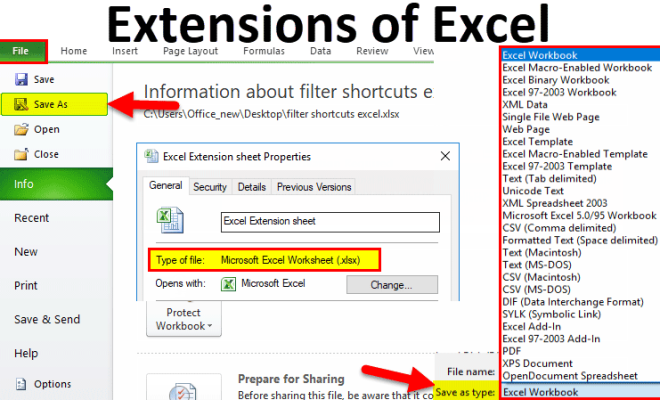
Excel is a popular spreadsheet program that is widely used in various industries and professions. With its ability to store, organize, and manipulate data, Excel has become an indispensable tool for businesses, educators, researchers, and individuals alike. One of the essential aspects of Excel is its file extensions. Let’s take a closer look at these file extensions and their uses.

.XLSX – The most commonly used Excel file extension, XLSX is the default file format for Excel 2007 or later versions. It is an open XML file format used to store a complete Excel workbook, including one or more worksheets, charts, and macros. The XLSX format is versatile, efficient, and compatible with various operating systems, making it an ideal choice for sharing and collaborating on Excel files.

.XLS – The XLS file extension is the legacy file format used in earlier versions of Excel. While it is still supported, the XLS format is gradually being phased out in favor of the more modern XLSX format. It includes the same components as XLSX, but it uses a different file structure and is less efficient. It can be useful when interacting with older systems or software that only supports the XLS file format.

.CSV – The CSV file extension stands for Comma-Separated Values. It is a plain-text file format where each line represents a separate row, and each field is separated by a comma or specified delimiter. CSV files are commonly used to exchange data between different applications, and they can be opened in Excel and other spreadsheet programs.

.XLSM – The XLSM file extension is used for a macro-enabled workbook, which means it includes one or more VBA (Visual Basic for Applications) macros that automate various tasks or perform calculations. The macros can be executed when the workbook is opened or in response to user input. XLSM files are commonly used in business, finance, and engineering fields to automate repetitive tasks and increase productivity.

.XLTM – The XLTM file extension is used for a macro-enabled template, which is a pre-defined workbook with formatting, formulas, and macros. The template can be customized and reused to create new workbooks with the same layout and functionality. XLTM files are useful for businesses and organizations that require standardized formats for reports, invoices, and other documents.

.XLTX – The XLTX file extension is used for a template, which is a pre-defined workbook with formatting and formulas, but without macros. Templates can be customized and reused to create new workbooks with the same look and feel. XLTX files are commonly used in education, research, and data analysis to create standardized reports, data visualizations, and charts.

In conclusion, Excel file extensions are essential components of the Excel application. They signify the type of file and its contents, which helps users identify the functionality and features in a workbook. Understanding Excel file extensions and their uses is critical when exchanging or sharing data with colleagues, clients, or partners. Excel offers a wide range of file formats that serve specific purposes, from legacy XLS to versatile XLSX, CSV, and template-based file formats.


Previous Article

What Does Embed Mean?

Next Article

How to Fix Msvcp100.dll Not Found or ...

Matthew Lynch

Related articles More from author

  • Digital & Mobile Technology

    T-Mobile 5G: When & Where You Can Get It

    June 4, 2023
    By Matthew Lynch
  • Digital & Mobile Technology

    Lost Your Phone With a Google Authenticator App? What to Do Next

    June 8, 2023
    By Matthew Lynch
  • Digital & Mobile Technology

    Microsoft Remote Desktop: How to Access Windows From Your Mac

    June 22, 2023
    By Matthew Lynch
  • Digital & Mobile Technology

    You Can Now Buy and Sell Crypto on eToro: Here’s How

    July 4, 2023
    By Matthew Lynch
  • Digital & Mobile Technology

    What Happens When You Clear Cache on Instagram

    March 20, 2023
    By Matthew Lynch
  • Best of the Best ListsDigital & Mobile Technology

    The 5 Best Open-Source Video Conferencing Software

    June 6, 2023
    By Matthew Lynch

Search

Login & Registration

  • Log in
  • Entries feed
  • Comments feed
  • WordPress.org

Newsletter

Signup for The Tech Edvocate Newsletter and have the latest in EdTech news and opinion delivered to your email address!

About Us

Since technology is not going anywhere and does more good than harm, adapting is the best course of action. That is where The Tech Edvocate comes in. We plan to cover the PreK-12 and Higher Education EdTech sectors and provide our readers with the latest news and opinion on the subject. From time to time, I will invite other voices to weigh in on important issues in EdTech. We hope to provide a well-rounded, multi-faceted look at the past, present, the future of EdTech in the US and internationally.

We started this journey back in June 2016, and we plan to continue it for many more years to come. I hope that you will join us in this discussion of the past, present and future of EdTech and lend your own insight to the issues that are discussed.

Newsletter

Signup for The Tech Edvocate Newsletter and have the latest in EdTech news and opinion delivered to your email address!

Contact Us

The Tech Edvocate
910 Goddin Street
Richmond, VA 23231
(601) 630-5238
[email protected]

Copyright © 2026 Matthew Lynch. All rights reserved.