Colleges Fight AI Cheating with Oral Exams
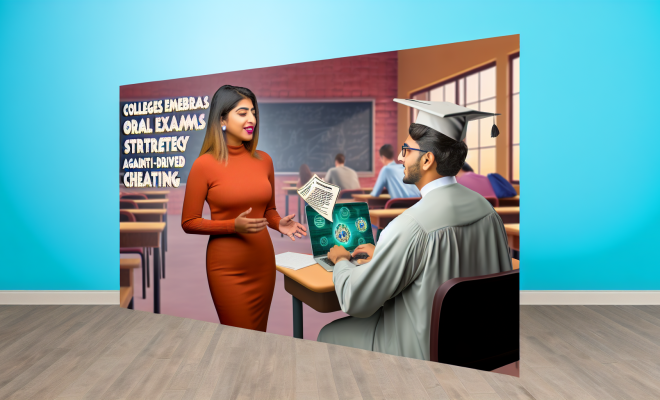
In an era where artificial intelligence (AI) has become increasingly integrated into the educational landscape, colleges are taking decisive steps to uphold academic integrity. A growing number of institutions are shifting towards oral examinations as a means to combat the rising trend of students using AI tools to complete assignments. This transformation aims to ensure that evaluations accurately reflect a student’s understanding and critical thinking abilities rather than relying solely on written work that can easily be generated by AI.
The Rise of AI in Education
As AI technologies advance, their applications in education have expanded significantly. Tools powered by AI can produce high-quality written content in mere moments, making it tempting for students to turn to these resources for their assignments. However, this trend raises critical questions about the authenticity of student work and their actual grasp of the subject matter.
Concerns Over Academic Integrity
Educators and administrators are increasingly worried that AI-generated submissions can provide flawless answers, masking a lack of true comprehension. This concern is not unfounded; numerous studies have shown that reliance on AI tools can hinder the development of essential skills such as critical thinking, problem-solving, and effective communication. As a result, institutions are looking for innovative ways to assess students’ knowledge and capabilities.
Transitioning to Oral Exams
In response to these challenges, colleges are implementing oral exams as a viable solution. Oral assessments allow educators to engage directly with students, enabling them to gauge not only the depth of their knowledge but also their ability to articulate and defend their ideas. By prioritizing verbal evaluations, institutions aim to promote genuine comprehension and critical analysis over rote memorization or superficial engagement with course material.
- Interactive Assessment: Oral exams facilitate a dynamic interaction between instructors and students, allowing for immediate feedback and clarification.
- Critical Thinking: These assessments challenge students to think on their feet, enhancing their analytical skills and their ability to express complex ideas clearly.
- Reduces AI Dependency: By focusing on verbal communication, colleges aim to reduce students’ reliance on AI tools for completing assignments.
Case Studies and Implementation
Several educational institutions have already begun to implement oral exams with promising outcomes. For instance, some universities have adopted a hybrid model, combining traditional written assessments with oral components. This approach allows students to demonstrate their understanding through both written and verbal communication, providing a more holistic view of their capabilities.
At the University of California, Berkeley, educators have reported that students are more engaged during oral exams, often displaying a level of enthusiasm and interest that is sometimes lacking in written assignments. Faculty members note that these assessments can highlight a student’s strengths and weaknesses more effectively, offering insights into areas where further development is needed.
Challenges in Transitioning
Despite the benefits, transitioning to oral exams is not without its challenges. Faculty must be adequately trained to conduct these assessments effectively, ensuring that they are fair and unbiased. Additionally, there is a need for clear guidelines and standards to maintain consistency across different departments and courses.
- Training Requirements: Educators may require professional development to effectively assess students in an oral format.
- Standardization: Establishing uniform criteria for assessment is crucial to ensure fairness.
- Student Comfort: Some students may feel anxious about oral exams, necessitating support mechanisms to help them perform confidently.
Future Implications
The shift towards oral examinations presents a significant evolution in educational assessment practices. As AI continues to grow and influence the academic environment, it is likely that more institutions will adopt similar strategies to mitigate the risks associated with AI-driven cheating. Furthermore, this trend may pave the way for a broader re-evaluation of how student learning and understanding are assessed in various disciplines.
Ultimately, the goal of this transition is clear: to foster an educational landscape where students are encouraged to engage deeply with their studies, promoting a culture of integrity and genuine learning. By prioritizing oral evaluations, colleges are taking a proactive stance against the misuse of technology, ensuring that graduates are not only knowledgeable but also capable of critical thought and effective communication.
Conclusion
As educational institutions continue to grapple with the implications of AI in academia, the move towards oral exams reflects a commitment to preserving the integrity of academic assessments. This evolution not only challenges students to develop their understanding but also prepares them for future endeavors where effective communication and critical thinking are paramount. In this rapidly changing landscape, colleges are setting a precedent that emphasizes the importance of authenticity in student learning and evaluation.