Bizarre: The Moon Is No One’s, But Everyone Wants Its Riches
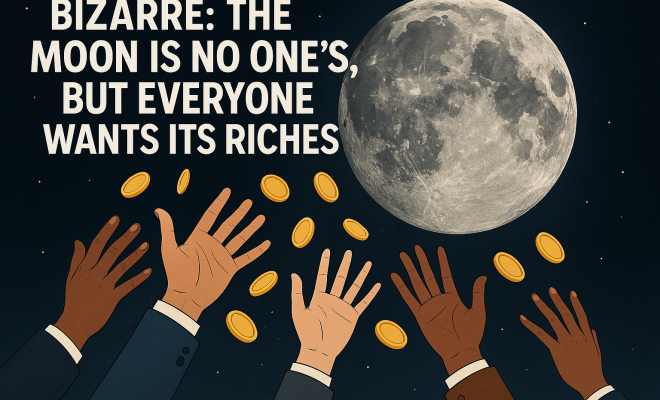
On September 6, 2026, former US President Donald Trump sent shockwaves through the space community with a simple, declarative social media post: “The Moon Is Ours.” This wasn’t just a casual remark; it was a statement that directly challenged nearly six decades of international space law, reigniting a debate as old as humanity’s reach for the stars: who owns the Moon, and can we mine it?
For anyone eyeing the vast, untapped wealth of lunar resources – from precious water ice at the poles to the tantalizing promise of helium-3 for fusion energy – Trump’s pronouncement, however legally dubious, highlighted a fundamental tension. We’re on the cusp of a new space race, one not driven by flags and footprints, but by profits and payloads. Yet, the legal framework governing this cosmic gold rush remains frustratingly opaque. This is where the 1967 Outer Space Treaty comes into play, a foundational document that serves as both a beacon and a bottleneck for aspiring lunar miners. Understanding its nuances is absolutely critical, acting as your ultimate Outer Space Treaty lunar mining guide.
The Cornerstone: What the Outer Space Treaty Actually Says (and Doesn’t Say)
The Treaty on Principles Governing the Activities of States in the Exploration and Use of Outer Space, including the Moon and Other Celestial Bodies – thankfully shortened to the Outer Space Treaty (OST) – was forged in the crucible of the Cold War. Signed by the US, the Soviet Union, and the UK, and now ratified by over 110 nations, it’s the bedrock of international space law. Its core tenets are clear: outer space, including the Moon and other celestial bodies, is not subject to national appropriation by claim of sovereignty, by means of use or occupation, or by any other means. In plain English, no country can plant a flag on the Moon and declare it theirs.
This principle of non-appropriation is vital. It prevents a colonial land grab in space, ensuring that the cosmos remains the “province of all mankind.” But here’s where the ambiguity creeps in, creating a legal gray area that has become the battleground for future space entrepreneurs. While the OST explicitly forbids national ownership of celestial bodies, it remains conspicuously silent on the ownership of resources extracted from those bodies by private entities. This wasn’t an oversight, but a product of its time. In 1967, lunar mining was the stuff of science fiction; the treaty’s drafters simply weren’t contemplating commercial resource extraction on a grand scale.
So, we have a treaty that says you can’t own the Moon, but doesn’t explicitly say you can’t own the rocks you dig up from it. This omission is the source of endless debate, legal maneuvering, and a significant amount of the controversy surrounding the nascent lunar mining industry. It’s a classic case of law struggling to keep pace with technological advancement and human ambition.
The “Province of All Mankind” Principle: A Noble Ideal Under Strain
Article I of the Outer Space Treaty declares that “the exploration and use of outer space, including the Moon and other celestial bodies, shall be carried out for the benefit and in the interests of all countries, irrespective of their degree of economic or scientific development, and shall be the province of all mankind.” This beautiful, almost poetic language underpins the entire treaty. It suggests a shared heritage, a common good that transcends national boundaries.
But what does “province of all mankind” actually mean when it comes to tangible, valuable resources? Does it imply that any extracted resources must be shared equitably? Or does it simply mean that all nations should have equal access to explore and use space, with the fruits of their labor remaining their own? This is where the interpretation becomes highly contentious. Developing nations often argue for a more equitable distribution of space resources, viewing lunar mining as a potential new frontier for economic exploitation by already wealthy nations. They point to the “benefit and interests of all countries” clause as justification for a more collective approach.
Conversely, nations and private companies actively pursuing space mining tend to interpret “province of all mankind” as a principle of non-discriminatory access and peaceful use, rather than a mandate for resource sharing. They argue that requiring resource sharing would stifle innovation, investment, and ultimately, the very exploration and use the treaty seeks to promote. This clash of interpretations is at the heart of the legal and ethical dilemma facing the international community, and it’s a critical aspect for any potential investor to understand in this Outer Space Treaty lunar mining guide. (See: Outer Space Treaty overview.)
National Laws Emerge: A Patchwork of Permissions
In the absence of a clear, universally accepted international framework for lunar mining, several nations have taken matters into their own hands, enacting domestic legislation to permit and regulate private companies’ activities in space resource extraction. This isn’t a violation of the Outer Space Treaty, per se, as the treaty primarily governs states, not private companies directly. However, Article VI of the OST states that “States Parties to the Treaty shall bear international responsibility for national activities in outer space… whether such activities are carried out by governmental agencies or by non-governmental entities.” This means that if a private company from, say, the United States, extracts resources from the Moon, the US government is ultimately responsible for ensuring those activities comply with international law. For more context, see industries facing catastrophe by 2026.
The US led the charge with the Commercial Space Launch Competitiveness Act of 2015, which explicitly grants US citizens the right to engage in commercial exploration, recovery, and use of space resources. Luxembourg, a small but ambitious player in the space sector, followed suit with its own space law in 2017, designed to attract space mining companies. The United Arab Emirates and Japan have also implemented similar national frameworks. These laws are a bold move, essentially asserting a domestic right to extract and own space resources, despite the international legal ambiguities. They are designed to provide legal certainty for private companies, encouraging investment and technological development.
However, this proliferation of national laws creates a potential “Wild West” scenario. If every nation develops its own rules, without international coordination, we could see conflicting claims, legal disputes, and even resource conflicts on the Moon. It’s a pragmatic approach for individual nations looking to jumpstart their space economies, but it underscores the urgent need for a more comprehensive international consensus.
The Artemis Accords: An Attempt at International Coordination
Recognizing the growing need for a more structured approach, the United States, through NASA, launched the Artemis Accords in 2020. These are a series of non-binding bilateral agreements designed to establish a common set of principles for peaceful and sustainable space exploration, particularly regarding lunar activities. As of late 2023, over 30 nations have signed on, including Japan, the UK, Canada, Italy, Australia, and the UAE.
The Accords are not a treaty, and they don’t supersede the Outer Space Treaty. Instead, they aim to operationalize some of the OST’s principles and introduce new ones relevant to modern space activities. Crucially for lunar mining, the Artemis Accords acknowledge the right to extract and utilize space resources. Article 10, for example, states that “the ability to extract and utilize space resources is vital to support safe and sustainable exploration and operations.” It further emphasizes that such activities should be conducted “in a manner that is consistent with the Outer Space Treaty.”
This is a significant step. While non-binding, the Accords represent a growing international consensus among many spacefaring nations that resource extraction is a legitimate activity. They also introduce principles like transparency, interoperability, registration of space objects, and the establishment of “safety zones” around lunar operations to prevent harmful interference. Critics, however, view the Accords as a US-led initiative that attempts to establish norms without broader international input, particularly from non-signatory nations like China and Russia, who have their own space ambitions. They argue that a truly global consensus should emerge from the UN Committee on the Peaceful Uses of Outer Space (COPUOS), rather than through a smaller, US-led coalition. Still, for any entity seeking to operate under a clear Outer Space Treaty lunar mining guide, the Artemis Accords offer valuable insight into the prevailing thought among many key players.
The Lure of Lunar Riches: Helium-3 and Water Ice
Why all this fuss over a barren rock? The Moon isn’t just a symbol; it’s a treasure trove of invaluable resources that could revolutionize industries on Earth and enable sustained human presence beyond our planet. Two resources, in particular, stand out: helium-3 and water ice.
Helium-3: The Holy Grail of Fusion Energy. This rare isotope is extremely scarce on Earth but abundant on the Moon, deposited by solar winds over billions of years. Scientists believe just a few hundred tons of lunar helium-3 could provide clean, safe fusion energy for the entire planet for centuries. Fusion power, often called the “energy of the future,” promises virtually limitless, non-polluting electricity. If lunar helium-3 can be harvested efficiently, its value would be astronomical, making the Moon an energy superpower. The technological challenges are immense, requiring sophisticated mining and processing techniques, but the potential payoff is staggering. (See: NASA's explanation of the treaty.)
Water Ice: The Lifeblood of Space Exploration. Discovered in permanently shadowed craters at the lunar poles, water ice is arguably even more immediately valuable. It can be melted for drinking water, split into hydrogen and oxygen for rocket fuel (propellant), and used for life support systems. Imagine refueling rockets directly on the Moon, dramatically reducing the cost and complexity of missions further into the solar system. Lunar water ice transforms the Moon from a distant destination into a crucial waystation, a cosmic gas station and supply depot. This resource alone could unlock unprecedented capabilities for deep-space exploration, making lunar bases and Mars missions far more feasible.
Beyond these two, the Moon also contains rare earth elements, titanium, aluminum, and silicon, all valuable for manufacturing and construction. The sheer economic potential is what drives the current race, making the legal ambiguities surrounding an Outer Space Treaty lunar mining guide so intensely debated. For more context, see Vietnam PUBG boycott and its implications.
The Moon Agreement: A Failed Attempt at Comprehensive Governance
In 1979, the United Nations adopted the Agreement Governing the Activities of States on the Moon and Other Celestial Bodies, more commonly known as the Moon Agreement. This treaty attempted to expand upon the Outer Space Treaty, specifically addressing resource exploitation. It declared that the Moon and its natural resources are the “common heritage of mankind” and proposed an international regime to govern the exploitation of those resources once such exploitation becomes feasible.
Sounds promising, right? The problem is, it was a spectacular failure in terms of adoption. Only 18 nations have ratified the Moon Agreement, and crucially, none of the major spacefaring powers – including the US, Russia, China, and most European nations – are signatories. They viewed its provisions on resource sharing as too restrictive, potentially stifling private enterprise and national initiatives. The concept of “common heritage of mankind” was interpreted as a disincentive for investment, as it implied that any profits would have to be shared with the international community. Consequently, the Moon Agreement remains largely a historical footnote, an example of what could have been but wasn’t, highlighting the deep divisions that exist on how to govern space resources.
The Path Forward: Navigating the Legal Labyrinth
So, where does this leave aspiring lunar miners? The current legal landscape is complex, a mosaic of foundational treaties, national laws, and non-binding accords. It’s clear that direct national ownership of the Moon is prohibited by the Outer Space Treaty. However, the right of private entities to extract and own resources, particularly under the jurisdiction of nations with enabling legislation like the US or Luxembourg, appears to be gaining de facto acceptance among many key players.
For a company looking to invest in lunar mining, the most pragmatic approach involves operating under the flag of a nation that has enacted domestic laws supporting space resource extraction and has signed the Artemis Accords. This provides the most robust legal footing currently available. However, it’s not without risk. Non-signatories of the Artemis Accords, or nations that interpret the Outer Space Treaty more strictly regarding resource sharing, could challenge such operations, leading to international disputes. The lack of an overarching, universally agreed-upon international regime remains the biggest hurdle.
There’s also the question of operational zones. The Artemis Accords propose “safety zones” around lunar operations, which could effectively grant exclusive access to certain areas for resource extraction, even without formal territorial claims. This is a crucial development, as it moves towards practical solutions for managing potential conflicts and ensuring safe operations. Any comprehensive Outer Space Treaty lunar mining guide must emphasize operating within these emerging norms.
The Ethical and Environmental Considerations
Beyond the legal and economic dimensions, lunar mining raises significant ethical and environmental questions. How do we ensure that the Moon, often viewed as a pristine natural satellite, isn’t scarred by industrial activity? What are the long-term environmental impacts of extensive mining operations? While the Moon lacks an atmosphere and biosphere in the terrestrial sense, it possesses unique geological features, potential scientific sites, and even areas of historical significance (like the Apollo landing sites) that warrant protection. For more context, see EV battery breakthroughs and their impact. (See: Scientific analysis of lunar mining.)
The concept of “space heritage” is gaining traction, arguing for the preservation of certain lunar sites for their scientific or cultural value. There are also concerns about orbital debris from mining operations and the potential for contamination of lunar samples. The Outer Space Treaty mandates that activities in space avoid “harmful contamination” and “adverse changes in the environment of the Earth.” While this primarily referred to microbial contamination from returning spacecraft in 1967, its spirit can be extended to encompass environmental protection of celestial bodies.
As we push towards lunar industrialization, these considerations will become increasingly important. Responsible space mining will require not just legal compliance, but also adherence to best practices for environmental stewardship and cultural preservation, even in an extraterrestrial context. Ignoring these aspects would be short-sighted and could lead to significant public backlash and further international discord.
The Future of Lunar Mining: A Call for Clarity and Cooperation
The Moon is calling, and humanity is answering. The race for lunar resources is real, driven by profound scientific curiosity, economic opportunity, and the yearning to expand our presence beyond Earth. While the 1967 Outer Space Treaty provides a vital foundation, its ambiguities regarding resource ownership are a ticking time bomb. Former President Trump’s provocative claim, whether intentional or not, simply underscored the urgency of the situation.
The current landscape, with its patchwork of national laws and the non-binding Artemis Accords, is a temporary solution. For sustained, peaceful, and equitable development of lunar resources, a more robust and universally accepted international legal framework is essential. This could take the form of an updated treaty, a series of UN resolutions, or a globally negotiated protocol. The UN Committee on the Peaceful Uses of Outer Space (COPUOS) remains the most appropriate forum for such discussions, even if progress there has been historically slow.
Ultimately, the Moon belongs to no one nation, but its resources hold the potential to benefit all of humanity. Realizing this potential will require unprecedented levels of international cooperation, legal ingenuity, and a shared commitment to developing space responsibly. For aspiring lunar miners and investors, staying abreast of these evolving legal and political currents isn’t just good business; it’s essential for navigating the complex and exciting frontier of space. This Outer Space Treaty lunar mining guide will continue to evolve as humanity’s reach extends further into the cosmos.
Trending Now
Frequently Asked Questions
Who owns the Moon according to international law?
According to the Outer Space Treaty of 1967, no country can claim ownership of the Moon or any celestial body. This treaty establishes that outer space is the province of all humanity, preventing national appropriation by means of sovereignty or occupation.
What is the Outer Space Treaty?
The Outer Space Treaty, signed in 1967, is a foundational document of international space law. It governs the exploration and use of outer space, stating that celestial bodies, including the Moon, cannot be claimed by any nation, ensuring space remains accessible to all.
Can we mine resources on the Moon?
While the Outer Space Treaty prohibits national ownership of celestial bodies, it doesn't explicitly ban the mining of lunar resources. This has led to debates about the legality and implications of mining activities on the Moon, as nations and private companies explore potential profits.
What resources can be found on the Moon?
The Moon is believed to have various valuable resources, including water ice at its poles, which could support future lunar bases, and helium-3, a potential fuel for fusion energy. These resources have sparked interest in lunar mining and exploration.
What did Trump mean by 'The Moon Is Ours'?
Former President Donald Trump's statement 'The Moon Is Ours' challenged the principles of the Outer Space Treaty, suggesting a shift towards national ownership or control over lunar resources. This remark reignited discussions about space law and the potential for a new space race focused on profits.
What's your take on this? Share your thoughts in the comments below — we read every one.