The Tech Edvocate

Top Menu

  • Advertisement
  • Apps
  • Home Page
  • Home Page Five (No Sidebar)
  • Home Page Four
  • Home Page Three
  • Home Page Two
  • Home Tech2
  • Icons [No Sidebar]
  • Left Sidbear Page
  • Lynch Educational Consulting
  • My Account
  • My Speaking Page
  • Newsletter Sign Up Confirmation
  • Newsletter Unsubscription
  • Our Brands
  • Page Example
  • Privacy Policy
  • Protected Content
  • Register
  • Request a Product Review
  • Shop
  • Shortcodes Examples
  • Signup
  • Start Here
    • Governance
    • Careers
    • Contact Us
  • Terms and Conditions
  • The Edvocate
  • The Tech Edvocate Product Guide
  • Topics
  • Write For Us
  • Advertise

Main Menu

  • Start Here
    • Our Brands
    • Governance
      • Lynch Educational Consulting, LLC.
      • Dr. Lynch’s Personal Website
      • Careers
    • Write For Us
    • The Tech Edvocate Product Guide
    • Contact Us
    • Books
    • Edupedia
    • Post a Job
    • The Edvocate Podcast
    • Terms and Conditions
    • Privacy Policy
  • Topics
    • Assistive Technology
    • Child Development Tech
    • Early Childhood & K-12 EdTech
    • EdTech Futures
    • EdTech News
    • EdTech Policy & Reform
    • EdTech Startups & Businesses
    • Higher Education EdTech
    • Online Learning & eLearning
    • Parent & Family Tech
    • Personalized Learning
    • Product Reviews
  • Advertise
  • Tech Edvocate Awards
  • The Edvocate
  • Pedagogue
  • School Ratings

logo

The Tech Edvocate

  • Start Here
    • Our Brands
    • Governance
      • Lynch Educational Consulting, LLC.
      • Dr. Lynch’s Personal Website
        • My Speaking Page
      • Careers
    • Write For Us
    • The Tech Edvocate Product Guide
    • Contact Us
    • Books
    • Edupedia
    • Post a Job
    • The Edvocate Podcast
    • Terms and Conditions
    • Privacy Policy
  • Topics
    • Assistive Technology
    • Child Development Tech
    • Early Childhood & K-12 EdTech
    • EdTech Futures
    • EdTech News
    • EdTech Policy & Reform
    • EdTech Startups & Businesses
    • Higher Education EdTech
    • Online Learning & eLearning
    • Parent & Family Tech
    • Personalized Learning
    • Product Reviews
  • Advertise
  • Tech Edvocate Awards
  • The Edvocate
  • Pedagogue
  • School Ratings
  • Cybersecurity vs. Green Energy: Which Path Will Make You Richer in 2026?

  • Why These 10 Renewable Energy Certifications Are Quietly Reshaping Careers by 2026

  • Why Millions Are Rushing to Online Renewable Energy Certifications Right Now

  • August AI vs. USMLE: The Unsettling Future of Medical Licensing

  • One AI’s Perfect USMLE Score Just Blew Up Medical Education As We Know It

  • This AI Just Aced the USMLE: Why Your Medical Career Might Never Be the Same

  • The Quiet Exodus: Why Senior FinTech Developers Are Abandoning Corporate Life

  • The Quiet Revolution: Where Elite FinTech Developers Are Fleeing in 2026

  • The Quiet Exodus: Why Senior FinTech Developers Are Ditching Corporate Life

  • AI Governance Software: Pricing and Features Comparison

Digital & Mobile Technology
Home›Digital & Mobile Technology›An Overview of the Nagle Algorithm for TCP Network Communication

An Overview of the Nagle Algorithm for TCP Network Communication
By Matthew Lynch
June 9, 2023
0
Spread the love

The Nagle algorithm, also known as the Nagle’s algorithm or the Nagle’s algorithm for TCP network communication, is a method of reducing the number of small packets that are sent on a TCP connection. The algorithm was developed by John Nagle in 1984, and it is a widely used technique for improving the efficiency of TCP communication across the internet.

TCP (Transmission Control Protocol) is a widely used protocol for transmitting data across the internet. It was developed to ensure reliable and efficient data transmission over long distances. TCP operates by breaking data into small packets and sending them across the network. The packets are then reassembled at the receiving end to form the original data.

One of the challenges faced by TCP is the issue of small packets. When data is transmitted in small packets, it results in increased network traffic and bandwidth usage. Additionally, small packets can cause delays in sending data, as the TCP protocol requires that each packet be acknowledged before the next one is sent.

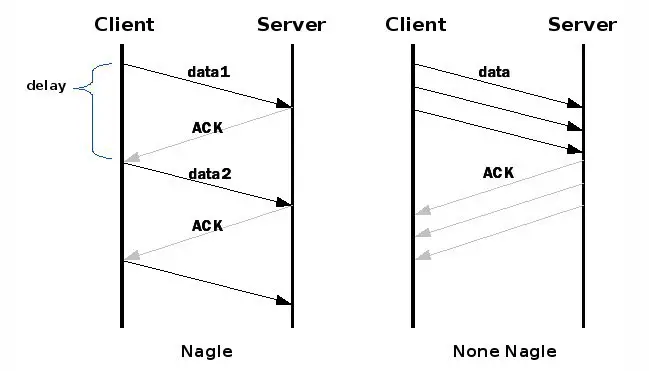
The Nagle algorithm was developed to address the issue of small packets in a TCP connection. The algorithm works by buffering small packets, temporarily delaying their transmission until a certain condition is met. This condition is based on several factors, including the size of the packet and the amount of data waiting to be transmitted.

When the Nagle algorithm is implemented in a TCP connection, small packets are combined into larger ones before being transmitted. This reduces the number of packets sent, resulting in reduced network traffic and improved efficiency. Additionally, by delaying the transmission of small packets, the algorithm reduces the number of acknowledgments required for successful data transmission.

One of the key benefits of the Nagle algorithm is that it reduces network congestion, which can lead to improved network performance. By reducing the number of packets sent, the algorithm helps to ensure that the available bandwidth is used more efficiently. This can be particularly useful in high-traffic environments, where network congestion is a common problem.

Another benefit of the Nagle algorithm is that it can help to reduce latency in TCP connections. By combining small packets into larger ones, the algorithm reduces the number of acknowledgments required, which can help to improve the speed of data transmission. Additionally, the algorithm can help to ensure that packets are transmitted in a timely manner, reducing the likelihood of delays or dropped packets.

In conclusion, the Nagle algorithm is a powerful technique for improving the efficiency of TCP network communication. By reducing the number of small packets sent, the algorithm can help to reduce network congestion and latency, resulting in improved network performance. As a widely used technique, the Nagle algorithm has become an essential part of modern TCP implementations, and it is likely to continue to be a key component of network communication for years to come.


Previous Article

How to Get Philo on Fire Stick

Next Article

How to Unfreeze a MacBook Pro

Matthew Lynch

Related articles More from author

  • Digital & Mobile Technology

    How to Install Google Chrome on Android TV

    June 13, 2023
    By Matthew Lynch
  • Digital & Mobile Technology

    How to Fix Cloudflare’s Error 1020: Access Denied

    August 5, 2023
    By Matthew Lynch
  • Digital & Mobile TechnologyEdTech & Innovation

    Ways to Access the Library Folder on Your Mac

    June 6, 2023
    By Matthew Lynch
  • Digital & Mobile Technology

    A Timeline And History Of Blockchain Technology

    April 10, 2023
    By Matthew Lynch
  • Digital & Mobile Technology

    The Best Gaming Keyboards With Macro Keys

    June 11, 2023
    By Matthew Lynch
  • Digital & Mobile Technology

    Vewd: What Is It and How Does It Work?

    July 6, 2023
    By Matthew Lynch

Search

Login & Registration

  • Log in
  • Entries feed
  • Comments feed
  • WordPress.org

Newsletter

Signup for The Tech Edvocate Newsletter and have the latest in EdTech news and opinion delivered to your email address!

About Us

Since technology is not going anywhere and does more good than harm, adapting is the best course of action. That is where The Tech Edvocate comes in. We plan to cover the PreK-12 and Higher Education EdTech sectors and provide our readers with the latest news and opinion on the subject. From time to time, I will invite other voices to weigh in on important issues in EdTech. We hope to provide a well-rounded, multi-faceted look at the past, present, the future of EdTech in the US and internationally.

We started this journey back in June 2016, and we plan to continue it for many more years to come. I hope that you will join us in this discussion of the past, present and future of EdTech and lend your own insight to the issues that are discussed.

Newsletter

Signup for The Tech Edvocate Newsletter and have the latest in EdTech news and opinion delivered to your email address!

Contact Us

The Tech Edvocate
910 Goddin Street
Richmond, VA 23231
(601) 630-5238
[email protected]

Copyright © 2026 Matthew Lynch. All rights reserved.