The Tech Edvocate

Top Menu

  • Advertisement
  • Apps
  • Home Page
  • Home Page Five (No Sidebar)
  • Home Page Four
  • Home Page Three
  • Home Page Two
  • Home Tech2
  • Icons [No Sidebar]
  • Left Sidbear Page
  • Lynch Educational Consulting
  • My Account
  • My Speaking Page
  • Newsletter Sign Up Confirmation
  • Newsletter Unsubscription
  • Our Brands
  • Page Example
  • Privacy Policy
  • Protected Content
  • Register
  • Request a Product Review
  • Shop
  • Shortcodes Examples
  • Signup
  • Start Here
    • Governance
    • Careers
    • Contact Us
  • Terms and Conditions
  • The Edvocate
  • The Tech Edvocate Product Guide
  • Topics
  • Write For Us
  • Advertise

Main Menu

  • Start Here
    • Our Brands
    • Governance
      • Lynch Educational Consulting, LLC.
      • Dr. Lynch’s Personal Website
      • Careers
    • Write For Us
    • The Tech Edvocate Product Guide
    • Contact Us
    • Books
    • Edupedia
    • Post a Job
    • The Edvocate Podcast
    • Terms and Conditions
    • Privacy Policy
  • Topics
    • Assistive Technology
    • Child Development Tech
    • Early Childhood & K-12 EdTech
    • EdTech Futures
    • EdTech News
    • EdTech Policy & Reform
    • EdTech Startups & Businesses
    • Higher Education EdTech
    • Online Learning & eLearning
    • Parent & Family Tech
    • Personalized Learning
    • Product Reviews
  • Advertise
  • Tech Edvocate Awards
  • The Edvocate
  • Pedagogue
  • School Ratings

logo

The Tech Edvocate

  • Start Here
    • Our Brands
    • Governance
      • Lynch Educational Consulting, LLC.
      • Dr. Lynch’s Personal Website
        • My Speaking Page
      • Careers
    • Write For Us
    • The Tech Edvocate Product Guide
    • Contact Us
    • Books
    • Edupedia
    • Post a Job
    • The Edvocate Podcast
    • Terms and Conditions
    • Privacy Policy
  • Topics
    • Assistive Technology
    • Child Development Tech
    • Early Childhood & K-12 EdTech
    • EdTech Futures
    • EdTech News
    • EdTech Policy & Reform
    • EdTech Startups & Businesses
    • Higher Education EdTech
    • Online Learning & eLearning
    • Parent & Family Tech
    • Personalized Learning
    • Product Reviews
  • Advertise
  • Tech Edvocate Awards
  • The Edvocate
  • Pedagogue
  • School Ratings
  • Medicube PDRN Pink Collagen Cream: Is It Safe to Use Now?

  • Tarte’s ‘Snatch Sticks’ Spark Unprecedented Backlash — Here’s Why Everyone’s Talking

  • This AI-Designed Drug Just Entered Phase III Trials — And It Might Reverse Your Biological Age

  • Unbelievable: Top AI Startups Caught Faking Revenue, Rocking Silicon Valley

  • Xbox Cloud Gaming’s Urgent Problem: Microsoft’s Brutal Truth Revealed

  • The Hypocrisy That’s Quietly Reshaping Gaming Journalism

  • Anthropic Insider: Why AI Could End Humanity by 2036

  • Unbelievable: OpenAI Claims AI Solved Million-Dollar Math Problem – But the Credit Battle Just Began

  • Heartbreaking: 93 Million Kids’ Futures Stolen by Surging Attacks on Education

  • Unsettling: The Cat in the Hat Trend That’s Causing Mass Panic in Schools

Digital & Mobile Technology
Home›Digital & Mobile Technology›How to Splice an RCA Cable

How to Splice an RCA Cable
By Matthew Lynch
May 9, 2023
0
Spread the love

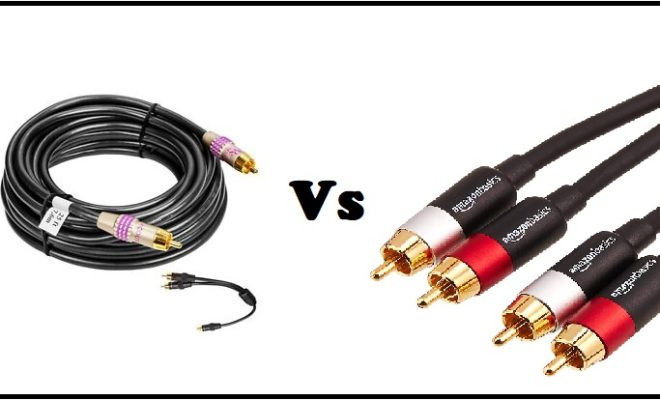
RCA cables are a common type of audio and video cables used to connect various devices such as speakers, televisions, DVD players, and gaming consoles. These cables are reliable in transmitting signals, but they can break or get damaged over time. Fortunately, splicing an RCA cable is a simple repair you can perform at home, saving you the cost of buying a new cable. In this article, we will guide you on how to splice an RCA cable.

Things you will need

– Scissors
– Wire stripper
– Soldering iron
– Solder
– Heat shrinks
– Electrical tape

Step 1: Cut the damaged area

The first step in splicing an RCA cable is to identify the area that needs repair/cutting. Use scissors to cut off the damaged part of the cable. Make sure you cut from the middle of the damaged part to avoid damaging any good wire.

Step 2: Strip the ends

After cutting, strip the cut ends of the cable using a wire stripper. Strip off about 1 inch of the outer insulation from each end of the RCA cable to expose the inner wires.

Step 3: Solder the wires

Take note of the color-coding of your RCA cables. Typically, RCA cables are made up of two or three wires, red, white, and yellow. Take the same color wires from each end of the cable and solder them together.

Use a solder iron to apply heat to the wires and then melt the solder on top of the wire. This way, the solder will hold the wires together. Make sure the solder coats the wire with an even layer. After soldering the wires, hold each joint in place until the solder cools down.

Step 4: Insulate the joints

After soldering the wires, slip a heat shrink over each joint and then heat it up using a heat gun. The heat shrink will protect the joint and keep the wires from coming apart. Alternatively, you can use electrical tape to wrap the joints securely.

Step 5: Test the cable

After splicing the RCA cable, it’s time to test it to see if it’s working correctly. Plug the cable into a device and check for a sound or video signal. If the device recognizes the RCA cable and delivers the expected signal, congratulations, you have successfully spliced an RCA cable. If not, you may need to revisit the soldering process to ensure the wires are properly soldered without touching each other.

Conclusion

Splicing an RCA cable is a simple and cost-effective repair you can perform at home. However, it requires precision and care. Always handle the wires with caution to avoid causing damage or short circuiting. Also, use the right tools and materials to ensure the best possible result. With this guide, you should be able to splice an RCA cable like a pro.  

Previous Article

How to Speed Up Your Linux PC

Next Article

How to Solve Math Problems Using Google ...

Matthew Lynch

Related articles More from author

  • Digital & Mobile Technology

    Biggest Technological Advances Since 1844

    June 10, 2023
    By Matthew Lynch
  • Digital & Mobile Technology

    How to Reduce WindowServer’s CPU Usage on Mac

    June 23, 2023
    By Matthew Lynch
  • Digital & Mobile Technology

    How to Change the Color of Your Apps on Android

    July 6, 2023
    By Matthew Lynch
  • Digital & Mobile Technology

    How to Open and Convert AVC Files

    July 14, 2023
    By Matthew Lynch
  • Digital & Mobile Technology

    3D TV Is Dead—What You Need To Know

    June 6, 2023
    By Matthew Lynch
  • Digital & Mobile Technology

    Guide to Making Facebook Photos Private

    July 29, 2023
    By Matthew Lynch

Search

Login & Registration

  • Log in
  • Entries feed
  • Comments feed
  • WordPress.org

Newsletter

Signup for The Tech Edvocate Newsletter and have the latest in EdTech news and opinion delivered to your email address!

About Us

Since technology is not going anywhere and does more good than harm, adapting is the best course of action. That is where The Tech Edvocate comes in. We plan to cover the PreK-12 and Higher Education EdTech sectors and provide our readers with the latest news and opinion on the subject. From time to time, I will invite other voices to weigh in on important issues in EdTech. We hope to provide a well-rounded, multi-faceted look at the past, present, the future of EdTech in the US and internationally.

We started this journey back in June 2016, and we plan to continue it for many more years to come. I hope that you will join us in this discussion of the past, present and future of EdTech and lend your own insight to the issues that are discussed.

Newsletter

Signup for The Tech Edvocate Newsletter and have the latest in EdTech news and opinion delivered to your email address!

Contact Us

The Tech Edvocate
910 Goddin Street
Richmond, VA 23231
(601) 630-5238
[email protected]

Copyright © 2026 Matthew Lynch. All rights reserved.