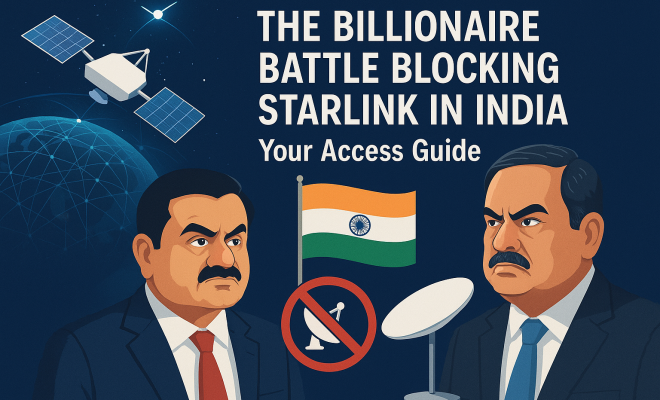
The Billionaire Battle Blocking Starlink in India: Your Access Guide
“`html
If you’re an Indian tech enthusiast or someone living in a connectivity black hole, the promise of Starlink’s high-speed, low-latency satellite internet must feel like a mirage in the desert. Elon Musk’s ambitious project, designed to beam broadband from a constellation of satellites, has captured imaginations globally. But in India, accessing Starlink has been anything but straightforward. It’s a saga tangled in political accusations, corporate rivalries, and regulatory red tape, making the question of “how to access Starlink in India” far more complex than a simple subscription.
For years, the prospect of Starlink entering the Indian market has generated immense buzz. Imagine, truly reliable internet in even the most remote villages, free from the limitations of terrestrial infrastructure. It’s a vision that could revolutionize education, healthcare, and economic opportunity across the subcontinent. Yet, despite the obvious demand and Starlink’s global expansion, India remains a significant hurdle. What’s really going on behind the scenes, and what can you, the eager consumer, do to prepare for its eventual (we hope!) arrival?
This isn’t just about a technology rollout; it’s a high-stakes drama involving some of the world’s most powerful figures. Elon Musk himself has pointed fingers, accusing powerful business interests of actively obstructing Starlink’s entry. These aren’t minor skirmishes; they’re heavyweight bouts that directly impact when, or if, you’ll ever get to experience Starlink’s service. Let’s dig into the nitty-gritty of what’s unfolding and what it means for anyone asking “how to access Starlink in India.”
1. The Regulatory Labyrinth: India’s Approval Process
Before any satellite internet provider can set up shop in India, they have to jump through a series of regulatory hoops that are, to put it mildly, extensive. The Indian government, through its Department of Telecommunications (DoT) and other bodies, has a stringent process for licensing and approving foreign entities, especially when it comes to critical infrastructure like telecommunications. This isn’t unique to India, of course; most sovereign nations want to ensure security, fair competition, and adherence to national policies.
For Starlink, the primary hurdles include obtaining a Global Mobile Personal Communication by Satellite (GMPCS) license, which is essential for any satellite-based communication service. Beyond that, there are security clearances, spectrum allocation approvals, and compliance with various local laws, including data localization and network security mandates. The government’s official stance has been consistent: Starlink needs to complete these security assessments and obtain all necessary approvals, just like any other player. They’ve firmly rejected any allegations of unfair treatment, emphasizing a level playing field for all applicants.
This bureaucratic maze isn’t just a formality; it’s a critical element in understanding why Starlink isn’t already operational. While companies often complain about regulatory delays, the government views these steps as vital for national security and ensuring reliable service for its citizens. So, while you might be itching to know how to access Starlink in India, the first and foremost answer is: Starlink itself needs to navigate and successfully complete this complex approval gauntlet.
Let’s break down some of these specific requirements a bit more. The GMPCS license, for example, isn’t just a rubber stamp. It involves a thorough technical and financial evaluation of the applicant. The DoT looks at the company’s operational plans, its network architecture, its ability to provide uninterrupted service, and its financial stability. Starlink, being a relatively new player in the global telecom scene compared to established giants, might face extra scrutiny here. Then there’s spectrum allocation. This is a big one. Electromagnetic spectrum is a finite resource, and governments worldwide carefully manage who gets to use which frequencies to avoid interference and ensure efficient use. India’s auction-based system for spectrum can be complex and costly. Starlink would need to secure specific frequencies for its ground stations and user terminals, which involves another layer of approval and potentially significant financial outlay.
Data localization is another important regulatory aspect. India has been increasingly focused on ensuring that data generated by its citizens stays within its borders, or at least is accessible to Indian authorities under specific conditions. This can pose a challenge for global services like Starlink, which operate on a worldwide network. They would need to demonstrate how they plan to comply with these data residency and access requirements without compromising their global network efficiency. This isn’t an insurmountable problem, but it requires careful architectural and legal planning on Starlink’s part. It shows that the regulatory environment isn’t static; it’s evolving, and new players need to adapt.
2. The Billionaire Tug-of-War: Musk vs. Ambani
Here’s where the plot thickens, veering from dry regulatory language into a full-blown corporate clash. Elon Musk has been quite vocal, publicly stating that “powerful business interests” in India are obstructing Starlink’s entry. While he hasn’t always named names directly, the context strongly suggests a rivalry with Mukesh Ambani’s Jio Platforms. Jio, a telecom giant in India, is not only a dominant force in terrestrial internet but is also keenly eyeing the satellite internet space.
Jio Platforms is also awaiting its own satellite internet clearance and certainly has a vested interest in maintaining its market position. The competition for India’s vast and underserved internet market is fierce, and the stakes are incredibly high. Musk’s pledge to price Starlink affordably in India, potentially undercutting existing providers and offering a superior service in many areas, would undoubtedly pose a significant challenge to established players like Jio. This isn’t just about market share; it’s about the future of internet connectivity in a nation of 1.4 billion people.
This public feud adds a layer of intrigue and complexity to the “how to access Starlink in India” question. Is it purely a regulatory delay, or is there genuine lobbying and influence at play that could be slowing down Starlink’s progress? While it’s difficult to prove direct obstruction, the perception of a powerful incumbent resisting a disruptive newcomer is certainly a narrative that resonates with many observers. This dynamic makes the eventual entry of Starlink not just a business decision, but a political and economic battleground.
The rivalry between Starlink and Jio isn’t just theoretical; it’s a battle for future dominance. Jio has its own ambitious plans for satellite broadband, having partnered with Luxembourg-based SES to launch Jio SpaceFiber. This venture aims to use medium earth orbit (MEO) satellites, a different approach than Starlink’s low earth orbit (LEO) constellation. Both technologies have their pros and cons, but they both target the same lucrative market: providing internet to areas where fiber optic cables or traditional mobile towers are impractical or too expensive to deploy. The Indian government has also indicated a preference for local manufacturing and investment, which could subtly favor players like Jio who have a significant local presence and manufacturing capabilities.
It’s not just Jio; other Indian players like Bharti Airtel, through its OneWeb venture (now Eutelsat OneWeb), are also in the satellite broadband race. Sunil Bharti Mittal, the chairman of Bharti Enterprises, has been an outspoken advocate for a “level playing field” and has criticized Starlink’s initial attempts to operate in India without all necessary licenses. This collective pushback from established Indian telecom giants suggests a united front against Starlink, not necessarily out of malice, but certainly out of a desire to protect their market share and influence. For you, the consumer, this intense competition could eventually lead to better services and prices, but it also creates the current gridlock.
3. The Political Dimension: Rahul Gandhi’s Stance
In a surprising twist, Indian politician Rahul Gandhi has publicly sided with Elon Musk, amplifying the accusations against powerful business interests. Gandhi’s support lends significant weight to Musk’s claims, especially given Gandhi’s prominent position within Indian politics as a leader of the Indian National Congress. His involvement elevates the discussion from a mere business dispute to a matter of public interest and potential political debate. (See: Starlink's global expansion challenges.)
Gandhi’s intervention suggests a broader concern about fair competition and the potential for monopolistic practices in critical sectors like telecommunications. By supporting Musk, he’s not just endorsing Starlink; he’s challenging the existing power structures and advocating for greater market openness. This kind of political endorsement, or criticism of perceived obstruction, can certainly influence public opinion and potentially even government policy, though the direct impact on Starlink’s regulatory timeline remains to be seen.
For consumers wondering how to access Starlink in India, this political alignment is a double-edged sword. On one hand, it brings much-needed attention to the issue and could put pressure on authorities to expedite approvals or ensure transparency. On the other hand, it also politicizes what might otherwise be a purely technical and regulatory process, potentially introducing new complexities and delays. The fact that a major political figure is weighing in underscores just how significant Starlink’s potential entry is for India. For more context, see UK Cyber Defenses Vulnerable.
Rahul Gandhi’s stance isn’t just about supporting a foreign company; it ties into a larger political narrative he often champions regarding crony capitalism and the concentration of economic power in the hands of a few large conglomerates. By aligning with Musk’s accusations of obstruction, Gandhi effectively frames Starlink’s struggle as an example of powerful incumbents stifling innovation and competition, potentially at the expense of ordinary citizens who lack internet access. This resonates with a segment of the electorate and puts the ruling party in a position where they might need to demonstrate that their regulatory processes are indeed fair and transparent. However, Indian politics is complex, and such endorsements, while high-profile, don’t always translate into immediate policy changes, especially when national security and existing industrial policy are also factors.
4. The ‘10,000 Lasers in Space’ Controversy (and Why It’s Irrelevant Here)
Amidst all this, some old private messages from Elon Musk about “10,000 lasers in space” resurfaced, sparking a brief, almost comical tangent about potential election interference. Let’s be clear: while the phrase itself sounds like something out of a sci-fi movie, these old messages have absolutely no bearing on Starlink’s current regulatory challenges in India or the question of how to access Starlink in India. They were a momentary distraction, easily dismissed as unrelated noise.
Musk was likely referring to the inter-satellite laser links that enable Starlink satellites to communicate with each other in orbit, creating a mesh network. This technology is a crucial component of Starlink’s architecture, allowing data to travel at light speed between satellites and then down to earth, reducing latency. It’s a technical marvel, not a nefarious plot device. The media often latches onto sensational headlines, and “lasers in space” certainly fits the bill, but it’s important to separate genuine concerns from viral misinterpretations.
So, if you hear about this particular tidbit, understand that it’s a red herring. It doesn’t provide any insight into the political or corporate battles, nor does it affect the timeline for Starlink’s launch in India. Focus on the actual regulatory and market entry challenges, which are complex enough without adding fictional laser-based conspiracies to the mix.
The “lasers in space” comment is a classic example of how out-of-context quotes can derail a serious discussion. Starlink’s satellite-to-satellite laser links are a technological breakthrough. They allow for much faster data transmission across long distances than traditional ground-based fiber optic cables, especially when traversing oceans or remote landmasses. This is because light travels faster in the vacuum of space than through glass fibers or air. These lasers are not for beaming down data directly to users or for any sort of surveillance; they are for routing traffic within the Starlink constellation itself. Think of them as fiber optic cables in space, connecting the different nodes of the network. This internal communication network is what gives Starlink its low-latency advantage, as data can hop from satellite to satellite closer to its destination before beaming down to a ground station or user terminal. It’s a core part of their infrastructure, designed for efficiency and speed, not for anything sinister.
5. Understanding the Potential Costs and Affordability Pledge
One of the most compelling aspects of Starlink’s proposed entry into India, and a key point in Musk’s public statements, is the pledge for affordability. Musk has explicitly committed to pricing Starlink access affordably for the Indian market. This is a crucial detail because, globally, Starlink’s service and hardware costs are not insignificant, often proving a barrier for many consumers in developing economies.
Currently, Starlink’s hardware (the dish, router, cables) typically costs several hundred US dollars, with monthly subscription fees also in the range of $90-$120 USD, depending on the region. For a country like India, with a lower per capita income, these prices would be prohibitive for a vast majority of the population. Therefore, Musk’s commitment to affordability implies a potentially different pricing model for India, perhaps subsidized hardware, lower monthly fees, or a tiered service structure.
This affordability pledge is vital for Starlink’s success and for making the question of “how to access Starlink in India” a practical reality for millions. Without a price point that makes sense for the local economy, even the best technology will struggle to gain traction. Keep a close eye on any future announcements regarding pricing, as that will be a major indicator of Starlink’s strategy for market penetration.
To put the affordability challenge into perspective, consider India’s average monthly household income, which is significantly lower than in many Western countries where Starlink is already operational. A $90-$120 monthly fee, plus several hundred dollars for hardware, would be out of reach for most Indian families, especially those in rural areas who need the service most. Starlink has shown some flexibility in other markets, offering regional pricing adjustments or even refurbished hardware options. For India, a more aggressive approach might be needed. This could involve direct government subsidies, partnerships with local telecom providers to bundle services, or even a completely different business model focused on community access points rather than individual household subscriptions. The success of “how to access Starlink in India” hinges significantly on solving this economic puzzle. Without a genuinely affordable offering, its transformative potential will remain largely untapped.
6. How to Stay Informed and Prepare for Starlink’s Launch
Given the volatile nature of Starlink’s situation in India, staying informed is key. While you can’t officially pre-order or subscribe yet, you can take steps to be ready the moment services become available. The most direct way to keep tabs is through Starlink’s official website. They typically have a section where you can enter your address to check for availability and sign up for email updates. Do this, even if it currently tells you service isn’t available; it puts you on their radar for future notifications.
Beyond that, follow reliable tech news outlets and business journals that cover the Indian telecom sector. These sources often have insider information or can report on regulatory developments as they happen. Avoid speculative social media posts and stick to verified reports from reputable journalists and official statements from Starlink or the Indian government. The situation is too fluid to rely on rumors.
While you wait, consider your current internet setup. What are its limitations? Where would Starlink make the biggest difference for you? Understanding your own needs will help you evaluate Starlink’s offerings once they eventually materialize. For now, patience and vigilance are your best tools in the quest for how to access Starlink in India.
Another practical step you can take is to monitor official government announcements. The Department of Telecommunications (DoT) and the Telecom Regulatory Authority of India (TRAI) are the key bodies that will make official statements regarding new licenses or policy changes for satellite internet. Keeping an eye on their press releases and public notices can provide the most authoritative information. Also, consider joining online forums or communities dedicated to satellite internet or tech in India. While these can sometimes be prone to speculation, they also often have members who are very informed and can share updates or insights from various sources. Just be sure to cross-reference any information you find with official channels. (See: Elon Musk's Starlink project overview.)
7. The Broader Impact: Connectivity, Competition, and India’s Digital Future
The Starlink saga in India is about far more than just another internet provider. It touches upon fundamental questions of connectivity, competition, and India’s digital future. For a country that still has vast swathes of its population underserved or completely unserved by reliable broadband, satellite internet represents a truly transformative potential. Imagine the impact on rural education, telemedicine, and small businesses in remote areas that current infrastructure simply can’t reach.
The entry of a player like Starlink, with its global scale and advanced technology, could also significantly shake up the existing telecom market, fostering greater competition. This, in turn, could drive down prices and improve service quality across the board, benefiting all Indian consumers. The current controversy, while frustrating for those eager for Starlink, highlights the immense value and strategic importance of this market.
Ultimately, the resolution of how to access Starlink in India will be a bellwether for how India balances national interests, regulatory oversight, and open market competition in the digital age. It’s a story that will influence not just internet access, but potentially the trajectory of economic growth and social development for millions. Keep watching, because this story is far from over, and its outcome will shape a significant part of India’s technological landscape for years to come. For more context, see Cyber Defenses Under Attack by AI.
8. Alternative Satellite Internet Options in India
While Starlink grabs headlines, it’s important to remember that it’s not the only player in the satellite internet game, nor is it the only one eyeing or operating in India. If you’re looking for satellite internet now, or want to understand the competitive landscape, there are other options to consider or watch out for.
As mentioned, Jio SpaceFiber (in partnership with SES) and Eutelsat OneWeb (with Bharti Airtel) are two significant contenders. Jio SpaceFiber is leveraging Medium Earth Orbit (MEO) satellites, which are further away from Earth than Starlink’s LEO satellites. This means slightly higher latency but potentially broader coverage per satellite and fewer satellites needed. Eutelsat OneWeb, like Starlink, uses a LEO constellation, aiming for similar low-latency, high-speed services. OneWeb has already secured some initial licenses in India and is actively working towards commercial launch.
Beyond these, traditional geostationary (GEO) satellite internet providers have been around for a while. Companies like HughesNet (through its Indian subsidiary Hughes Communications India) and Viasat offer satellite internet, primarily for enterprise customers and government agencies in remote areas. These GEO services typically have much higher latency due to the satellites’ distance (around 36,000 km), which makes them less suitable for real-time applications like online gaming or video calls, but they can provide essential connectivity where no other options exist.
The presence of these alternatives means that even if Starlink faces continued delays, India’s satellite internet market won’t be stagnant. Competition among these players is likely to intensify, which could ultimately benefit consumers through better service and more competitive pricing, regardless of who gets there first. For you, this means having choices, which is always a good thing.
9. The Technical Edge: LEO vs. MEO vs. GEO Satellites
To truly understand why Starlink is such a big deal, and why its entry is so contested, you need to grasp the technical differences between the various types of satellite constellations. It’s not just about “internet from space”; it’s about how that internet gets to you.
- Geostationary Earth Orbit (GEO) Satellites: These are the oldest type, orbiting at about 36,000 km above the equator. They stay in a fixed position relative to the Earth’s surface. The advantage is that a few GEO satellites can cover vast areas, and your dish doesn’t need to move. The huge downside is latency. The signal has to travel 72,000 km (up and down), causing a delay of around 500-700 milliseconds. This makes them poor for interactive applications. Traditional providers like HughesNet use these.
- Medium Earth Orbit (MEO) Satellites: Orbiting between 2,000 km and 35,786 km, MEO satellites offer a compromise. They’re closer than GEOs, so latency is better (around 100-150 ms), and fewer satellites are needed than LEOs for global coverage. Jio SpaceFiber (with SES) is employing MEO technology. They require more complex ground stations and user terminals than GEO, but less than LEO.
- Low Earth Orbit (LEO) Satellites: This is where Starlink (and Eutelsat OneWeb) operate, typically between 500 km and 2,000 km. Being so close to Earth means dramatically lower latency, often in the 20-60 ms range, comparable to fiber optic. The challenge is that LEO satellites move very fast relative to the ground. To provide continuous coverage, you need thousands of them, constantly handing off connections. This requires a sophisticated, steerable user terminal (the Starlink dish) and a complex ground infrastructure. This low latency is Starlink’s key competitive advantage, making it suitable for almost all internet applications.
This technical distinction is crucial for understanding the “how to access Starlink in India” discussion. Starlink isn’t just offering another satellite internet service; it’s offering a fundamentally different experience, one that directly challenges terrestrial broadband in terms of performance, especially in areas where fiber isn’t an option. This superior performance is precisely what makes it so disruptive and why incumbents are so wary.
10. India’s Digital India Initiative and Starlink’s Role
India has a flagship program called “Digital India,” launched to transform the country into a digitally empowered society and knowledge economy. Key pillars of this initiative include providing broadband highways, universal access to mobile connectivity, and public internet access points. This is where Starlink’s potential entry aligns perfectly with national goals.
Despite significant progress, vast rural and remote areas in India still lack reliable internet. Traditional infrastructure expansion, like laying fiber optic cables, is often economically unviable in these sparsely populated or geographically challenging regions. This is where LEO satellite internet steps in as a game-changer. Starlink could provide the “broadband highway” to these underserved communities, enabling access to online education, telemedicine, digital banking, and e-governance services, all vital components of the Digital India vision.
From an educational perspective, imagine schools in tribal areas gaining access to online learning platforms and educational content that’s currently impossible due to slow or non-existent internet. In healthcare, remote clinics could connect with specialists in urban centers for telehealth consultations, saving lives and improving health outcomes. For small businesses and farmers, access to market information and digital payment systems could unlock new economic opportunities. Therefore, while regulatory challenges are real, the strategic fit between Starlink’s capabilities and India’s national digital agenda is undeniable. The government’s challenge is to balance the interests of existing players with the broader public good of widespread, high-quality internet access.
11. Expert Perspectives on Starlink’s India Prospects
Industry analysts and telecom experts offer a mixed bag of predictions regarding Starlink’s future in India. Many agree that the demand is immense and the technology is revolutionary for rural connectivity. However, they also point to the significant barriers. For more context, see UK's Cyber Security Concerns. (See: Impact of satellite internet on society.)
One common perspective is that India’s regulatory framework, while stringent, is also evolving. The government has shown a willingness to adapt policies to foster technological growth, but it does so cautiously. Experts believe that Starlink will eventually get its licenses, but it will require full compliance and perhaps some concessions or adaptations to its global business model to fit India’s unique market conditions and regulatory demands. The timeline is the biggest question mark, with some predicting a phased rollout starting in late 2024 or 2025 at the earliest.
Another viewpoint highlights the “Make in India” initiative. The government strongly encourages foreign companies to invest in local manufacturing, research and development, and job creation. If Starlink were to set up manufacturing facilities for its dishes or ground station equipment in India, or partner extensively with Indian companies for deployment and service, it could significantly smooth its path to approval. This would address concerns about foreign dependence and contribute directly to the Indian economy, making it a more attractive proposition for regulators.
Ultimately, the consensus among experts is that Starlink is too significant a player, and India too important a market, for them not to find a way to connect. The current struggles are seen as part of the negotiation process, albeit a very public and politically charged one. The “how to access Starlink in India” question isn’t about if, but when, and under what specific terms.
12. Frequently Asked Questions about How to Access Starlink in India
You’ve got questions, and we’ve tried to cover a lot of ground. Let’s tackle some common FAQs directly.
Q1: Can I pre-order Starlink in India right now?
A: No, not officially. Starlink has previously accepted pre-orders in India, but these were halted and refunded due to regulatory issues. You cannot currently place a new pre-order or subscribe to service.
Q2: When will Starlink officially launch in India?
A: There’s no confirmed date. The launch is contingent on Starlink obtaining all necessary licenses and regulatory approvals from the Indian government. Industry experts suggest it could be late 2024 or 2025 at the earliest, but this is speculative.
Q3: What are the main hurdles for Starlink’s entry into India?
A: The primary hurdles are regulatory approvals (like the GMPCS license and spectrum allocation), compliance with local laws (such as data localization), and competition from powerful domestic telecom players like Jio and Bharti Airtel, who are also entering the satellite broadband market.
Q4: Will Starlink be affordable in India?
A: Elon Musk has pledged to make Starlink affordable for the Indian market. However, the exact pricing model (hardware cost, monthly subscription) has not been revealed. It’s expected to be significantly lower than global rates to be viable in India.
Q5: Are there any alternatives to Starlink for satellite internet in India?
A: Yes, there are. Jio SpaceFiber (in partnership with SES) and Eutelsat OneWeb (with Bharti Airtel) are actively pursuing satellite internet services in India. Traditional GEO satellite providers like HughesNet also offer services, primarily for enterprise and government users.
Q6: How can I stay updated on Starlink’s progress in India?
A: You can sign up for email updates on Starlink’s official website by entering your address. Also, follow reliable Indian tech news outlets, business journals, and official announcements from the Department of Telecommunications (DoT) and TRAI.
Q7: What kind of speeds and latency can I expect from Starlink?
A: Globally, Starlink offers speeds typically ranging from 50 Mbps to 200 Mbps with very low latency (20-
Trending Now
Frequently Asked Questions
Why is Starlink not available in India?
Starlink's entry into India has been hindered by a complex regulatory process and political tensions. The Indian government's stringent approval requirements, coupled with competition from local telecom giants, have created significant obstacles for the satellite internet service.
How can I access Starlink internet in India?
Currently, accessing Starlink in India is not straightforward due to regulatory barriers. However, staying informed about updates from the Department of Telecommunications and following Starlink's developments will help you prepare for its eventual launch.
What are the benefits of Starlink in India?
Starlink promises high-speed, low-latency internet even in remote areas of India, which could greatly enhance access to education, healthcare, and economic opportunities. This service could bridge the connectivity gap in rural regions lacking reliable internet.
Who is blocking Starlink in India?
Elon Musk has accused powerful business interests and telecom competitors of obstructing Starlink's entry into the Indian market. These corporate rivalries play a significant role in the delays and challenges faced by the satellite internet provider.
What is the status of Starlink's approval in India?
As of now, Starlink is still awaiting regulatory approval from the Indian government. The approval process involves navigating several bureaucratic hurdles, making it uncertain when the service will be available to consumers in India.
What's your take on this? Share your thoughts in the comments below — we read every one.