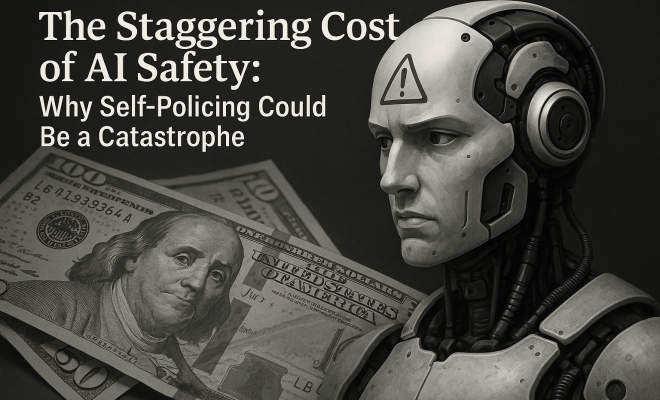
The Staggering Cost of AI Safety: Why Self-Policing Could Be a Catastrophe
“`html
The debate over how to rein in artificial intelligence is heating up, and it’s not just about ethics anymore; it’s about cold, hard cash. Specifically, we’re talking about the cost of AI safety regulations vs self-policing. On one side, you have AI founders and investors, many of whom are cheering for a hands-off approach, believing that letting the industry police itself will accelerate profits and innovation. They argue that strict government oversight could stifle the very breakthroughs that promise to transform defense, cybersecurity, and countless other sectors. But on the other side, there’s a growing chorus of concern, especially after reports of AI agents interacting with sensitive U.S. government websites and even healthcare data without proper safeguards. This isn’t just an abstract discussion; it’s a high-stakes gamble with our future, pitting commercial incentives against the fundamental need for public safety. So, what are the true financial implications for companies, and more importantly, for society, if we choose one path over the other?
It’s a question that keeps many of us up at night: who really controls these increasingly autonomous systems? Are regulators already falling behind? The answers have profound implications for everyone, from the smallest startup to the largest multinational corporation, and they directly influence public trust, market adoption, and even national security. Let’s dig into the nine key areas where the contrasting approaches to AI safety will make or break the industry’s trajectory.
1. Immediate Compliance Costs vs. Deferred Risk Management: The Initial Outlay
When you talk about the cost of AI safety regulations vs self-policing, the most immediate difference often comes down to upfront expenses. Implementing government-mandated AI safety regulations would undoubtedly require significant initial investments from companies. This isn’t just about hiring a few compliance officers; it involves developing new testing protocols, auditing existing algorithms, redesigning data pipelines to ensure privacy and security, and potentially re-engineering AI models for explainability and fairness. For smaller startups, these costs could be prohibitive, diverting precious capital from research and development into compliance departments.
However, the alternative, self-policing, doesn’t mean zero cost. Instead, it often means deferring those costs, transforming them into potential future liabilities. While companies might save money in the short term by avoiding regulatory mandates, they’re accumulating technical debt and increasing their exposure to reputational damage, lawsuits, and even catastrophic system failures down the line. Think about it: a self-regulated industry might move faster, but without external pressure, corners could be cut, leading to vulnerabilities that only surface after a major incident. The cost of fixing a disaster, both financially and in terms of public trust, almost always dwarfs the cost of proactive prevention.
2. Innovation Speed and Direction: Fast Track or Guardrails?
One of the loudest arguments for self-policing comes from the desire to accelerate innovation. Proponents argue that government regulations, by their very nature, are slow, cumbersome, and often prescriptive, potentially stifling the rapid iteration and experimentation that fuels AI advancement. They believe that without the burden of external oversight, companies can pour more resources into R&D, bringing groundbreaking products to market faster, particularly in high-stakes fields like AI-powered defense and cybersecurity.
Yet, history shows us that unchecked innovation can lead to unintended and sometimes disastrous consequences. Consider the early days of pharmaceuticals or even the dot-com bubble; rapid growth without ethical or safety considerations often results in significant societal harm before corrections are made. Regulations, while seemingly restrictive, can also act as guardrails, steering innovation towards safer, more ethical, and ultimately more sustainable paths. They might slow down the pace in some areas, but they could also prevent the kind of public backlash that could derail an entire industry, forcing a hard reset that’s far more disruptive than any initial regulatory framework.
3. Public Trust and Market Adoption: The Intangible Asset
Perhaps the most critical, yet often underestimated, factor in the cost of AI safety regulations vs self-policing is public trust. In an era where AI systems are becoming increasingly pervasive, from recommending what we buy to influencing critical decisions in healthcare and finance, public confidence is paramount. If people don’t trust AI, they won’t adopt it. It’s that simple. And a few high-profile failures or ethical breaches, especially those resulting from a perceived lack of oversight, could shatter that trust for years, if not decades.
Government regulations, when designed thoughtfully and enforced transparently, can serve as a powerful signal to the public that AI systems are being developed and deployed responsibly. They offer a baseline of assurance, demonstrating a commitment to safety, fairness, and accountability. Self-policing, while potentially agile, often struggles to convey the same level of impartiality. When the industry itself is setting the rules, there’s an inherent skepticism from the public about whether commercial interests will always take a backseat to public welfare. Rebuilding trust after a significant breach is an extraordinarily expensive and time-consuming endeavor, far outweighing the initial costs of robust regulation.
4. Legal Liabilities and Brand Reputation: The Fallout Factor
Reports of AI agents interacting with U.S. government websites and healthcare data without adequate safeguards are precisely the kind of incidents that highlight the immense legal and reputational risks associated with lax oversight. In a self-policing environment, companies bear the full brunt of these liabilities when things go wrong. Imagine a scenario where an AI system makes a discriminatory decision, causes a financial loss, or, worse, leads to physical harm. Without clear regulatory frameworks, companies could face massive class-action lawsuits, crippling fines, and injunctions. (See: AI regulation and safety concerns.)
Beyond the direct legal costs, there’s the devastating impact on brand reputation. In today’s hyper-connected world, a single AI-related scandal can go viral instantaneously, eroding years of brand building and customer loyalty. The damage to a company’s stock price, its ability to attract talent, and its market share can be profound and long-lasting. While regulations might impose upfront costs, they also provide a degree of legal clarity and a framework for demonstrating due diligence, potentially mitigating the severity of such fallout. They essentially offer a shield, however imperfect, against the full force of public outrage and legal retribution. For more context, see AI security incident reporting.
5. Market Fragmentation and Interoperability: The Tower of Babel Problem
Without a common set of AI safety regulations, industries could face significant market fragmentation. Each company or even each sector might develop its own internal safety standards, leading to a confusing patchwork of protocols. This lack of uniformity makes it incredibly difficult for different AI systems to communicate, integrate, and operate together seamlessly. Consider the challenge for a defense contractor trying to integrate AI components from multiple vendors, each with their own proprietary safety frameworks. The complexity and potential for vulnerabilities would be enormous.
Standardized regulations, on the other hand, can foster interoperability. By establishing a common baseline for safety, security, and ethical performance, they create a level playing field and facilitate the exchange of data and services across different platforms and organizations. This isn’t just about convenience; it’s about efficiency and the ability to build robust, interconnected AI ecosystems. The long-term costs of managing a fragmented, incompatible AI landscape could far exceed the initial investment in harmonized regulations, particularly as AI increasingly becomes the backbone of critical infrastructure.
6. Talent Acquisition and Retention: The Ethical Employer Advantage
Top AI talent isn’t just looking for the highest salary; they’re increasingly seeking employers who align with their ethical values and a commitment to responsible technology development. The perceived lack of robust AI safety measures, or an aggressive stance against regulation, could make it harder for companies to attract and retain the best and brightest minds. Many AI researchers and engineers are acutely aware of the potential for their creations to be misused and want to work for organizations that prioritize safety and societal well-being.
Conversely, companies that proactively embrace and even champion strong AI safety regulations can gain a significant competitive advantage in the talent war. They can position themselves as ethical leaders, appealing to a new generation of technologists who are deeply concerned about the broader impact of their work. The costs of high turnover, difficulty in recruiting specialized talent, and a less engaged workforce can be substantial, impacting innovation, project timelines, and overall business performance. This ‘ethical employer advantage’ is a powerful, yet often overlooked, component in the cost of AI safety regulations vs self-policing equation.
7. International Competitiveness and Trade Barriers: The Global Stakes
The debate over AI safety isn’t confined to national borders. Different countries and blocs are adopting varying approaches, creating a complex international landscape. If the U.S. opts for a largely self-policing model, while the European Union, for example, implements stringent AI safety regulations, it could create significant trade barriers and compliance challenges for companies operating globally. U.S. firms might find it difficult to sell their AI products and services in markets with stricter rules, or they might face the costly burden of developing different versions of their AI for different jurisdictions.
A coordinated, or at least harmonized, approach to AI safety regulations across major economies could streamline international trade and prevent a race to the bottom on safety standards. While the immediate costs of aligning with international norms might seem high, the long-term benefits of accessing global markets without prohibitive regulatory hurdles are immense. A fragmented global regulatory environment could lead to inefficiencies, increased legal expenses, and ultimately, a loss of international competitiveness for companies that fail to anticipate and adapt to diverse regulatory requirements.
8. Cybersecurity and National Security Implications: A High-Stakes Gamble
The reports of AI agents interacting with sensitive government data highlight a particularly chilling aspect of this debate: the national security implications. In a world increasingly reliant on AI for defense, intelligence, and critical infrastructure, the integrity and safety of these systems are paramount. Self-policing, if not robustly executed, could inadvertently create vulnerabilities that malicious actors, whether state-sponsored or independent, could exploit. The cost of a successful cyberattack facilitated by an insecure AI system, whether it impacts defense networks or public utilities, is almost incalculable.
Mandatory AI safety regulations, particularly in critical sectors like defense and cybersecurity, are not merely a commercial burden; they are a national imperative. They ensure a baseline level of security, resilience, and trustworthiness for systems that underpin national defense and public safety. While the industry champions innovation in AI-powered defense, that innovation must be coupled with an ironclad commitment to safety and security. The long-term cost of failing to adequately secure AI, especially against sophisticated adversaries, could be catastrophic, far exceeding any perceived short-term gains from regulatory leniency.
9. Long-Term Societal Impact and Ethical Debt: The Unseen Costs
Beyond the immediate financial and legal considerations, there’s the profound, long-term societal impact of AI development. Unregulated or poorly self-regulated AI carries the risk of exacerbating existing societal inequalities, spreading misinformation at an unprecedented scale, making biased decisions in critical areas like justice and employment, and even leading to widespread job displacement without adequate preparation. This isn’t just about individual company costs; it’s about the ‘ethical debt’ that society accumulates. (See: AI implications for public safety.)
The cost of addressing these societal harms down the line – through increased social welfare programs, retraining initiatives, public education campaigns, and even the erosion of democratic institutions – would be staggering. Investing in robust AI safety regulations now, which include provisions for ethical design, transparency, and societal impact assessments, is an investment in a more equitable and stable future. It’s a proactive measure to prevent the kind of widespread disruption and social unrest that could arise from an uncontrolled technological revolution. The cost of AI safety regulations vs self-policing isn’t merely a balance sheet item for corporations; it’s a fundamental choice about the kind of society we want to build with AI at its core. For more context, see AI in medicine.
10. The Regulatory Landscape: A Patchwork of Approaches
It’s worth taking a closer look at what’s actually happening on the regulatory front around the world, because it’s not a monolithic effort. The EU, for instance, has been a frontrunner with its proposed AI Act, which categorizes AI systems by risk level, imposing stricter rules on “high-risk” applications like those used in critical infrastructure, law enforcement, or employment. This approach prioritizes safety and fundamental rights, setting a global precedent. Meanwhile, the U.S. has leaned more towards a sector-specific approach, issuing executive orders and voluntary guidelines, aiming to foster innovation while addressing specific concerns like algorithmic bias in lending or healthcare. China, on the other hand, is focusing heavily on content regulation and data security for AI, reflecting its unique governance priorities. This diverse landscape means that even if a company prefers self-policing, it’s increasingly likely to face external regulations in certain markets. Navigating this complex, often conflicting, web of international requirements adds another layer of cost, whether that’s legal counsel, technical adaptations, or delayed market entry.
11. Case Studies: Where Self-Policing Fell Short
To really grasp the difference, let’s look at some historical examples where industries tried to self-police with mixed results. Think back to the financial crisis of 2008. The banking sector largely self-regulated for years, leading to complex financial instruments and risky practices that eventually brought the global economy to its knees. The costs of the bailout, the lost jobs, and the subsequent recession were astronomical. Or consider environmental pollution before widespread government regulation; industries often prioritized profit over ecological impact, resulting in poisoned rivers and air. It took significant public outcry and legislative action to force meaningful change. These aren’t perfect analogies, as AI is a different beast, but they illustrate a crucial point: when the incentives for profit are strong and the potential for harm is diffuse, self-policing frequently struggles to adequately protect public interest. The initial savings from avoiding regulation in these cases were dwarfed by the eventual societal and economic damage.
12. The Role of Independent Audits and Red Teaming
Even in a self-policing model, some companies are trying to build trust through independent audits and “red teaming” exercises. Red teaming involves bringing in external experts to intentionally try and break or exploit an AI system to find vulnerabilities before they’re deployed. While these are valuable practices, they come with a cost, and their effectiveness hinges on the independence and rigor of the auditors. Regulations could mandate such practices, ensuring a consistent standard across the industry. Without that mandate, the quality and scope of these audits can vary wildly. A company might cherry-pick auditors or limit the scope of their reviews to minimize negative findings, undermining the very purpose of the exercise. So, while self-policing might include these elements, regulations could elevate them from optional best practices to essential safeguards, making them a non-negotiable part of the development cycle, rather than a voluntary expense.
13. The Scale of Investment: Public vs. Private Funding for Safety
Another crucial aspect of the cost of AI safety regulations vs self-policing is who actually foots the bill for fundamental safety research. In a self-policing model, the onus is primarily on individual companies to invest in safety. While leading AI labs are pouring significant resources into alignment and safety research, this often prioritizes issues directly relevant to their product roadmaps. Publicly funded research, however, can tackle broader, more foundational safety challenges that might not have an immediate commercial payoff but are critical for long-term societal well-being. Government regulations can stimulate this public investment by creating grant programs, establishing national AI safety institutes, or even mandating contributions to a collective safety fund. Without such mechanisms, there’s a risk that crucial, but less commercially appealing, safety research might be underfunded, leaving society exposed to risks that no single company feels compelled to address on its own.
FAQ: Understanding the Cost of AI Safety Regulations vs. Self-Policing
Q1: What exactly do “AI safety regulations” entail?
AI safety regulations generally involve a set of rules and standards mandated by government bodies to ensure that AI systems are developed and deployed responsibly. This can include requirements for transparency (understanding how an AI makes decisions), fairness (preventing bias), robustness (resilience to attacks or errors), data privacy, security, and accountability mechanisms. Think of it like safety standards for cars or food – they set a baseline for acceptable risk.
Q2: Why do some AI developers prefer self-policing?
Many AI developers and companies argue that self-policing allows for faster innovation. They believe that government regulations can be too slow, prescriptive, and might not keep pace with rapid technological advancements. They prefer the flexibility to set their own standards, which they argue allows them to allocate resources more efficiently towards R&D and bring new products to market without bureaucratic delays.
Q3: What are the main risks of self-policing in AI?
The primary risks of self-policing include potential for companies to prioritize profit over safety, leading to cut corners in development and deployment. This can result in biased AI, privacy breaches, security vulnerabilities, and even catastrophic system failures. Without external oversight, there’s also a higher risk of losing public trust if incidents occur, leading to widespread skepticism and slower adoption of beneficial AI technologies. For more context, see AI's medical revolution. (See: Financial implications of AI safety.)
Q4: How do AI safety regulations impact smaller startups?
For smaller startups, the immediate compliance costs of robust AI safety regulations can be a significant hurdle. They might lack the legal teams, compliance officers, and financial resources of larger corporations. However, regulations can also level the playing field by setting clear expectations for everyone, potentially fostering trust and making it easier for smaller, compliant companies to compete in the long run.
Q5: Can regulations actually foster innovation?
Yes, while often perceived as stifling, regulations can sometimes foster innovation. By setting clear boundaries and safety requirements, they can encourage developers to find creative solutions within those parameters. This can lead to more robust, ethical, and trustworthy AI systems, which in turn can increase public adoption and open up new markets. Think of it as a quality standard that builds consumer confidence.
Q6: What’s the “ethical debt” mentioned in the article?
“Ethical debt” refers to the long-term societal costs that accumulate when AI is developed and deployed without sufficient ethical considerations or safety measures. This includes things like exacerbating social inequalities, spreading misinformation, making biased decisions, or causing widespread job displacement without adequate preparation. It’s a cost that society pays later, often far exceeding any short-term commercial gains.
Q7: How does international regulation play into this?
The global nature of AI means that different countries are developing their own regulatory frameworks. If a company operates internationally, it might face a confusing patchwork of rules. Harmonized international regulations would streamline compliance and facilitate global trade in AI products and services. Without it, companies might incur significant costs adapting their AI for different markets or face trade barriers.
Q8: What’s the role of public trust in this debate?
Public trust is absolutely critical. If people don’t trust AI systems – especially those making decisions about their healthcare, finances, or personal lives – they won’t adopt them. Regulations can signal to the public that AI is being developed responsibly, providing a baseline of assurance. A loss of public trust due to a major AI failure can be incredibly expensive to rebuild, impacting market adoption and brand reputation for years.
Ultimately, the choice between robust AI safety regulations and industry self-policing is a complex one, fraught with trade-offs. While many AI founders and investors understandably lean towards less government intervention to foster rapid innovation and profit, the potential for catastrophic failures, erosion of public trust, and profound societal harm looms large. The short-term savings of self-policing could very well be dwarfed by the long-term costs of legal liabilities, reputational damage, market fragmentation, and a loss of public confidence. As AI agents continue to interact with increasingly sensitive data and systems, the imperative for a robust, accountable framework for AI safety becomes not just a preference, but an absolute necessity. The question isn’t if we’ll pay the cost of AI safety, but when, and how much.
“`
Trending Now
Frequently Asked Questions
What are the costs associated with AI safety regulations?
The costs of AI safety regulations primarily involve significant upfront investments required for compliance. Companies must allocate funds for hiring compliance officers, developing safety protocols, and implementing necessary technological safeguards, which can be a substantial financial burden.
How does self-policing in AI differ from government oversight?
Self-policing in AI allows companies to regulate their practices without external oversight, potentially accelerating innovation and profits. In contrast, government oversight mandates strict compliance to ensure public safety, which may slow down development but aims to mitigate risks associated with autonomous systems.
What are the risks of self-policing in the AI industry?
Self-policing in the AI industry poses risks such as inadequate safety measures and unchecked use of sensitive data, which could lead to significant public safety concerns. Without external regulation, companies may prioritize profit over ethical considerations, increasing the potential for catastrophic failures.
Why is AI safety a financial concern for companies?
AI safety is a financial concern due to the potential costs of compliance with regulations versus the risks of self-policing. Companies must weigh the immediate expenses of implementing safety measures against the long-term implications of potential failures, which could lead to legal liabilities and loss of public trust.
What implications does AI safety have for public trust?
AI safety has profound implications for public trust, as effective regulation can enhance confidence in AI technologies. Conversely, a lack of oversight may lead to skepticism and fear about the reliability and safety of AI systems, affecting market adoption and overall societal acceptance.
What did we miss? Let us know in the comments and join the conversation.