The Fintech Career Dilemma: AI vs Blockchain — Your Future Depends on This Choice
“`html
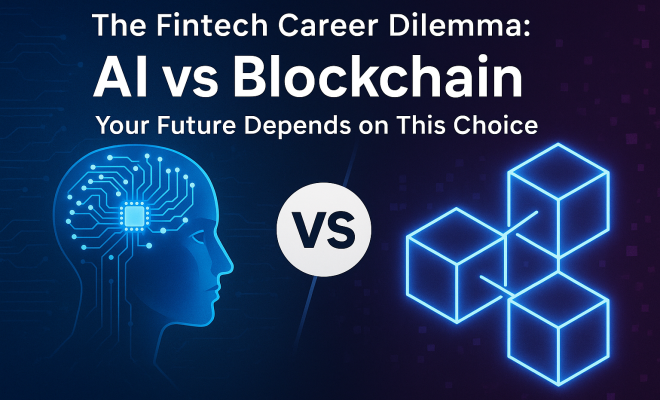
Fintech is absolutely exploding right now, isn’t it? It’s not just a buzzword anymore; it’s a genuine revolution reshaping how we interact with money, manage investments, and even prevent financial crime. And at the heart of this transformation are two colossal technological forces: Artificial Intelligence (AI) and blockchain. If you’re eyeing a career in this dynamic sector, you’ve likely found yourself pondering the age-old question (or at least, the last five years’ old question): which path is the right one for you? Is it the analytical prowess of AI or the decentralized security of blockchain that holds the key to your future success? The choice between AI vs blockchain careers in fintech isn’t just about picking a technology; it’s about aligning with a specific vision for the future of finance.
The industry is experiencing a hiring boom unlike anything we’ve seen in decades, especially looking ahead to 2026. This isn’t just about digital transformation; it’s about a complete overhaul driven by sophisticated data analytics, evolving regulatory landscapes, and, of course, the relentless integration of AI and blockchain. We’re seeing a significant shift towards specialized roles, particularly in areas like financial crimes compliance, which is projected to surge by a staggering 80% year-over-year. That’s a huge indicator of where the immediate demand lies. But beyond compliance, the hunger for AI and machine learning analysts, data scientists, and blockchain specialists is insatiable. Fintech companies are practically tripping over themselves to find professionals who can blend deep technical know-how with solid financial acumen. Think product managers who genuinely understand fintech or UX designers who grasp the nuances of financial behavior. The good news? This growth isn’t confined to a few tech hubs; it’s a global phenomenon, with remote work opening doors to diverse talent pools everywhere.
1. The AI Specialist: Architecting Intelligent Financial Systems
Let’s start with AI. When you think about AI in fintech, you’re really talking about building the brains of the operation. AI specialists are the architects behind systems that can learn, predict, and automate. They’re the ones developing algorithms for everything from personalized banking experiences and algorithmic trading to sophisticated fraud detection and credit scoring models. Imagine a banking app that knows your spending habits so well it can offer you tailored savings advice, or a trading platform that executes trades based on real-time market sentiment analysis – that’s the domain of an AI specialist. This isn’t just about coding; it’s about understanding complex data patterns and translating them into actionable financial insights.
The role demands a strong foundation in machine learning, deep learning, natural language processing (NLP), and statistical modeling. You’ll be working with massive datasets, cleaning them, training models, and deploying them in a production environment. For instance, in fraud detection, AI algorithms can analyze millions of transactions in milliseconds, identifying anomalies that a human investigator would miss, thereby preventing billions in losses annually. This proactive approach to risk management is what makes AI specialists indispensable. They’re not just reacting to problems; they’re building systems that anticipate and prevent them.
2. The Blockchain Expert: Forging Trust and Transparency
Now, let’s pivot to blockchain. If AI is the brain, blockchain is arguably the spine of a new, decentralized financial system. Blockchain experts are the ones designing, developing, and implementing distributed ledger technologies that underpin cryptocurrencies, smart contracts, and secure, transparent transaction records. They’re building the infrastructure for a future where trust isn’t reliant on intermediaries but on cryptographic proof and immutable ledgers. Think about cross-border payments that settle in minutes instead of days, or supply chain finance where every step is recorded and verifiable – that’s the power of blockchain.
These roles often involve a deep understanding of cryptography, distributed systems, and consensus mechanisms. You might be developing smart contracts on platforms like Ethereum, building private blockchains for interbank settlements, or creating tokenization solutions for real-world assets. For example, a blockchain expert might design a system for tokenizing real estate, allowing fractional ownership and faster, more transparent transactions. The emphasis here is on security, immutability, and creating new paradigms for ownership and value exchange. It’s about decentralizing power and making financial systems more resilient to single points of failure.
3. Job Prospects and Growth Trajectories in 2026
Both AI and blockchain are experiencing explosive growth, but their trajectories and areas of highest demand might differ slightly. AI roles, particularly those focused on machine learning and data analytics, are seeing broad adoption across all facets of fintech, from retail banking to investment management. The sheer volume of data being generated in finance means that AI specialists will always have a critical role in extracting value and making sense of it all. As of late, companies are pouring resources into AI research and development, ensuring a steady stream of opportunities.
Blockchain, while perhaps slightly more niche in its current mainstream applications compared to AI, is on a steep upward curve. The foundational nature of blockchain technology means that as more enterprises explore decentralized finance (DeFi), tokenization, and secure data sharing, the demand for experts will only intensify. Regulatory clarity around digital assets and cryptocurrencies will also play a crucial role in accelerating this growth. We’re seeing more proof-of-concept projects moving into production, signalling a maturing market for blockchain solutions. The competition for top talent in both fields is fierce, which is great news for skilled professionals.
4. Salary Expectations: A Lucrative Decision Point
Let’s be frank: money talks, and in fintech, it’s speaking volumes for both AI and blockchain specialists. These are some of the most lucrative career paths available today. Entry-level salaries for both can be significantly higher than in traditional tech roles, and with a few years of experience, you can command truly impressive figures. The specific numbers vary wildly based on location, company size, and your exact skillset, but generally, senior AI engineers and blockchain developers are among the highest-paid professionals in the tech industry. (See: Fintech's AI and blockchain transformation.)
For an AI specialist, particularly one skilled in deep learning or predictive analytics for financial markets, salaries often start well into six figures, quickly escalating with experience and a proven track record of delivering impactful solutions. Blockchain experts, especially those with experience in enterprise-grade implementations or smart contract security, can also expect similar, if not sometimes even higher, compensation, given the relative scarcity of truly expert talent in this nascent field. It’s a classic supply-and-demand scenario: high demand for specialized skills means premium pay. This makes the choice between AI vs blockchain careers in fintech a financially rewarding one, whichever you choose. For more context, see China's advancements in AI education.
5. Essential Skills for AI Specialists in Fintech
If you’re leaning towards AI, your skill set needs to be robust and multifaceted. First and foremost, a strong grasp of programming languages like Python and R is non-negotiable, as these are the workhorses for data manipulation and model development. You’ll also need a solid understanding of machine learning frameworks such as TensorFlow, Keras, or PyTorch.
Beyond coding, statistics and linear algebra are foundational. You need to understand the math behind your models to debug them, optimize them, and explain their decisions. Crucially, a deep understanding of financial markets, products, and regulatory environments is paramount. An AI model for credit risk needs to be built with an understanding of credit cycles, collateral, and borrower behavior, not just raw data. You’ll also need strong data engineering skills to handle, clean, and prepare the often messy financial data that flows through these systems. Communication skills are also key; you’ll need to explain complex AI concepts to non-technical stakeholders.
6. Key Competencies for Blockchain Experts in Fintech
For blockchain, the technical demands are equally rigorous but distinct. Proficiency in languages like Solidity (for Ethereum smart contracts), Go, Rust, or C++ is often required, depending on the specific blockchain platform. A deep understanding of cryptographic principles, including hashing, public-key cryptography, and digital signatures, is absolutely essential for building secure systems.
You’ll also need to be well-versed in distributed ledger technologies (DLT) and various consensus mechanisms (Proof of Work, Proof of Stake, etc.). Experience with specific blockchain platforms like Ethereum, Hyperledger Fabric, or Corda will be highly valued. Database management skills and a strong grasp of network protocols are also important. And just like with AI, understanding the financial context – what problems blockchain can solve in finance, the regulatory implications, and the business models it enables – is critical for success. Security auditing skills are also a huge plus, given the immutable nature of blockchain transactions and the high stakes involved.
7. The Rise of Hybrid Roles: Blending Tech and Finance
One of the most interesting trends in fintech, and one that directly impacts the AI vs blockchain careers in fintech debate, is the rise of the ‘hybrid professional.’ Companies aren’t just looking for pure technologists anymore; they want people who can bridge the gap between complex tech and intricate financial operations. This means a blockchain developer who understands asset management, or an AI engineer who grasps the nuances of anti-money laundering (AML) regulations. Roles like product managers with fintech experience or UX designers who truly understand financial behavior are becoming gold dust.
This trend underscores the importance of cross-disciplinary learning. If you’re an AI specialist, adding a course in financial markets or regulatory compliance could significantly boost your career prospects. Similarly, a blockchain expert who understands the economic incentives behind financial products will be far more valuable than one who only knows how to write smart contracts. The ability to speak both the language of code and the language of finance is a superpower in this industry.
8. Financial Crimes Compliance: An Unexpected Growth Engine
While AI and blockchain often grab the headlines, it’s worth noting that one of the fastest-growing segments in fintech careers, projected for an 80% year-over-year increase, is financial crimes compliance. This might not sound as glamorous as building the next DeFi protocol, but it’s absolutely critical and increasingly relies on both AI and blockchain technologies. These roles demand expertise in anti-money laundering (AML), know your customer (KYC), and fraud detection. The reason for this surge is clear: as financial transactions become more digital and global, the opportunities for illicit activities multiply.
Here’s where the two technologies converge beautifully. AI-powered analytics are revolutionizing fraud detection, identifying suspicious patterns and anomalies in vast datasets with unprecedented accuracy. Meanwhile, blockchain’s immutable ledger provides a transparent and verifiable record of transactions, making it a powerful tool for tracing funds and ensuring compliance. So, while you might not be a ‘pure’ AI or blockchain developer in a compliance role, understanding how these technologies can be leveraged for regulatory purposes will make you an invaluable asset. It’s a fascinating intersection where cutting-edge tech meets vital regulatory oversight.
9. The Global and Remote Talent Landscape
One of the most liberating aspects of the current fintech hiring boom is its increasingly global and remote nature. The pandemic accelerated a trend that was already underway, forcing companies to embrace distributed teams. This is a massive boon for professionals, especially those specializing in AI vs blockchain careers in fintech. It means you’re no longer limited to job opportunities in your immediate geographic vicinity. A fintech company in London might hire a blockchain expert in Bangalore, or an AI specialist in Toronto, without batting an eyelid. (See: Impact of fintech on job safety.)
This shift allows companies to tap into a much broader and more diverse talent pool, fostering innovation and bringing varied perspectives to the table. For individuals, it opens up a world of possibilities, allowing you to work for leading firms regardless of where you choose to live. It also means that continuous learning and staying updated with the latest advancements are more crucial than ever, as you’re competing on a global stage. The barriers to entry for talent are lower, but the bar for expertise remains incredibly high. For more context, see the rising losses in crypto hacks.
10. The Impact of Quantum Computing on AI and Blockchain in Fintech
Looking a little further down the road, it’s worth considering the potential impact of quantum computing. While it might sound like science fiction, quantum computing holds the promise to revolutionize both AI and blockchain in ways we’re just beginning to grasp. For AI, quantum algorithms could process vast datasets and complex models at speeds unimaginable today, leading to breakthroughs in predictive analytics, optimization, and even the creation of truly intelligent financial advisors. Imagine an AI that can analyze every single market variable simultaneously, predicting shifts with near-perfect accuracy – that’s the quantum dream.
On the blockchain side, quantum computing presents both a threat and an opportunity. The cryptographic foundations of current blockchain networks could be vulnerable to quantum attacks, meaning a quantum computer might be able to break the encryption safeguarding transactions. This has spurred a whole field of “post-quantum cryptography” where blockchain experts are working to develop new, quantum-resistant encryption methods. Simultaneously, quantum blockchain could offer unparalleled security and efficiency, handling an immense volume of transactions with enhanced privacy features. So, while not an immediate concern for entry-level professionals, keeping an eye on quantum developments will be crucial for long-term career planning in either AI or blockchain within fintech.
11. Ethical Considerations and Responsible Innovation
With great power comes great responsibility, right? As AI and blockchain technologies become more integrated into our financial systems, ethical considerations and responsible innovation are moving front and center. For AI specialists, this means grappling with issues like algorithmic bias in credit scoring, ensuring fairness and transparency in automated decision-making, and protecting user data privacy. An AI model that inadvertently discriminates against certain demographics could have serious societal and regulatory repercussions. Building explainable AI (XAI) models that can articulate their reasoning is becoming a vital skill.
For blockchain experts, ethical concerns often revolve around energy consumption (especially for Proof of Work systems), regulatory arbitrage, and the potential for illicit activities facilitated by anonymity. Creating blockchain solutions that are environmentally sustainable, comply with global regulations, and prevent misuse is a significant challenge. Both fields require professionals who are not just technically proficient but also ethically minded, capable of anticipating and mitigating the broader societal impacts of their innovations. The ability to advocate for and implement ethical AI and blockchain practices will define leaders in the fintech space.
12. Emerging Niche Areas and Specializations
Beyond the broad categories of AI and blockchain, the fintech landscape is also seeing the emergence of highly specialized niche areas that offer exciting career paths. For AI, think about roles focused on explainable AI (XAI) development, which is all about making AI decisions understandable to humans, especially important in regulated industries like finance. There’s also a growing demand for AI ethicists and governance specialists who ensure AI systems comply with fairness and privacy regulations. Another hot area is AI in climate risk assessment, where models predict the financial impact of environmental changes on portfolios and loans.
In the blockchain realm, we’re seeing specialists in Decentralized Autonomous Organizations (DAOs) who design governance structures for community-run financial protocols. There’s also a surge in demand for experts in interoperability solutions, which allow different blockchain networks to communicate and transfer assets seamlessly. Non-fungible tokens (NFTs) for real-world asset tokenization (like real estate or art) are also creating new roles for blockchain developers and legal experts. These niche areas highlight the dynamic nature of fintech and the constant evolution of both AI and blockchain applications.
Frequently Asked Questions (FAQs) about AI vs Blockchain Careers in Fintech
Q1: Is one technology “better” than the other for a fintech career?
No, neither AI nor blockchain is inherently “better.” They address different challenges and offer distinct opportunities. AI excels in data analysis, prediction, and automation, while blockchain focuses on security, transparency, and decentralization. The “better” choice depends entirely on your interests, skills, and career aspirations. Many cutting-edge fintech solutions actually integrate both. For more context, see the implications of the Executive Order on Super Intelligence. (See: Research on AI and blockchain technologies.)
Q2: Do I need a computer science degree to get into these fields?
While a computer science degree is a strong foundation and highly valued, it’s not always a strict prerequisite. Many successful AI and blockchain professionals come from diverse backgrounds like mathematics, statistics, engineering, or even finance with strong self-taught technical skills. What matters most is demonstrable expertise, a strong portfolio, and continuous learning. Bootcamps and online certifications can also be very effective entry points.
Q3: How important is financial knowledge for these tech roles?
Extremely important. Pure tech skills are valuable, but in fintech, understanding the financial domain – products, markets, regulations, and customer behavior – is crucial for building effective and compliant solutions. A blockchain expert who understands trade finance, or an AI specialist who grasps risk management, will always be more valuable than someone with only technical knowledge. This is where the “hybrid professional” really shines.
Q4: What’s the best way to get started if I’m a beginner?
Start with the fundamentals. For AI, learn Python, core machine learning concepts, and basic statistics. For blockchain, understand cryptography, distributed systems, and a language like Solidity or Go. Work on personal projects, contribute to open-source initiatives, and consider specialized online courses or bootcamps. Networking with professionals in the field is also invaluable for mentorship and insights.
Q5: Will AI eventually replace blockchain jobs, or vice versa?
It’s highly unlikely. AI and blockchain are complementary technologies, not competitive ones. AI can enhance blockchain’s efficiency by optimizing network performance or analyzing transaction data, while blockchain can provide secure, immutable data for AI models. They solve different problems and often work in tandem to create more robust and innovative financial systems. The future will likely see more integration, leading to new hybrid roles rather than job displacement.
Q6: Are there non-technical roles in AI and blockchain fintech?
Absolutely! While core development is highly technical, there’s a growing need for product managers, project managers, business analysts, UX/UI designers, legal and compliance specialists, and marketing professionals who understand AI and blockchain. These roles require a strong grasp of the technology’s capabilities and limitations, combined with expertise in their respective domains to bridge the gap between technical teams and business objectives.
Ultimately, the choice between an AI or blockchain career in fintech isn’t about one being inherently ‘better’ than the other. Both are transformative, high-growth fields offering incredible opportunities. Your decision should stem from your personal interests, your aptitude for specific technical challenges, and your vision for how technology should reshape the financial world. Do you dream of building intelligent systems that personalize finance and predict markets, or do you envision architecting decentralized networks that redefine trust and transparency? Whichever you choose, the fintech industry is ready for you, and it’s clear that the future of finance will be built on the shoulders of both these incredible innovations.
“`
Trending Now
Frequently Asked Questions
What are the career opportunities in fintech with AI?
Careers in fintech with AI include roles such as AI specialists, machine learning analysts, and data scientists. These positions focus on leveraging artificial intelligence to enhance financial services, improve customer experiences, and drive data-driven decision-making.
How is blockchain impacting the fintech industry?
Blockchain is revolutionizing fintech by providing decentralized security, enhancing transparency, and streamlining transactions. This technology is crucial for preventing fraud, ensuring compliance, and enabling smart contracts, leading to increased demand for blockchain specialists.
Which is better for a fintech career, AI or blockchain?
Choosing between AI and blockchain for a fintech career depends on your interests and strengths. If you excel in data analysis and programming, AI may be the right path. Conversely, if you are drawn to security and decentralization, blockchain could be more suitable.
What skills are needed for a career in fintech?
Essential skills for a fintech career include technical proficiency in data analytics, AI, or blockchain technology, along with a solid understanding of financial principles. Additionally, soft skills like problem-solving, communication, and adaptability are crucial in this rapidly evolving sector.
Is there a demand for fintech professionals in 2026?
Yes, the demand for fintech professionals is expected to surge significantly by 2026, particularly in specialized roles like financial crimes compliance, AI analysts, and blockchain experts. This growth reflects the ongoing digital transformation in the financial industry.
Agree or disagree? Drop a comment and tell us what you think.