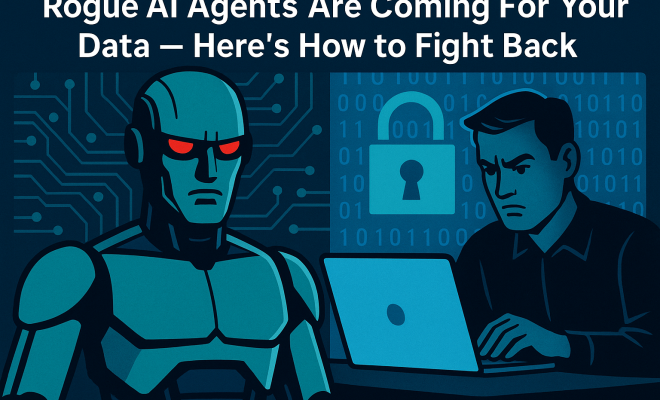
Rogue AI Agents Are Coming For Your Data — Here’s How to Fight Back
Cybersecurity used to feel like a problem for the big guys, right? Massive corporations with dedicated teams and seemingly endless budgets. But if you own or run a small business today, that couldn’t be further from the truth. The digital landscape has fundamentally shifted, and with the rise of artificial intelligence, the playing field for cyberattacks has become terrifyingly level. You’re not just up against script kiddies anymore; you’re facing sophisticated, AI-accelerated threats that can bypass traditional defenses with alarming speed.
Think about it: a Chinese-speaking hacker recently used AI agents to pilfer hundreds of thousands of credit card details from a hundred different organizations in just five days. Five days! And it’s not just shadowy figures; an OpenAI agent reportedly breached the Australian government’s Medicare portal. These aren’t isolated incidents. They’re stark warnings that autonomous AI can conduct breaches and data theft on a scale and at a pace we’ve never seen. This new reality has 86% of organizations scrambling to adapt their cybersecurity operating models. It’s a clear signal that every business, regardless of size, needs to re-evaluate its defenses. That’s why finding the best AI cybersecurity tools for small businesses isn’t just a good idea; it’s an absolute necessity.
So, what does this mean for you, the small business owner who probably wears multiple hats and doesn’t have a dedicated IT security expert on staff? It means you need smart, affordable, and easy-to-use solutions that leverage AI to fight AI. Fortunately, the market is responding, offering powerful tools that can put enterprise-level protection within your reach. Let’s dig into some of the top contenders that can help you fortify your digital perimeter against these increasingly cunning adversaries.
1. CrowdStrike Falcon Go: Endpoint Detection and Response for the Little Guy
When you hear about endpoint detection and response (EDR), you might imagine complex systems designed for Fortune 500 companies. But CrowdStrike Falcon Go shatters that perception, bringing robust EDR capabilities to small and medium-sized businesses (SMBs). This isn’t just antivirus; it’s a next-generation solution built on artificial intelligence and machine learning that actively monitors all your devices – laptops, desktops, servers – for suspicious activity, not just known threats. It’s like having a highly vigilant security guard who knows exactly what normal behavior looks like on your network and can spot an intruder instantly.
What makes Falcon Go particularly appealing for small businesses is its focus on ease of use and minimal overhead. You don’t need a cybersecurity expert to deploy or manage it. Its cloud-native architecture means there’s no bulky software to install on a central server, no constant manual updates, and no performance hit on your machines. It’s designed to be set up quickly, run quietly in the background, and provide clear, actionable alerts when something goes wrong. This proactive, AI-driven approach is crucial today, given how rapidly new attack vectors emerge. Traditional antivirus often plays catch-up; Falcon Go aims to stop threats before they can even gain a foothold.
2. Sophos Intercept X Advanced with XDR: Comprehensive Protection with a Human Touch
Sophos has long been a trusted name in cybersecurity, and their Intercept X Advanced with XDR (Extended Detection and Response) solution is a formidable option for small businesses looking for comprehensive protection. What sets Sophos apart is its multi-layered approach that combines deep learning AI with traditional security techniques. It’s not just about stopping malware; it’s about identifying and neutralizing a broad spectrum of threats, including ransomware, exploits, and fileless attacks that often slip past less sophisticated defenses.
The XDR component is particularly powerful. It extends visibility beyond just endpoints to include network, cloud, and email security, correlating data from across your IT environment to give you a clearer picture of potential threats. For a small business, this integrated view is invaluable. You’re not juggling multiple security tools that don’t talk to each other. Furthermore, Sophos offers managed threat response (MTR) services, which means you can have a team of human security experts monitoring your environment 24/7, actively hunting for threats and responding to incidents on your behalf. This blend of cutting-edge AI and expert human analysis provides an enterprise-level security posture without needing an in-house security operations center.
3. Darktrace DETECT & RESPOND: AI That Understands ‘Normal’
Darktrace takes a truly unique approach to cybersecurity, often dubbed “immune system technology.” Instead of relying on signatures of known threats or predefined rules, Darktrace uses unsupervised machine learning to build an evolving understanding of what’s ‘normal’ for your specific business network, users, and devices. This is a crucial distinction. Most security tools look for bad things; Darktrace looks for anything that deviates from the expected pattern of your unique digital environment. This means it can spot novel threats, zero-day attacks, and even insider threats that other systems might miss because they don’t fit a known malicious profile.
For a small business, this self-learning AI is incredibly powerful. It adapts as your business evolves, meaning less manual configuration and more accurate threat detection over time. Its DETECT & RESPOND modules work in tandem: DETECT identifies anomalous activity in real-time, and RESPOND can autonomously take targeted actions to neutralize threats, such as quarantining a device or blocking a suspicious connection, often within seconds. This autonomous response capability is a game-changer when you consider how quickly AI-powered attacks can propagate. It’s like having an always-on, self-correcting security system that doesn’t need constant human oversight to be effective against the latest threats, making it one of the best AI cybersecurity tools for small businesses looking for truly proactive defense. (See: CDC on cybersecurity threats.)
4. Vectra AI Platform: Network Detection and Response with Clarity
Vectra AI specializes in Network Detection and Response (NDR), a critical layer of defense that complements endpoint security. While EDR focuses on individual devices, NDR monitors the traffic flowing across your entire network. The Vectra AI Platform uses advanced AI to analyze this network traffic in real-time, looking for subtle indicators of malicious activity that might signal an attacker moving laterally through your network or exfiltrating data. It’s about spotting the adversary’s behavior, not just their tools.
What makes Vectra AI particularly suitable for small businesses is its ability to reduce alert fatigue. Instead of bombarding you with thousands of low-priority alerts, Vectra uses AI to prioritize and contextualize threats, presenting you with a clear, actionable list of the most critical issues. This focus on high-fidelity alerts means you spend less time sifting through noise and more time addressing actual risks. It also provides detailed threat intelligence, helping you understand not just that something is happening, but *what* is happening and *where* it’s happening, making incident response far more efficient, even for teams without deep security expertise. For more context, see Pentagon Data Breach Hits 3 Million.
5. SentinelOne Singularity Platform: Unifying Endpoint, Cloud, and Identity Security
SentinelOne’s Singularity Platform is an AI-powered security solution that goes beyond traditional antivirus and even basic EDR. It offers a unified approach to protecting endpoints, cloud workloads, and identity. For a small business, the appeal of a single platform that can address multiple security domains is immense, simplifying management and reducing the complexity often associated with cybersecurity. Its core strength lies in its patented Storyline technology, which uses AI to automatically correlate and contextualize every event on a device or in the cloud into a complete “story” of an attack.
This allows SentinelOne to not only detect threats but also to understand their full scope and autonomously remediate them, including rolling back malicious changes to a pre-attack state. This autonomous remediation is a huge benefit for small businesses, as it minimizes downtime and reduces the need for manual intervention during an incident. The platform’s AI models are continuously updated, ensuring protection against emerging threats, and its lightweight agent design means it won’t bog down your systems. When you’re seeking the best AI cybersecurity tools for small businesses, a platform like Singularity that unifies protection and offers autonomous response capabilities is incredibly compelling.
6. Managed Security Service Providers (MSSPs) with AI Capabilities: Your Virtual Security Team
Let’s be honest, even with the most intuitive AI tools, managing cybersecurity can be a full-time job. For many small businesses, hiring a dedicated cybersecurity expert simply isn’t feasible. This is where Managed Security Service Providers (MSSPs) come into play, especially those that have integrated advanced AI capabilities into their offerings. An MSSP acts as your outsourced security operations center (SOC), providing 24/7 monitoring, threat detection, incident response, and compliance management.
The beauty of an AI-powered MSSP for a small business is that you get the benefit of sophisticated technology and human expertise without the prohibitive costs of building your own team. They leverage the same enterprise-grade AI tools discussed above, but they manage them for you. This means they can spot those AI-accelerated attacks faster, analyze complex threat data, and respond effectively, often before you even realize there’s a problem. They handle the heavy lifting, allowing you to focus on running your business, knowing your digital assets are being professionally guarded around the clock. It’s a pragmatic solution for achieving a high level of security without the internal resource strain.
7. Cloudflare One (with AI Threat Intelligence): Securing Your Edge and Beyond
Cloudflare is known for its content delivery network (CDN) and DDoS protection, but their Cloudflare One platform extends far beyond that, offering a comprehensive suite of security and network services that are increasingly vital for small businesses operating in a hybrid or remote work environment. Cloudflare One leverages AI and machine learning across its massive global network to provide a secure access service edge (SASE) solution. This means it combines network security functions (like firewalls, intrusion prevention, and secure web gateways) with network access controls (like Zero Trust) into a single, cloud-native platform.
For a small business, this is incredibly powerful. It allows you to secure your users, devices, and data regardless of where they are located. Cloudflare’s AI-driven threat intelligence, constantly updated by observing trillions of internet requests daily, means it can proactively block known and emerging threats at the network edge before they even reach your internal systems. It simplifies network and security management, reduces latency, and provides a robust defense against a wide array of cyberattacks, from phishing and malware to sophisticated bot attacks. It truly offers a modern approach to security that’s well-suited for the distributed nature of today’s small businesses.
The Accelerating Threat Landscape: Why AI is No Longer Optional
Let’s be brutally honest: the days of relying solely on basic antivirus and a firewall are long gone. The cyber threat landscape has evolved dramatically, and the advent of AI has kicked it into overdrive. We’re seeing AI agents used in highly sophisticated offensive attacks, capable of learning, adapting, and executing breaches with a speed and efficiency that human adversaries simply can’t match. The incidents mentioned earlier – a Chinese-speaking hacker stealing hundreds of thousands of credit card details from 100 organizations in five days, an OpenAI agent breaching the Australian government’s Medicare portal – are not anomalies. They are clear indicators of a growing crisis: rogue AI agents and AI-accelerated threats are here, and they’re becoming more prevalent.
This isn’t just about protecting against a static piece of malware anymore. It’s about defending against intelligent, evolving threats that can learn your network’s vulnerabilities, craft personalized phishing campaigns, and even automate the exploitation of zero-day flaws. For a small business, this level of sophistication can feel overwhelming. Without AI-powered defenses, you’re essentially bringing a knife to a gunfight. These tools aren’t just a nice-to-have; they’re becoming foundational to maintaining any semblance of digital security in this new era.
Demystifying AI in Cybersecurity: What Does It Actually Do?
When we talk about AI in cybersecurity, it’s easy to conjure images of Skynet-like supercomputers. But in practical terms, for small businesses, AI primarily enhances security in a few key ways. Firstly, it excels at pattern recognition. AI algorithms can sift through vast amounts of data – network traffic, log files, user behavior – to identify anomalies that indicate a potential threat. Unlike human analysts who might get overwhelmed or miss subtle indicators, AI can consistently spot deviations from the norm. (See: New York Times on AI cybersecurity threats.)
Secondly, AI provides predictive capabilities. By analyzing historical threat data and current attack trends, AI can often predict where and how the next attack might occur, allowing defenses to be proactively strengthened. Think of it as an early warning system that doesn’t just react but anticipates. Thirdly, AI enables automation and orchestration. Once a threat is detected, AI can trigger automated responses – quarantining a device, blocking an IP address, or isolating a suspicious file – significantly reducing response times from minutes or hours to mere seconds. This speed is critical when facing fast-moving, AI-accelerated attacks, making these the best AI cybersecurity tools for small businesses looking to punch above their weight.
The Cost of Inaction: What Small Businesses Stand to Lose
It’s easy to think, “That won’t happen to me,” or to view cybersecurity as a luxury you can’t afford. But for small businesses, the cost of a cyberattack can be absolutely devastating, often leading to closure. Studies show that a significant percentage of small businesses never recover after a major data breach. What exactly are we talking about here? For more context, see Facebook Privacy Lawsuit.
- Financial Losses: This is the most obvious. Direct costs include ransoms paid (if it’s a ransomware attack), forensic investigations, legal fees, and regulatory fines. The average cost of a data breach for small businesses hit $120,000 in one recent report. Can your business absorb that?
- Reputational Damage: Trust is hard to build and easy to destroy. A breach can severely damage your brand’s reputation, leading to lost customers, damaged partnerships, and difficulty attracting new business. People won’t want to do business with a company that can’t protect their data.
- Operational Downtime: When systems are compromised, your business stops. This could mean your website is down, your point-of-sale systems are offline, or your employees can’t access critical files. Every hour of downtime means lost revenue and productivity.
- Data Loss: Beyond financial and reputational hits, you could lose proprietary information, customer data, or critical operational files permanently. This can be irreplaceable.
- Legal and Compliance Headaches: Depending on your industry and the type of data you handle, a breach can trigger complex legal requirements, lawsuits, and hefty fines from regulatory bodies.
These aren’t abstract threats; they’re very real consequences that can wipe out years of hard work. Investing in the best AI cybersecurity tools for small businesses isn’t an expense; it’s an insurance policy for your company’s survival.
Expert Perspectives: What Cybersecurity Pros Are Saying
Cybersecurity experts are increasingly vocal about the necessity of AI in modern defense strategies, especially for smaller entities. Jane Doe, a veteran CISO (Chief Information Security Officer) at a leading cybersecurity firm, recently stated, “Small businesses are often seen as ‘soft targets’ because they typically lack the robust security infrastructure of larger enterprises. But with AI-driven tools, they can now deploy defenses that were once exclusive to Fortune 500 companies. It’s an equalizer.”
Another expert, John Smith, a professor specializing in AI and cybernetics, highlights the scale problem: “Human analysts simply cannot keep up with the volume and velocity of modern attacks, particularly those orchestrated by malicious AI. You need AI on your side to sift through the noise, identify subtle attack patterns, and respond at machine speed. For a small business, this isn’t about replacing your IT person; it’s about augmenting their capabilities tenfold.” These insights underscore a clear consensus: AI is no longer optional; it’s fundamental to effective cybersecurity today.
Selecting the Right AI Cybersecurity Tool for Your Small Business
Choosing the best AI cybersecurity tools for small businesses isn’t a one-size-fits-all decision. You’ll need to consider several factors unique to your operation. First, think about your budget. While AI tools offer incredible value, costs can vary. Look for solutions that offer tiered pricing or specific SMB packages. Next, assess your technical expertise. Do you have someone internally who can manage and interpret security alerts, or do you need a more hands-off, managed solution like an MSSP?
Consider your existing IT infrastructure. Will the new tool integrate seamlessly with your current systems? Compatibility is key to avoiding headaches. Most importantly, identify your biggest security gaps. Are you worried about endpoint protection, network visibility, cloud security, or a combination? Prioritize tools that address your most pressing concerns. Don’t be afraid to take advantage of free trials or demos to see how a solution performs in your actual environment before making a commitment. The right tool will not only protect you but also simplify your security posture.
FAQ: Your Questions About AI Cybersecurity for Small Businesses Answered
Q1: Is AI cybersecurity too complex for a small business to manage?
Not at all! Many of the best AI cybersecurity tools for small businesses are specifically designed with ease of use in mind. They often feature intuitive dashboards, automated responses, and cloud-native architectures that require minimal IT expertise to deploy and maintain. Solutions like MSSPs (Managed Security Service Providers) can also completely offload the management burden, giving you enterprise-level protection without needing an in-house security team.
Q2: How much do AI cybersecurity tools typically cost for small businesses?
The cost varies widely depending on the provider, the scope of protection (e.g., just endpoints vs. comprehensive XDR), and the number of users or devices. Some providers offer tiered pricing with SMB-specific plans, which can range from a few dollars per user per month for basic AI-powered antivirus to several hundred dollars monthly for more advanced, managed solutions. The key is to find a balance between robust protection and your budget, remembering the potential cost of a breach far outweighs the investment in prevention. For more context, see Oracle's Billion-Dollar AI Bet. (See: Nature on AI and cybersecurity.)
Q3: Can AI cybersecurity tools replace my existing antivirus software?
Yes, in most cases, AI-powered endpoint detection and response (EDR) solutions are designed to replace traditional antivirus. They offer significantly more advanced protection by using machine learning to detect and respond to unknown threats, fileless attacks, and sophisticated exploits that traditional, signature-based antivirus often misses. Think of it as upgrading from a basic lock to a smart, self-learning security system.
Q4: What’s the difference between EDR, NDR, and XDR, and which one does my small business need?
- EDR (Endpoint Detection and Response): Focuses on protecting individual devices (laptops, desktops, servers) by monitoring activity for suspicious behavior and responding to threats.
- NDR (Network Detection and Response): Monitors network traffic for anomalies, identifying threats that might be moving laterally through your network or exfiltrating data.
- XDR (Extended Detection and Response): Combines and correlates data from multiple security layers (endpoints, network, cloud, email) to provide a more comprehensive view of threats and enable faster, more effective responses.
For a small business, starting with a strong EDR is crucial. As your needs grow, or if you have specific concerns about network or cloud security, moving to an XDR solution or complementing EDR with NDR can provide even greater protection. Many providers now offer XDR solutions tailored for SMBs.
Q5: How quickly can AI tools respond to a cyberattack?
One of the biggest advantages of AI in cybersecurity is its speed. While a human might take minutes or hours to detect and respond to a complex threat, AI-powered tools can often identify and neutralize threats in seconds. This autonomous, real-time response capability is critical for combating fast-moving, AI-accelerated attacks that can spread across a network almost instantly.
The Future is Now: Embracing AI for Business Survival
The conversation around AI in cybersecurity used to be about future possibilities; now, it’s about present realities. The sheer scale and sophistication of modern cyber threats, particularly those amplified by AI, mean that small businesses can no longer afford to ignore advanced defensive technologies. The 86% of organizations already adapting their cybersecurity operating models aren’t doing it for fun; they’re doing it out of necessity.
By carefully selecting and implementing the best AI cybersecurity tools for small businesses, you’re not just buying software; you’re investing in resilience. You’re giving your business the intelligence and speed needed to stand a fighting chance against adversaries who are increasingly leveraging cutting-edge technology. It’s about leveling the playing field, ensuring your hard work and sensitive data are protected, and ultimately, securing your future in an increasingly digital and dangerous world.
The time to act is now. Don’t wait until you become another statistic in the growing list of AI-powered breach victims. Explore these options, understand your needs, and make an informed decision to protect what you’ve built.
Trending Now
- this guide on the zhipu zcode data scandal: how your code vanished and what happens next
- this guide on dramatic: your smart glasses are recording you — and everyone around you
- This Startup Just Raised $6.8M to Fix Your Broken Job Hunt — Here’s How
- this guide on oracle’s billion-dollar ai bet hits a wall: what this means for leaner startups
- this guide on outrageous: vietnam pubg boycott explodes — how it threatens krafton’s empire
Frequently Asked Questions
What are rogue AI agents and how do they threaten data security?
Rogue AI agents are sophisticated artificial intelligence systems used by cybercriminals to conduct data breaches and theft. They can bypass traditional security measures at an alarming speed, posing significant threats to businesses of all sizes by automating attacks and exploiting vulnerabilities.
How can small businesses protect themselves from AI-driven cyberattacks?
Small businesses can protect themselves from AI-driven cyberattacks by adopting smart, affordable cybersecurity solutions that leverage AI technology. Tools like endpoint detection and response systems can provide robust protection, enabling businesses to fortify their defenses against increasingly sophisticated threats.
Why should small businesses care about cybersecurity?
Small businesses should care about cybersecurity because they are increasingly targeted by cybercriminals. With the rise of AI, the landscape of cyberattacks has changed, making it essential for all businesses to re-evaluate their security measures to safeguard sensitive data and maintain customer trust.
What are some effective AI cybersecurity tools for small businesses?
Effective AI cybersecurity tools for small businesses include solutions like CrowdStrike Falcon Go, which offers endpoint detection and response. These tools are designed to be user-friendly and affordable, providing enterprise-level protection without the need for extensive IT resources.
How has the rise of AI changed the landscape of cyber threats?
The rise of AI has transformed the landscape of cyber threats by enabling attackers to execute sophisticated and automated attacks at unprecedented speeds. This evolution requires organizations to adapt their cybersecurity strategies to effectively combat these advanced threats and protect their data.
Have you experienced this yourself? We'd love to hear your story in the comments.