Why Your Degree Might Be Obsolete: The Quiet Rise of AI Certifications
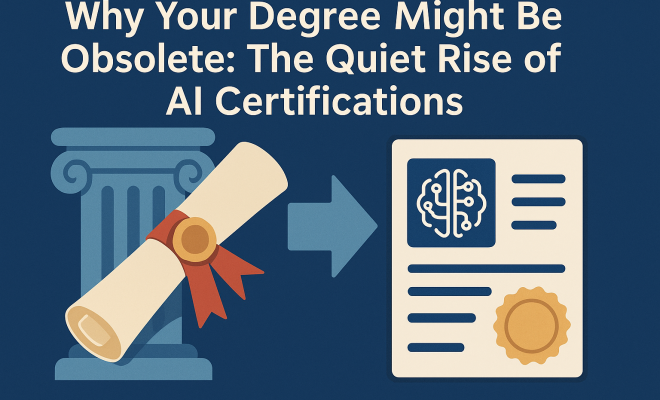
We’ve all heard the old adage: get a good degree, land a good job. For generations, that was the undisputed path to professional success. But something profound is happening in the job market, a quiet revolution that’s challenging the very foundation of that belief. The demand for specialized Artificial Intelligence skills isn’t just growing; it’s exploding, reshaping industries and creating an entirely new hierarchy of valuable expertise. What if I told you that a four-year university degree might soon be less impactful than a targeted AI certification for landing those coveted, high-paying roles?
It sounds almost unbelievable, doesn’t it? Yet, the data tells a compelling story. According to PwC’s 2025 Global AI Jobs Barometer, workers possessing AI skills are now commanding a staggering 56% wage premium. And here’s the kicker: that figure doubled in just twelve months. Think about that for a moment. In an economy where inflation gnaws at our purchasing power, a specific skill set is doubling its market value year over year. This isn’t a trend; it’s a seismic shift, making AI certifications not just attractive, but potentially essential for anyone looking to future-proof their career or make a significant leap in income.
This article will explore the top AI certifications that are leading this charge, offering practical, job-ready skills that companies like Google, AWS, Microsoft, and IBM are actively seeking. We’ll look at how these certifications stack up against traditional education, why they’re gaining such rapid traction, and which ones are poised to offer the most significant career growth in 2026 and beyond. If you’re wondering how to navigate this rapidly evolving landscape, or if you’re feeling the pressure to reskill, you’ve come to the right place. Let’s dive into the future of professional development.
1. Google Cloud Professional Machine Learning Engineer Certification: The Search Giant’s Seal of Approval
When Google puts its name on something, the world pays attention. Their Professional Machine Learning Engineer Certification is no exception. This isn’t just a badge; it’s a rigorous validation of your ability to design, build, and productionize machine learning models on Google Cloud Platform. It covers everything from data preprocessing and model training to deployment and continuous monitoring, all within Google’s robust ecosystem. Given Google’s dominance in AI research and infrastructure, this certification carries significant weight, signaling to employers that you can handle real-world ML challenges at scale.
What makes this particular set of AI certifications so valuable is its focus on practical application. You’re not just learning theoretical concepts; you’re learning how to implement them using tools and services like TensorFlow, Kubeflow, and Vertex AI. This hands-on experience is precisely what employers are desperate for. They don’t want someone who can just talk about machine learning; they want someone who can build it, deploy it, and optimize it in a production environment. Earning this certification demonstrates that you’ve mastered the core competencies required to be an effective ML engineer within one of the most widely used cloud platforms.
2. AWS Certified Machine Learning – Specialty: Cloud Prowess for AI
Amazon Web Services (AWS) is the undisputed leader in cloud computing, and its Certified Machine Learning – Specialty certification reflects that dominance. This certification is designed for individuals who perform a development or data science role and have at least two years of experience developing, architecting, or running ML workloads in the AWS Cloud. It delves deep into the specifics of AWS services related to machine learning, such as SageMaker, Rekognition, Comprehend, and Textract.
Think of it this way: if Google Cloud is one of the premier playgrounds for ML, AWS is another massive, indispensable one. Many organizations, from startups to Fortune 500 companies, run their AI workloads on AWS. Possessing this certification means you understand the intricacies of building, training, tuning, and deploying machine learning models on the world’s most extensive cloud infrastructure. It’s a powerful statement of your ability to leverage cloud-native AI services, a skill that is incredibly in demand as more companies migrate their operations to the cloud.
3. Microsoft Certified: Azure AI Engineer Associate: Bridging AI and Enterprise
Microsoft Azure is a formidable competitor in the cloud space, particularly strong within enterprise environments. The Microsoft Certified: Azure AI Engineer Associate certification is tailored for those who design and implement Microsoft Azure AI solutions. This includes natural language processing, speech, computer vision, knowledge mining, and conversational AI. It’s a comprehensive examination of your ability to integrate AI capabilities into existing applications and workflows using Azure’s extensive suite of AI services.
This certification is particularly appealing for professionals working in or aiming for roles within large organizations that already leverage Microsoft technologies. It demonstrates a deep understanding of how to apply AI to solve common business problems, from automating customer service with chatbots to enhancing data analysis with intelligent search. For many companies, Azure is their go-to cloud platform, making this one of the most strategically valuable AI certifications for enterprise-focused roles. (See: BBC article on AI skills demand.)
4. IBM AI Engineering Professional Certificate (Coursera): A Foundational Powerhouse
IBM has a long and storied history in artificial intelligence, from Deep Blue to Watson. Their AI Engineering Professional Certificate, offered through Coursera, provides a robust, multi-course pathway into the world of AI and machine learning. It covers essential topics like Python programming, data science, machine learning algorithms, deep learning, and even practical application development using libraries like scikit-learn, Keras, and TensorFlow. For more context, see this crucial AI debate.
What’s particularly compelling about this offering is its accessibility and breadth. It’s designed to take learners from foundational concepts to practical engineering skills, making it an excellent choice for those relatively new to the field or looking to solidify their understanding across multiple AI domains. It’s a testament to IBM’s commitment to democratizing AI education and offers a solid stepping stone for anyone aspiring to become an AI engineer, providing a credential that is recognized and respected across the industry.
5. DeepLearning.AI TensorFlow Developer Professional Certificate (Coursera): Master of the ML Framework
When you talk about deep learning, TensorFlow quickly enters the conversation. Developed by Google, TensorFlow is one of the most widely used open-source machine learning frameworks. The DeepLearning.AI TensorFlow Developer Professional Certificate, also available on Coursera, is specifically designed to validate your ability to build and deploy advanced AI applications using TensorFlow.
This certification is incredibly focused and practical. It covers everything from building neural networks for image recognition and natural language processing to deploying models to mobile and web platforms. If your career aspirations lean heavily into deep learning, computer vision, or NLP, and you want to master a leading framework, this is one of the most targeted and valuable AI certifications you can pursue. It signals expertise in a specific, high-demand area of AI development.
6. TensorFlow Data and Deployment Specialization (Coursera): Beyond the Basics
Building on the TensorFlow Developer certificate, the TensorFlow Data and Deployment Specialization takes your skills to the next level. This program, also from DeepLearning.AI and available on Coursera, focuses on the critical aspects of getting ML models into production and handling real-world data challenges. It delves into advanced techniques for data processing, feature engineering, and deploying models to various environments, including edge devices and large-scale cloud systems.
Why is this specialization so important? Because building a model in a Jupyter notebook is one thing; deploying it reliably and efficiently in a production environment, capable of handling vast amounts of data, is an entirely different beast. This specialization addresses that gap, providing the crucial skills needed to move from experimentation to real-world impact. It’s about bridging the gap between data science and MLOps, a highly sought-after combination in today’s AI job market. These AI certifications demonstrate not just theoretical knowledge but practical deployment capability.
7. Google Generative AI Learning Path (Coursera): The Cutting Edge of Creativity
Generative AI, exemplified by models like ChatGPT and DALL-E, has captivated the world and is rapidly transforming various industries. Google’s Generative AI Learning Path, offered through Coursera, is a vital resource for anyone looking to understand and work with this groundbreaking technology. This path covers the fundamentals of generative AI, its applications, and how to use Google’s tools and platforms to build and deploy generative models.
This isn’t just about understanding the hype; it’s about gaining practical skills in a field that is still relatively nascent but experiencing explosive growth. From creating realistic images and text to designing new forms of media, generative AI is opening up entirely new career possibilities. As companies race to integrate generative capabilities into their products and services, professionals with this knowledge will be at a distinct advantage. These specific AI certifications put you at the forefront of the next wave of AI innovation.
8. Professional Certificate in Data Science (HarvardX): The Academic Foundation for AI
While many of these AI certifications focus on specific tools and platforms, a strong foundation in data science remains paramount for any AI professional. The Professional Certificate in Data Science from HarvardX, offered through edX, provides a rigorous academic grounding in the statistical and computational methods essential for data analysis and machine learning. It covers topics like R programming, data visualization, probability, inference, and machine learning basics.
This isn’t a direct AI engineering certification, but it’s an incredibly valuable prerequisite or complementary credential. Understanding the underlying statistical principles and data manipulation techniques is crucial for building effective and ethical AI systems. Harvard’s reputation, combined with the comprehensive curriculum, makes this a standout choice for those who want a deeper, more academic understanding of the data science principles that power artificial intelligence. It ensures you don’t just know *how* to use the tools, but *why* they work. (See: New York Times on AI certifications.)
9. The Shifting Sands of Education: Why Certifications are Surging
So, why are these specialized AI certifications gaining so much ground, perhaps even eclipsing the traditional university degree in certain sectors? It boils down to a few critical factors: speed, relevance, and cost. A four-year degree is a significant investment of time and money, often with a curriculum that struggles to keep pace with the rapid evolution of technology. By the time you graduate, some of what you learned might already be outdated. For more context, see AI cybersecurity flaw.
AI certifications, on the other hand, are agile. They are designed by the very companies that are building and deploying AI, ensuring the skills taught are directly applicable to current industry needs. They can often be completed in months, not years, and at a fraction of the cost. This rapid upskilling capability allows professionals to quickly adapt to market demands, making them incredibly attractive to employers who need job-ready talent yesterday, not in four years. It’s a pragmatic, efficient approach to skill acquisition that aligns perfectly with the fast-paced tech world.
10. The Financial Impact: A 56% Wage Premium and Beyond
Let’s circle back to that eye-popping statistic from PwC: a 56% wage premium for workers with AI skills, a figure that doubled in just twelve months. This isn’t just a slight bump in pay; it’s a monumental financial incentive. In many cases, investing in one or more of these AI certifications could lead to a return on investment that far outstrips the cost of a traditional degree, and in a much shorter timeframe.
This isn’t about ditching higher education entirely. A degree still offers a broad foundation, critical thinking skills, and networking opportunities. But for targeted career advancement in AI, these certifications are proving to be a more direct, efficient, and financially rewarding path. They represent a clear signal to employers: ‘I have the specific, in-demand skills you need right now to drive innovation and revenue.’ In a world increasingly driven by AI, that signal is becoming louder and more valuable every day.
11. Understanding the AI Certification Ecosystem: Vendor-Neutral vs. Vendor-Specific
When you’re looking at AI certifications, you’ll quickly notice a split between vendor-specific and vendor-neutral options. The majority of the certifications we’ve discussed so far, like those from Google, AWS, and Microsoft, fall into the vendor-specific category. They validate your expertise in a particular cloud platform’s AI services and tools. This is fantastic if you know which ecosystem you want to work in or if your current employer uses a specific cloud provider.
Vendor-neutral certifications, on the other hand, focus on broader AI concepts, algorithms, and methodologies that apply across different platforms and tools. They might cover machine learning fundamentals, deep learning theory, or ethical AI principles without tying you to a single vendor. While we didn’t highlight many strictly vendor-neutral options in our top list, foundational data science certifications like the HarvardX one lean in that direction by teaching underlying principles. Both types have their place; vendor-specific certifications are great for immediate job readiness within an existing tech stack, while vendor-neutral ones offer a more transferable, long-term conceptual understanding. Often, a combination of both provides the most robust skill set.
12. The Rise of MLOps Certifications: Bridging Development and Operations
We touched on the TensorFlow Data and Deployment Specialization, which hints at a crucial trend: the increasing demand for MLOps skills. MLOps, or Machine Learning Operations, is the practice of reliably and efficiently deploying and maintaining machine learning models in production. It’s the intersection of ML, DevOps, and data engineering. Building an amazing model is only half the battle; getting it to production, monitoring its performance, and iterating on it continuously is where the real value lies for businesses.
As AI applications become more complex and critical to business operations, companies desperately need professionals who can bridge the gap between data scientists (who build the models) and operations engineers (who manage the infrastructure). This means expertise in things like CI/CD for ML, containerization (Docker, Kubernetes), model versioning, pipeline orchestration, and responsible AI practices. Look for new AI certifications emerging specifically in the MLOps space, as these are quickly becoming gold standards for ensuring AI projects deliver sustained impact. These skills are particularly valuable because they address the operational challenges that often prevent AI projects from moving beyond the experimental phase. For more context, see data thieves in smart homes.
13. The Importance of Ethical AI and Explainable AI (XAI) in Certifications
Beyond the technical prowess, there’s a growing emphasis on the ethical implications of AI. As AI systems become more autonomous and influential, questions about bias, fairness, transparency, and accountability are paramount. Forward-thinking AI certifications are starting to integrate modules on ethical AI principles and responsible AI development. This isn’t just a philosophical discussion; it has real-world consequences, from biased hiring algorithms to discriminatory loan applications.
Closely related is the concept of Explainable AI (XAI). Businesses and regulators increasingly demand to understand *why* an AI model made a particular decision, especially in critical domains like healthcare, finance, or legal systems. Certifications that equip you with skills in XAI techniques – like interpreting model predictions, understanding feature importance, and identifying potential biases – will become incredibly valuable. Employers aren’t just looking for someone who can build a model; they’re looking for someone who can build a *responsible* and *understandable* model.
14. Navigating the Prerequisite Puzzle: What You Need Before You Start
You might be wondering, “Do I need a computer science degree to even attempt these AI certifications?” The short answer is usually no, but a foundational understanding is definitely helpful. Most professional-level AI certifications assume you have a solid grasp of:
- Programming: Python is almost universally required, often with libraries like NumPy and Pandas.
- Mathematics: Linear algebra, calculus, and statistics are the bedrock of machine learning. While you don’t need to be a theoretical mathematician, knowing the concepts behind gradient descent or eigenvectors is crucial.
- Data Fundamentals: Understanding data structures, databases, and how to query data (SQL) is often essential, as AI models are only as good as the data they’re trained on.
Many certification providers, especially those on platforms like Coursera or edX, offer introductory courses or “paths” that help you build these prerequisites. Don’t let a lack of formal education deter you; focus on acquiring these foundational skills first, and the certifications will become much more attainable and impactful.
15. The Ecosystem of Learning: Combining Certifications with Projects and Community
While AI certifications are a fantastic way to validate skills, they’re rarely a silver bullet on their own. The most successful AI professionals combine their certifications with a few other crucial elements:
- Personal Projects: Build things! Apply what you learn in your certifications to solve real-world problems (or even just interesting hypothetical ones). A strong portfolio of projects on GitHub is often as important as, if not more important than, any single certification. It shows you can apply your knowledge.
- Continuous Learning: AI is moving at lightning speed. What’s cutting edge today might be standard tomorrow. Subscribing to newsletters, following researchers, reading papers, and experimenting with new tools are all part of staying relevant.
- Community Engagement: Join online forums, attend meetups (virtual or in-person), contribute to open-source projects. Networking and learning from peers is invaluable. The AI community is vibrant and collaborative, and active participation can open doors and provide insights you won’t get from solitary study.
Think of certifications as a structured way to acquire core skills, but always remember that practical application, ongoing curiosity, and community involvement truly differentiate top talent.
The landscape of professional development is undeniably changing. While a traditional degree will always hold value, the rise of specialized AI certifications represents a powerful, accessible, and highly effective alternative for career growth, particularly in the fast-moving tech sector. If you’re looking to make a significant impact, increase your earning potential, and stay relevant in the age of artificial intelligence, investing in these job-ready skills isn’t just a good idea — it’s quickly becoming a necessity.
Trending Now
- this guide on bombshell: your ‘natural’ weight loss pills are hiding this deadly secret
- read the full story
- our breakdown of revealed: the $8 billion secret behind controversial flock traffic cameras
- This One Thing Is Killing PlayStation Plus in September 2026
- our breakdown of this crucial ai debate just got an unprecedented endorsement
Frequently Asked Questions
Are AI certifications worth it?
Yes, AI certifications are increasingly becoming valuable as they provide specialized skills that employers are actively seeking. According to recent data, individuals with AI skills are commanding a significant wage premium, making these certifications a worthwhile investment for career advancement.
How do AI certifications compare to a traditional degree?
AI certifications often focus on practical, job-ready skills that are in high demand in the tech industry. Unlike traditional degrees, which can take years to complete, AI certifications can be earned in a shorter time frame, making them a more efficient option for career growth.
What are the top AI certifications to pursue?
Some of the top AI certifications include Google Cloud Professional Machine Learning Engineer, AWS Certified Machine Learning, and Microsoft Certified: Azure AI Fundamentals. These certifications are recognized by major tech companies and can enhance job prospects significantly.
Why is there a growing demand for AI skills?
The demand for AI skills is surging due to the rapid adoption of AI technologies across various industries. Companies are seeking professionals who can leverage AI to improve efficiency and drive innovation, leading to a significant increase in job opportunities in this field.
How can I future-proof my career in AI?
To future-proof your career in AI, consider pursuing relevant certifications, staying updated on industry trends, and gaining practical experience through projects. Networking with professionals in the field and continuously learning will also enhance your career prospects in this evolving landscape.
What did we miss? Let us know in the comments and join the conversation.