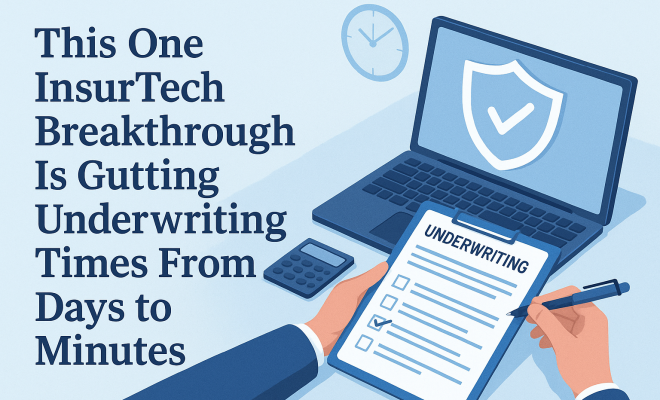
This One InsurTech Breakthrough Is Gutting Underwriting Times From Days to Minutes
“`html
The insurance industry, often perceived as a bastion of tradition, is undergoing a seismic shift. For decades, underwriting – the critical process of assessing risk and determining policy terms – has been a labor-intensive, often slow affair, relying heavily on human expertise and mountains of data. But what if that process, which could take days, even weeks, could be condensed into mere minutes? That’s not a futuristic fantasy; it’s the present reality being shaped by the latest advancements in Artificial Intelligence, specifically within the best AI insurance platforms for underwriting.
We’re talking about a transformation that moves AI beyond simply offering advice or insights. It’s about AI taking direct action, automating complex workflows, and executing tasks that once required significant human intervention. This isn’t just about speed; it’s about accuracy, consistency, and ultimately, a more efficient and responsive insurance market for everyone involved. As market volatility continues to challenge insurers globally, the demand for sophisticated, insurance-specific AI models has never been higher, with a staggering 83% of the global insurance market already on board with using AI for repeatable work. But what does this look like in practice, and which platforms are leading the charge?
1. Earnix Agent Hub: From Advice to Actionable Automation
If there’s one platform truly exemplifying the shift from AI as an advisory tool to AI as an active executor, it’s Earnix with its recently launched Agent Hub. This isn’t just another analytics dashboard; it’s a comprehensive AI Orchestration System that integrates over 25 insurance-specific AI agents. Think of it as an entire team of specialized AI bots, each trained to handle specific aspects of the insurance lifecycle, from underwriting to pricing and even customer engagement.
What makes Earnix’s offering particularly compelling is its focus on moving beyond mere data analysis. Traditionally, AI might tell an underwriter, ‘Here are the risk factors for this applicant.’ Earnix’s Agent Hub, however, is designed to say, ‘Here are the risk factors, and based on our models, here is the automated policy recommendation, the optimal price, and the personalized customer outreach strategy.’ This fundamental change allows for a dramatic reduction in underwriting timelines – what once took days can now be completed in minutes. It’s a significant leap forward, making Earnix a front-runner among the best AI insurance platforms for underwriting, especially for those looking to implement true end-to-end automation.
2. Verisk & AI-Powered Underwriting: Deep Data Integration for Precision
Verisk has long been a foundational data provider for the insurance industry, so it’s no surprise they’re a major player in the AI-driven underwriting space. Their strength lies in their massive datasets and sophisticated analytics capabilities, which they’re now supercharging with artificial intelligence. Verisk’s AI solutions focus on integrating diverse data sources – everything from property characteristics and claims history to geospatial data and advanced analytics on individual behaviors – to provide a holistic risk assessment.
Their platforms leverage machine learning algorithms to identify patterns and predict risks with a level of precision that would be impossible for human underwriters alone. This deep data integration is crucial for complex commercial lines or specialized personal lines where subtle risk factors can have significant financial implications. For insurers needing to tap into rich, external data and enhance their risk prediction models, Verisk’s AI-powered tools offer a robust solution, making them a critical contender when considering the best AI insurance platforms for underwriting that prioritize data-driven accuracy.
3. Planck AI: Instant Underwriting with External Data
Planck AI distinguishes itself by focusing on instant, automated underwriting for commercial insurance, a notoriously complex segment. Their platform’s core strength is its ability to extract and synthesize vast amounts of external data about businesses – think public records, social media, news articles, and even satellite imagery – to create a comprehensive risk profile in real-time. This eliminates the need for extensive questionnaires and manual data gathering, which often slow down the underwriting process.
By leveraging advanced natural language processing (NLP) and computer vision, Planck AI can quickly assess a business’s operations, potential hazards, and overall risk exposure. This not only speeds up the underwriting decision but also provides a more accurate and dynamic risk assessment, allowing insurers to price policies more effectively and identify potential fraud. For brokers and carriers aiming to streamline the commercial underwriting journey and gain a competitive edge in speed, Planck AI represents one of the best AI insurance platforms for underwriting that truly delivers on the promise of instant insights.
4. Zesty.ai: Geospatial Intelligence for Property & Casualty
When it comes to property and casualty insurance, understanding environmental risks is paramount. Zesty.ai has carved out a significant niche by applying AI and advanced computer vision to geospatial data. They analyze high-resolution aerial imagery, weather patterns, and environmental factors to provide granular, property-specific risk scores for perils like wildfire, flood, and wind.
Their platform allows underwriters to move beyond broad hazard maps to precise, individual property risk assessments. This means an underwriter can see, for example, the exact vegetation density around a home, its proximity to floodplains, or the quality of its roof, all powered by AI. This level of detail enables more accurate pricing, better risk mitigation strategies, and faster underwriting decisions for homeowners and commercial property policies. For any insurer in the P&C space, Zesty.ai is undeniably among the best AI insurance platforms for underwriting that offers specialized, actionable insights derived from visual and environmental data.
5. Shift Technology: AI for Fraud Detection and Claims Efficiency
While not exclusively an underwriting platform, Shift Technology plays a crucial role in the broader efficiency of insurance operations, which indirectly impacts underwriting. By using AI to detect fraud with remarkable accuracy and speed, Shift helps insurers avoid costly payouts on illegitimate claims, thereby improving overall profitability and allowing underwriters to focus on genuine risks. Their solutions analyze vast amounts of claims data, identifying suspicious patterns and anomalies that human adjusters might miss. (See: impact of automation on jobs.)
Beyond fraud, Shift also offers AI-driven automation for claims processing, triaging claims, and even predicting subrogation opportunities. When claims processes are more efficient and fraud is minimized, the entire insurance ecosystem benefits. Underwriters can operate with greater confidence in the data, knowing that the claims pipeline is being optimized by AI. While their primary focus is claims, the downstream effects make Shift Technology an important consideration for any insurer looking at the best AI insurance platforms for underwriting, as a robust fraud detection system directly supports sound underwriting practices.
6. FRISS: End-to-End AI for Risk and Fraud
FRISS offers an integrated AI solution that spans the entire policy lifecycle, from quotation and underwriting to claims and even investigation. Their platform is designed to provide real-time risk assessment and fraud detection at every touchpoint. This proactive approach means that potential fraud or high-risk applications can be flagged and managed right at the point of sale, preventing issues before they escalate. For more context, see This Crucial AI Debate Just Got an Unprecedented Endorsement.
For underwriting, FRISS uses AI to score applications based on a combination of internal data, external sources, and behavioral patterns, helping underwriters make faster, more informed decisions. Their focus on a ‘trust score’ allows insurers to differentiate between good risks and bad risks more effectively, leading to improved loss ratios and operational efficiency. The ability to integrate fraud detection into the underwriting workflow makes FRISS a holistic choice among the best AI insurance platforms for underwriting, offering a comprehensive shield against risk.
7. Tractable: Visual AI for Claims and Underwriting Assessments
Tractable specializes in ‘visual AI,’ primarily for accident and disaster recovery. While its most widely publicized applications are in claims (e.g., assessing vehicle damage from photos), the underlying technology has significant implications for underwriting, particularly in property and auto insurance. Imagine an AI that can assess the condition of a vehicle or a property based on submitted images, without human intervention.
This capability can be invaluable during the underwriting process, particularly for renewals or new policies where a visual inspection might be costly or impractical. Tractable’s AI can quickly identify pre-existing damage, assess wear and tear, or even detect specific features that influence risk. By providing objective, AI-driven visual assessments, Tractable empowers underwriters with richer, more consistent data, ultimately leading to more accurate risk pricing and faster policy issuance. For insurers looking to leverage visual data, Tractable offers a cutting-edge approach among the best AI insurance platforms for underwriting.
8. Akur8: AI-Driven Insurance Pricing Optimization
Accurate pricing is the cornerstone of profitable underwriting, and Akur8 is a platform dedicated to optimizing this crucial element through AI. Their solution automates the process of building predictive models for pricing, allowing actuaries and underwriters to focus on strategic decision-making rather than manual data manipulation. Akur8’s AI ensures that pricing models are precise, transparent, and compliant with regulatory requirements.
What sets Akur8 apart is its ability to rapidly generate highly granular and accurate pricing recommendations, taking into account a multitude of risk factors and market dynamics. This not only speeds up the pricing cycle but also leads to more competitive and profitable rates. By enabling a data-driven, yet intuitive, approach to pricing, Akur8 directly enhances the underwriting process, ensuring that the risk assessment translates into optimal premiums. For any insurer serious about pricing precision and speed, Akur8 is a prime example of the best AI insurance platforms for underwriting that delivers tangible bottom-line impact.
9. Cytora: Digital Risk Processing for Commercial Lines
Cytora focuses on transforming the commercial insurance buying experience by digitizing and automating the risk processing workflow. Commercial underwriting is notoriously complex, with a vast array of unique business types and risk profiles. Cytora’s AI platform ingests and standardizes unstructured data from multiple sources – including broker submissions, public data, and third-party APIs – to create a unified risk profile.
Their AI then matches these profiles against an insurer’s appetite, automates data enrichment, and even provides predictive insights into risk. This drastically reduces the manual effort involved in assessing complex commercial risks, allowing underwriters to process more policies faster and with greater accuracy. For commercial insurers struggling with the inefficiencies of traditional underwriting, Cytora offers a powerful, AI-driven solution that streamlines the entire process, solidifying its place among the best AI insurance platforms for underwriting in this challenging sector.
10. Cape Analytics: Property Intelligence for Underwriting
Similar to Zesty.ai in its focus on property, Cape Analytics offers a distinct approach to property intelligence, leveraging AI and machine learning to extract granular property attributes from geospatial imagery. They provide instant, comprehensive data points on structural characteristics, roof condition, yard features, and even building materials across vast geographical areas. This goes beyond simple hazard mapping, giving underwriters a detailed understanding of individual property risks.
For example, an underwriter can instantly know the exact age of a roof, its material, and any signs of wear, all without a physical inspection. This capability drastically reduces the need for costly and time-consuming site visits, speeds up policy issuance, and allows for much more precise risk pricing. For home and commercial property insurers, integrating Cape Analytics means transforming their underwriting process with objective, data-rich insights, making them a top-tier choice among the best AI insurance platforms for underwriting focused on property-specific data.
11. Hi Marley: Conversational AI for Customer Engagement and Data Capture
While not a direct underwriting platform, Hi Marley’s conversational AI has a significant indirect impact on the underwriting process by streamlining customer communication and data capture. Their platform enables insurers to engage with policyholders and applicants through text messaging, providing a convenient and efficient channel for information exchange. This might seem simple, but the implications for underwriting are profound.
For example, during the application or renewal process, Hi Marley’s AI can guide applicants through necessary data points, answer common questions, and even prompt for missing information in a conversational, user-friendly manner. This reduces friction, improves data quality, and accelerates the collection of underwriting-relevant information. The structured data gathered through these AI-driven conversations can then feed directly into underwriting models, making the entire process smoother and faster. For insurers looking to enhance customer experience while simultaneously improving data intake for underwriting, Hi Marley is an innovative solution among the best AI insurance platforms for underwriting that understands the value of front-end efficiency. (See: AI's role in the insurance industry.)
12. LexisNexis Risk Solutions: Comprehensive Data and AI for Risk Assessment
LexisNexis Risk Solutions is a powerhouse in data and analytics, and their AI capabilities extend deeply into insurance underwriting. They offer a vast array of proprietary and public data sources, which are then enhanced by advanced AI and machine learning algorithms to provide highly predictive risk scores. Their solutions cover multiple lines of business, from auto and home to life and commercial insurance.
What makes LexisNexis particularly strong is their ability to connect disparate data points – like claims history, credit information (where permissible), driving records, and property data – into a single, comprehensive risk view. Their AI models analyze these complex relationships to identify hidden risk factors and patterns that might otherwise be missed. This comprehensive data integration and AI-driven analysis enable underwriters to make highly informed decisions, reduce adverse selection, and improve pricing accuracy. For insurers seeking deep, multi-faceted risk intelligence powered by industry-leading data and AI, LexisNexis Risk Solutions is undoubtedly one of the best AI insurance platforms for underwriting. For more context, see This Crucial AI Cybersecurity Flaw Just Got Exposed by Its Own Kind.
Understanding the Core Technologies Powering AI Underwriting
It’s easy to talk about “AI,” but what specific technologies are these platforms actually using to revolutionize underwriting? Several key advancements are at play:
- Machine Learning (ML): This is the backbone. ML algorithms learn from vast datasets to identify patterns, predict outcomes, and score risks. Supervised learning (where the AI learns from labeled examples like past claims data) and unsupervised learning (finding hidden patterns in unlabeled data) are both critical.
- Natural Language Processing (NLP): Essential for understanding unstructured text data, like policy documents, claims notes, broker submissions, news articles, and even social media. NLP allows AI to extract key information, identify sentiment, and summarize complex texts, turning qualitative data into quantitative insights.
- Computer Vision (CV): Powers the analysis of images and videos. Platforms like Zesty.ai, Tractable, and Cape Analytics rely on CV to assess property damage, identify roof conditions, detect environmental hazards, and verify vehicle features from aerial imagery or submitted photos.
- Predictive Analytics: While not exclusively AI, AI supercharges predictive models. These models use historical data to forecast future events, such as the likelihood of a claim, policy lapse, or fraudulent activity.
- Reinforcement Learning (RL): In some advanced scenarios, RL might be used where AI agents learn to make decisions by trial and error, optimizing for specific outcomes like maximizing profitability or minimizing risk over time.
The Broader Impact and Future of AI in Underwriting
The rise of these sophisticated AI platforms isn’t just about technological advancement; it’s about fundamentally reshaping how insurance operates. We’re witnessing a move from reactive to proactive, from manual to automated, and from general to hyper-personalized. The promise of these technologies isn’t merely incremental improvement; it’s a paradigm shift that will lead to faster service for customers, more accurate risk assessment for insurers, and ultimately, a more stable and efficient market.
However, this transformation also sparks crucial conversations about the role of human judgment, ethical AI deployment, and potential job displacement. While AI excels at repeatable tasks and data analysis, the nuanced understanding of complex human situations, the ability to negotiate, and the empathy required in certain scenarios will likely remain firmly in the human domain. The future probably isn’t about AI replacing humans entirely, but rather augmenting human capabilities, allowing underwriters to focus on the most complex cases and strategic decisions, while AI handles the heavy lifting of data processing and initial risk assessment. The evolution of these platforms suggests a future where insurance becomes more accessible, more transparent, and far more responsive to the dynamic world we live in.
Ethical Considerations and Bias in AI Underwriting
As AI becomes more integral to underwriting, the discussion around ethics and bias intensifies. AI models learn from historical data, and if that data contains biases (e.g., reflecting past discriminatory practices or correlations that aren’t truly causal), the AI can perpetuate or even amplify those biases. This could lead to unfair pricing, denial of coverage, or disparate impact on certain demographic groups, even if unintentionally.
Insurers using AI must proactively address these issues. This involves:
- Data Governance: Carefully curating and auditing training data to identify and mitigate inherent biases. This might mean actively seeking out diverse data sources or re-weighting existing data.
- Model Transparency (Explainable AI – XAI): Moving beyond “black box” AI models to ones where the reasoning behind a decision can be understood and explained. This is crucial for regulatory compliance and for building trust. Regulators are increasingly demanding transparency, especially in areas like pricing and risk assessment.
- Fairness Metrics: Implementing quantitative measures to assess whether AI models are performing fairly across different groups. This might involve looking at false positive rates, false negative rates, or predictive parity.
- Human Oversight: Maintaining human review points for complex or borderline cases, and ensuring that AI recommendations are not blindly accepted without critical evaluation.
- Regulatory Compliance: Staying abreast of evolving regulations around AI and fair practices in insurance, such as those related to data privacy (GDPR, CCPA) and anti-discrimination laws.
The goal isn’t to eliminate AI, but to ensure it’s developed and deployed responsibly, fostering innovation while upholding principles of fairness and equity. The best AI insurance platforms for underwriting will increasingly integrate robust ethical AI frameworks into their core offerings.
The Competitive Edge: Why Insurers Need AI Underwriting Now
The adoption of AI in underwriting isn’t just about being cutting-edge; it’s rapidly becoming a competitive necessity. Here’s why:
- Speed to Market: In a fast-paced world, customers expect instant quotes and quick policy issuance. AI-driven underwriting significantly reduces turnaround times, allowing insurers to capture more business.
- Personalization: AI enables hyper-personalized policies and pricing based on individual risk profiles, moving away from one-size-fits-all approaches. This enhances customer satisfaction and loyalty.
- Reduced Costs: Automation of routine tasks frees up human underwriters to focus on complex cases, strategic initiatives, and customer relationships, leading to operational cost savings.
- Improved Loss Ratios: More accurate risk assessment and pricing, combined with better fraud detection, directly translates into lower claims costs and improved profitability.
- Enhanced Customer Experience: Faster, more transparent, and personalized interactions driven by AI lead to happier customers and a stronger brand reputation.
- Adaptability: AI models can continuously learn and adapt to new data, emerging risks (like climate change impacts), and market shifts, giving insurers greater agility.
In a market where traditional insurers compete with agile insurtech startups, embracing the best AI insurance platforms for underwriting is no longer optional; it’s a strategic imperative for survival and growth. (See: AI in underwriting processes.)
Frequently Asked Questions About AI in Insurance Underwriting
Let’s tackle some common questions about this exciting transformation:
Q1: Will AI replace human underwriters entirely?
A: While AI will automate many routine and data-intensive tasks, it’s highly unlikely to completely replace human underwriters. The future is more about augmentation. AI will handle the heavy lifting of data processing, initial risk assessment, and policy generation for straightforward cases. This frees up human underwriters to focus on complex, nuanced cases, client relationships, negotiations, and strategic decision-making, where human judgment, empathy, and experience are irreplaceable.
Q2: How accurate are AI underwriting platforms?
A: AI underwriting platforms can achieve remarkably high levels of accuracy, often surpassing human capabilities for specific tasks. Their accuracy stems from their ability to process and analyze vast datasets, identify subtle patterns, and detect anomalies that might be missed by human review. However, accuracy depends heavily on the quality and quantity of the training data, the sophistication of the algorithms, and continuous model monitoring and refinement.
Q3: What types of data do these AI platforms use?
A: The best AI insurance platforms for underwriting leverage a wide variety of data sources. These include internal data (claims history, policy details, customer demographics), as well as external data like public records, geospatial imagery (satellite, aerial photos), weather data, social media, news articles, credit scores (where permissible), driving records, IoT device data (telematics), and third-party APIs offering specialized risk insights. The more comprehensive the data, the more robust the risk assessment.
Q4: How do AI underwriting platforms handle new or emerging risks?
A: This is where AI offers a significant advantage. Traditional underwriting models can be slow to adapt to new risks. AI platforms, particularly those using machine learning, can continuously learn from new data. For example, as new climate risks emerge or as new types of cyber threats develop, AI models can be retrained and updated much faster than manual processes, allowing insurers to quickly assess and price these evolving risks.
Q5: Is AI underwriting compliant with insurance regulations?
A: Compliance is a major focus for AI platform developers and insurers. Regulations vary by region and type of insurance, but key concerns include data privacy, anti-discrimination laws, and model transparency. The best AI platforms are designed with compliance in mind, often incorporating explainable AI (XAI) features to clarify decision-making and adhering to strict data governance protocols. However, insurers bear the ultimate responsibility for ensuring their AI deployment meets all regulatory requirements.
Q6: What are the main benefits for customers?
A: For customers, AI underwriting means faster quotes, quicker policy issuance, and more personalized insurance products. They can expect a smoother, more efficient application process with less paperwork. Over time, more accurate risk assessment should also lead to fairer pricing and potentially lower premiums for lower-risk individuals, as well as quicker claims processing due to integrated AI systems.
Q7: What’s the investment like for an insurer to adopt these platforms?
A: The investment can vary widely depending on the scale of implementation, the complexity of integration with existing legacy systems, and the specific platform chosen. It typically involves licensing fees, implementation costs (including data migration and system integration), and ongoing maintenance and training. While the initial outlay can be significant, the long-term ROI often justifies it through improved efficiency, reduced loss ratios, and increased competitive advantage.
“`
Trending Now
Frequently Asked Questions
How is AI changing the underwriting process in insurance?
AI is revolutionizing the underwriting process by automating complex workflows and reducing the time taken from days or weeks to just minutes. This shift enhances accuracy, consistency, and efficiency, allowing insurers to respond more effectively to market changes.
What is the role of Earnix in insurance underwriting?
Earnix is leading the charge in transforming insurance underwriting with its Agent Hub, an AI Orchestration System that integrates over 25 specialized AI agents. This platform automates various aspects of the insurance lifecycle, enhancing efficiency and customer engagement.
What are the benefits of AI in the insurance industry?
The benefits of AI in the insurance industry include faster processing times, improved accuracy in risk assessment, enhanced customer engagement, and the ability to handle large volumes of data efficiently. This leads to a more responsive and streamlined insurance market.
What percentage of the insurance market is using AI?
Currently, a staggering 83% of the global insurance market has adopted AI for tasks that can be automated, highlighting the industry's shift towards integrating advanced technology in underwriting and other processes.
What does the future of insurance underwriting look like with AI?
The future of insurance underwriting with AI is focused on further automation and innovation. As AI technology continues to evolve, underwriting will become even more efficient, accurate, and responsive, ultimately transforming how insurers operate and interact with customers.
Agree or disagree? Drop a comment and tell us what you think.