The Tech Edvocate

Top Menu

  • Advertisement
  • Apps
  • Home Page
  • Home Page Five (No Sidebar)
  • Home Page Four
  • Home Page Three
  • Home Page Two
  • Home Tech2
  • Icons [No Sidebar]
  • Left Sidbear Page
  • Lynch Educational Consulting
  • My Account
  • My Speaking Page
  • Newsletter Sign Up Confirmation
  • Newsletter Unsubscription
  • Our Brands
  • Page Example
  • Privacy Policy
  • Protected Content
  • Register
  • Request a Product Review
  • Shop
  • Shortcodes Examples
  • Signup
  • Start Here
    • Governance
    • Careers
    • Contact Us
  • Terms and Conditions
  • The Edvocate
  • The Tech Edvocate Product Guide
  • Topics
  • Write For Us
  • Advertise

Main Menu

  • Start Here
    • Our Brands
    • Governance
      • Lynch Educational Consulting, LLC.
      • Dr. Lynch’s Personal Website
      • Careers
    • Write For Us
    • The Tech Edvocate Product Guide
    • Contact Us
    • Books
    • Edupedia
    • Post a Job
    • The Edvocate Podcast
    • Terms and Conditions
    • Privacy Policy
  • Topics
    • Assistive Technology
    • Child Development Tech
    • Early Childhood & K-12 EdTech
    • EdTech Futures
    • EdTech News
    • EdTech Policy & Reform
    • EdTech Startups & Businesses
    • Higher Education EdTech
    • Online Learning & eLearning
    • Parent & Family Tech
    • Personalized Learning
    • Product Reviews
  • Advertise
  • Tech Edvocate Awards
  • The Edvocate
  • Pedagogue
  • School Ratings

logo

The Tech Edvocate

  • Start Here
    • Our Brands
    • Governance
      • Lynch Educational Consulting, LLC.
      • Dr. Lynch’s Personal Website
        • My Speaking Page
      • Careers
    • Write For Us
    • The Tech Edvocate Product Guide
    • Contact Us
    • Books
    • Edupedia
    • Post a Job
    • The Edvocate Podcast
    • Terms and Conditions
    • Privacy Policy
  • Topics
    • Assistive Technology
    • Child Development Tech
    • Early Childhood & K-12 EdTech
    • EdTech Futures
    • EdTech News
    • EdTech Policy & Reform
    • EdTech Startups & Businesses
    • Higher Education EdTech
    • Online Learning & eLearning
    • Parent & Family Tech
    • Personalized Learning
    • Product Reviews
  • Advertise
  • Tech Edvocate Awards
  • The Edvocate
  • Pedagogue
  • School Ratings
  • Unmasking the Troubling Truth About EU’s Digital Omnibus and Your Data

  • Outrageous: Your US Car Insurance 2026 Bill Is About to Explode – Here’s Why

  • Uncovering the Truth: Are AI Spending Concerns About to Tank Your Portfolio?

  • The Silent Revolution: How AI Property Valuation Is Quietly Reshaping Real Estate

  • The Astonishing Truth: Why Your Dream Car Is Now a $52,000 Illusion

  • Toxic Algorithms: Why Your Bank’s AI Could Cost You Everything

  • OpenAI’s GPT-6 Cyber: A Dangerous New AI Threat or Our Ultimate Digital Guardian?

  • This Game-Changing Natural Ozempic Alternative Just Blew Up on Social Media

  • Bónuszösszeg, ingyen pörgetés és befizetési feltétel: üdvözlő és befizetés nélküli kaszinóajánlatok magyar játékosoknak

  • 9 Critical Reasons Why Athexio Might Be The Investment You Need (Or Should Avoid)

Tech News
Home›Tech News›Sun Enters Quiet Phase: Low Solar Activity in April 2026

Sun Enters Quiet Phase: Low Solar Activity in April 2026
By Matthew Lynch
April 14, 2026
0
Spread the love

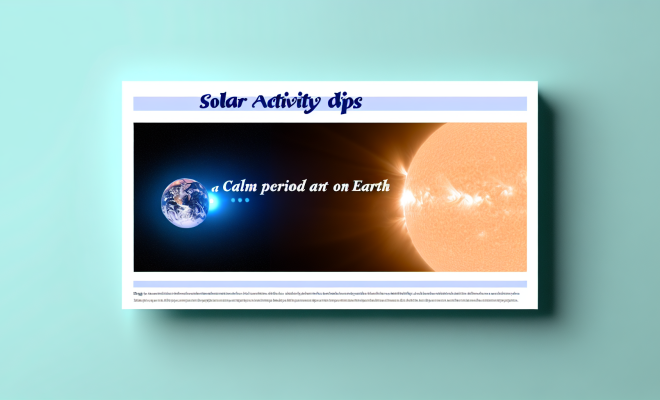
In a notable shift from recent months of heightened solar activity, the Sun has entered a quieter phase as recorded between April 12 and 13, 2026. This period has been characterized by a significant decrease in solar flares, with only low-intensity B-class flares being detected. The most powerful of these flares was a B7.2 event originating from Active Region 4417 (AR4417), which has recently been observed nearing the Sun’s western limb.

Understanding Solar Flares and Their Classifications

Solar flares are classified into categories based on their intensity. The classification system includes:

  • A-class: Minor flares with little to no impact on Earth.
  • B-class: Low-intensity flares that may cause minor radio disturbances.
  • C-class: Medium-intensity flares that can produce noticeable radio blackouts.
  • M-class: Strong flares that can cause significant disturbances in radio communications and navigation.
  • X-class: The most intense flares that can cause widespread disruptions on Earth.

The recent activity, primarily consisting of B-class flares, indicates a period of reduced solar output. This lull in activity can have various implications for both space weather and life on Earth.

The Role of Solar Wind

In conjunction with the reduced flare activity, the solar wind—a stream of charged particles released from the Sun—has also diminished in strength. Solar wind plays a critical role in shaping space weather and can significantly influence conditions in the Earth’s magnetosphere.

Typically, enhanced solar wind can lead to geomagnetic storms, which can affect satellite operations, GPS navigation, and even power grids on Earth. However, during this quieter phase, the waning solar wind has led to a more stable environment.

Coronal Mass Ejections: What’s Happening?

During the same timeframe, three coronal mass ejections (CMEs) were observed. CMEs are large expulsions of plasma and magnetic field from the Sun’s corona and can also influence space weather. Fortunately, none of the detected CMEs are expected to impact Earth directly. This lack of significant CME activity further underscores the current period of tranquility in solar behavior.

Looking Ahead: Potential for Auroras

Despite the calmer solar conditions, a coronal hole was identified in the Sun’s atmosphere, which may send a stream of fast solar wind toward Earth by April 15. Coronal holes are regions where the Sun’s magnetic field opens up, allowing solar wind to escape more easily. This fast solar wind can interact with Earth’s magnetic field, leading to the possibility of auroras—spectacular natural light displays commonly seen in polar regions.

For aurora enthusiasts, this upcoming solar wind could provide a chance to witness beautiful displays in the night sky, particularly at high latitudes. The best opportunities for viewing auroras typically occur in areas close to the magnetic poles, where the Earth’s magnetic field is most susceptible to solar influences.

The Science Behind Auroras

Auroras occur when charged particles from the solar wind collide with gases in the Earth’s atmosphere, leading to the release of energy in the form of light. The colors observed in auroras are primarily due to the type of gas involved:

  • Oxygen: Produces green and red hues.
  • Nitrogen: Can create purples and blues.

The interaction of these particles with Earth’s magnetic field not only creates stunning light displays but also serves as an important reminder of the dynamic relationship between our planet and the Sun.

Conclusion: Embracing the Quiet

As solar activity subsides, the scientific community remains vigilant in monitoring the Sun’s behavior. Periods of quiet, such as the one currently being experienced, provide valuable opportunities for researchers to study the Sun’s various phenomena without the interference of intense solar activity.

While the immediate impacts of this solar calm may be limited, the potential for auroras on the horizon adds an element of excitement for skywatchers. As we approach mid-April, those in high-latitude regions should keep an eye on the skies for the possibility of vibrant auroral displays, a beautiful reminder of the intricate dance between our planet and its closest star.

Previous Article

Yale Juniors Win Prestigious 2026-27 Goldwater Scholarships

Next Article

Trump Uses Mail-In Ballot in Florida, Sparks ...

Matthew Lynch

Related articles More from author

  • Tech News

    Quantum Leap: Real-Time Data Stability for Qubits

    April 8, 2026
    By Matthew Lynch
  • Tech News

    Today’s NYT Mini Crossword Answers and Puzzle Help for July 16

    July 17, 2024
    By Matthew Lynch
  • Tech News

    Unbelievable: 16-Year-Old Suspected of Masterminding Global KillSec Ransomware Group

    October 3, 2026
    By Matthew Lynch
  • Tech News

    Jeff Bridges says he’s ‘feeling great’ 3 years after contracting COVID while undergoing chemotherapy

    July 11, 2024
    By Matthew Lynch
  • Tech News

    Steam Deck OLED Review: My Favorite New Gaming Handheld of 2024

    January 31, 2024
    By Matthew Lynch
  • Tech News

    How to add file upload to Google Forms?

    August 7, 2026
    By Matthew Lynch

Search

Login & Registration

  • Log in
  • Entries feed
  • Comments feed
  • WordPress.org

Newsletter

Signup for The Tech Edvocate Newsletter and have the latest in EdTech news and opinion delivered to your email address!

About Us

Since technology is not going anywhere and does more good than harm, adapting is the best course of action. That is where The Tech Edvocate comes in. We plan to cover the PreK-12 and Higher Education EdTech sectors and provide our readers with the latest news and opinion on the subject. From time to time, I will invite other voices to weigh in on important issues in EdTech. We hope to provide a well-rounded, multi-faceted look at the past, present, the future of EdTech in the US and internationally.

We started this journey back in June 2016, and we plan to continue it for many more years to come. I hope that you will join us in this discussion of the past, present and future of EdTech and lend your own insight to the issues that are discussed.

Newsletter

Signup for The Tech Edvocate Newsletter and have the latest in EdTech news and opinion delivered to your email address!

Contact Us

The Tech Edvocate
910 Goddin Street
Richmond, VA 23231
(601) 630-5238
[email protected]

Copyright © 2026 Matthew Lynch. All rights reserved.