Tesla’s Supervised Self-Driving Software Approved in the Netherlands
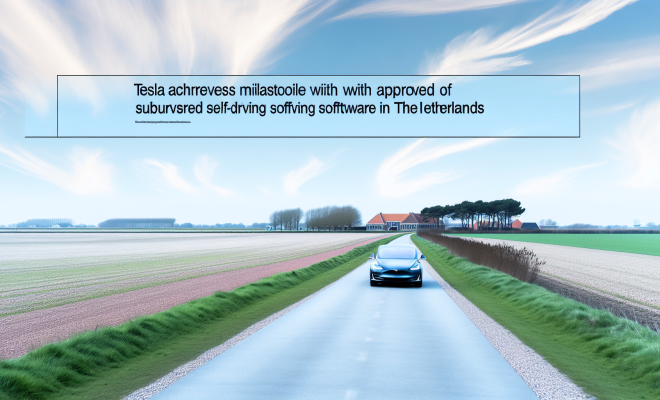
In a landmark decision, Dutch regulators have granted approval for Tesla’s supervised self-driving software, making it the first of its kind to receive regulatory clearance in Europe. This significant milestone not only marks a crucial step for Tesla in its quest to expand its autonomous driving capabilities but also sets a precedent for other electric vehicle manufacturers seeking similar endorsements in the European market.
Details of the Approval
The approval allows Tesla’s autonomous driving system to be utilized on both highways and city streets in the Netherlands. However, it comes with a vital stipulation: human supervision is required while the software is in operation. This means that drivers must remain alert and ready to take control of the vehicle at any moment, ensuring a layer of safety as the technology continues to evolve.
Significance for Tesla and the European Market
Tesla’s success in securing approval from Dutch regulators is not just a win for the company; it represents a broader shift in the European automotive landscape. With stringent regulations governing autonomous vehicles, achieving this clearance is a strong indicator of Tesla’s commitment to meeting safety standards while advancing its innovative technologies.
This approval comes at a time when the demand for electric vehicles and autonomous driving solutions is surging across Europe. Tesla, known for its cutting-edge technology and environmental consciousness, aims to lead this charge. By obtaining regulatory approval in the Netherlands, the company is positioning itself strategically to replicate this success in other European Union member states.
Future Prospects and Challenges
While the approval in the Netherlands is a significant achievement, Tesla faces the challenge of navigating various regulatory frameworks across different countries within the EU. Each member state has its own set of rules and requirements for autonomous driving technology, which can complicate the approval process.
The company is expected to engage with regulators in other countries to secure similar approvals. This effort is crucial as Tesla aims to expand its market presence and maintain its competitive edge in the rapidly evolving automotive industry.
Technological Advancements in Autonomous Driving
Tesla’s supervised self-driving software is part of the company’s broader vision for autonomous transportation. The technology leverages advanced algorithms and machine learning to navigate complex driving environments. It is designed to assist drivers by providing features such as:
- Lane keeping
- Traffic-aware cruise control
- Automatic lane changes
- Summon functionality, allowing the vehicle to navigate to the driver autonomously
These features not only enhance the driving experience but also aim to increase safety on the roads. However, the requirement for human oversight remains a critical component, reflecting the current state of technology and the need for caution as the industry progresses.
Public Perception and Acceptance
As Tesla rolls out its supervised self-driving software, public perception will play a crucial role in its success. Autonomous driving technology has been met with mixed reactions, with some consumers expressing excitement about the innovations while others voice concerns about safety and reliability.
To address these concerns, Tesla must engage with the public and demonstrate the effectiveness and safety of its technology. Educational campaigns, transparent communication about software capabilities, and data-driven evidence of safety improvements will be key in fostering consumer trust.
The Road Ahead for Tesla in Europe
The approval of Tesla’s supervised self-driving software in the Netherlands is a pivotal point in the company’s journey toward achieving full autonomy. As they seek to expand their footprint in Europe, Tesla must navigate regulatory landscapes while continuing to innovate.
With the automotive industry undergoing a radical transformation driven by advancements in technology and changing consumer preferences, Tesla’s ability to adapt will be essential. The company is not only competing with traditional automakers but also with new entrants in the EV and autonomous driving space.
In summary, the recent approval in the Netherlands represents a significant step forward for Tesla and the future of autonomous driving in Europe. As the company continues to push the boundaries of innovation, the eyes of the automotive world will be closely watching how Tesla navigates the challenges ahead and capitalizes on this momentous opportunity.