TOI 5205b: The Astronomical Enigma Reshaping Planetary Formation Theories
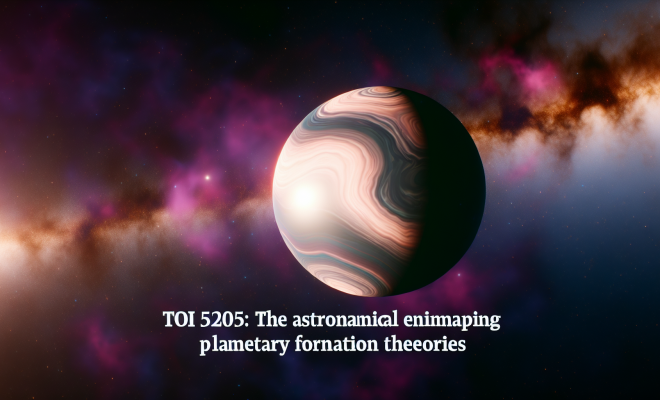
In the realm of exoplanetary research, few discoveries have challenged existing theories as dramatically as TOI 5205b. Dubbed a ‘forbidden planet,’ this gas giant has emerged as a significant anomaly in our understanding of planetary formation, particularly in relation to its size and composition in orbit around a red dwarf star. The planet was discovered through the Transiting Exoplanet Survey Satellite (TESS) mission, and its characteristics are prompting scientists to reevaluate the fundamental principles governing planet formation.
Understanding TOI 5205b
TOI 5205b is classified as a super-sized gas giant, a designation that highlights its unexpected size. It orbits a relatively small star, a red dwarf, which typically exhibits characteristics that would not support the existence of a planet of TOI 5205b’s scale. The discovery of this planet has raised eyebrows among astronomers and planetary scientists, as it contradicts established models that dictate how planets should form around such stars.
The Discovery Process
The discovery of TOI 5205b was made possible through NASA’s TESS mission, which was launched in 2018 with the primary goal of identifying exoplanets beyond our solar system. TESS utilizes the transit method, observing stars for periodic dimming that indicates a planet passing in front of them. This method allows researchers to gather crucial data about the size, composition, and orbit of the discovered planets.
TOI 5205b was confirmed as a planet after extensive observations that included follow-up analyses from various telescopes and research teams. The data revealed an intriguing profile: the planet’s mass and volume are not only larger than expected but also inconsistent with the theoretical frameworks used to understand planetary formation.
Why is TOI 5205b Considered ‘Forbidden’?
The term ‘forbidden planet’ refers to the fact that TOI 5205b defies the conventional models of planetary formation. Typically, gas giants form in regions where there is an abundance of material, often around larger stars that provide the gravitational pull necessary to attract gas and dust. However, TOI 5205b’s host star is a red dwarf, which is much smaller and cooler than stars like our Sun. This discrepancy raises critical questions about how such a massive planet could exist in such an inhospitable environment.
Implications for Planetary Formation Models
According to current theories, the formation of a gas giant like TOI 5205b around a red dwarf star is improbable due to the limited mass and temperature of the star, which would typically not allow significant accretion of gas. This anomaly has prompted scientists to consider alternative scenarios that might explain the planet’s existence:
- Migration from a Different Region: One possibility is that TOI 5205b formed farther away from its star and migrated inward over time, a process that could involve complex gravitational interactions with other celestial bodies.
- Unconventional Formation Processes: Another theory suggests that the planet may have formed via processes that have not yet been fully understood, potentially involving interactions with the interstellar medium or other nearby stars.
- Variability in Star Formation: The findings may also indicate that red dwarfs can support planet formation in ways that current models do not account for, suggesting that a reevaluation of these stars’ roles in planet development is necessary.
Future Research Directions
As TOI 5205b continues to intrigue astronomers, future research will likely focus on understanding the characteristics of this planet in greater detail. Observational studies using advanced telescopes, such as the James Webb Space Telescope (JWST), could provide more insights into its atmosphere, composition, and potential for hosting satellites or moons.
Further studies may also involve examining other exoplanets orbiting red dwarfs to determine whether TOI 5205b is an anomaly or part of a larger trend. By expanding the dataset, scientists can better assess the validity of existing models and potentially develop new frameworks that account for these surprising discoveries.
The Broader Impact on Astrophysics
The discovery of TOI 5205b is significant not only for planetary science but also for our broader understanding of astrophysics. It underscores the complexity of the universe and the potential for unexpected phenomena that challenge our current knowledge. As researchers delve deeper into these mysteries, they may uncover new principles that govern not just planetary formation but also the evolution of solar systems at large.
Conclusion
TOI 5205b stands as a testament to the ever-evolving nature of scientific inquiry. Its existence compels astronomers to reconsider long-held beliefs about how planets form and survive around smaller stars. As technology and methodologies continue to advance, the insights gained from TOI 5205b could pave the way for a new era of discovery in astrophysics, leading to a deeper understanding of the cosmos and our place within it.