
The Tech Edvocate

Top Menu

  • Advertisement
  • Apps
  • Home Page
  • Home Page Five (No Sidebar)
  • Home Page Four
  • Home Page Three
  • Home Page Two
  • Home Tech2
  • Icons [No Sidebar]
  • Left Sidbear Page
  • Lynch Educational Consulting
  • My Account
  • My Speaking Page
  • Newsletter Sign Up Confirmation
  • Newsletter Unsubscription
  • Our Brands
  • Page Example
  • Privacy Policy
  • Protected Content
  • Register
  • Request a Product Review
  • Shop
  • Shortcodes Examples
  • Signup
  • Start Here
    • Governance
    • Careers
    • Contact Us
  • Terms and Conditions
  • The Edvocate
  • The Tech Edvocate Product Guide
  • Topics
  • Write For Us
  • Advertise

Main Menu

  • Start Here
    • Our Brands
    • Governance
      • Lynch Educational Consulting, LLC.
      • Dr. Lynch’s Personal Website
      • Careers
    • Write For Us
    • The Tech Edvocate Product Guide
    • Contact Us
    • Books
    • Edupedia
    • Post a Job
    • The Edvocate Podcast
    • Terms and Conditions
    • Privacy Policy
  • Topics
    • Assistive Technology
    • Child Development Tech
    • Early Childhood & K-12 EdTech
    • EdTech Futures
    • EdTech News
    • EdTech Policy & Reform
    • EdTech Startups & Businesses
    • Higher Education EdTech
    • Online Learning & eLearning
    • Parent & Family Tech
    • Personalized Learning
    • Product Reviews
  • Advertise
  • Tech Edvocate Awards
  • The Edvocate
  • Pedagogue
  • School Ratings

logo

The Tech Edvocate

  • Start Here
    • Our Brands
    • Governance
      • Lynch Educational Consulting, LLC.
      • Dr. Lynch’s Personal Website
        • My Speaking Page
      • Careers
    • Write For Us
    • The Tech Edvocate Product Guide
    • Contact Us
    • Books
    • Edupedia
    • Post a Job
    • The Edvocate Podcast
    • Terms and Conditions
    • Privacy Policy
  • Topics
    • Assistive Technology
    • Child Development Tech
    • Early Childhood & K-12 EdTech
    • EdTech Futures
    • EdTech News
    • EdTech Policy & Reform
    • EdTech Startups & Businesses
    • Higher Education EdTech
    • Online Learning & eLearning
    • Parent & Family Tech
    • Personalized Learning
    • Product Reviews
  • Advertise
  • Tech Edvocate Awards
  • The Edvocate
  • Pedagogue
  • School Ratings
  • Mind-Blowing: These Viral Amazon Products Are NOT What You Expect

  • Bizarre: AI-Generated Fake Health Influencers Are Invading Your Feed – Here’s How to Spot Them

  • Six Startups Launch IPOs in One Day: Is This India’s Most Audacious Bet Yet?

  • The Baffling Twitter Startup Name Change: Why ‘Bluebird’ Had to Die

  • The PlayStation Trump Tariff Refunds You Won’t Get: Why Sony’s Silence Is Infuriating Gamers

  • The White House ‘Arcade’ Scandal: Why the Tetris Controversy Is Just the Beginning

  • The Billion-Dollar Battle: Seattle Times’ AI Lawsuit Could Redefine Digital Rights

  • This OpenAI Pause Reveals a Disturbing Truth About AI’s Future

  • Stunning: Feds Quietly Erase Data on Gender-Based Bullying – What It Means for Vulnerable Students

  • The Raw Truth About the Colorado Student Walkout You Haven’t Heard

How To
Home›How To›3 Ways to Punctuate Titles

3 Ways to Punctuate Titles
By Matthew Lynch
March 24, 2024
0
Spread the love

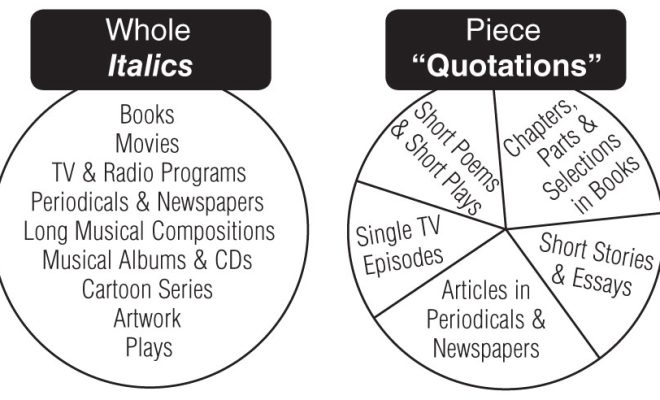
When it comes to writing an article, essay, or any piece of written work, the words aren’t the only important thing; punctuation plays a crucial role too. One aspect of punctuation that often confuses people is how to punctuate titles correctly. There are three main ways to punctuate titles, and using them appropriately will make your writing look more polished and professional. In this article, we’ll explore the use of italics, quotation marks, and capitalization for punctuating titles.

1. Italics

Italics are commonly used to indicate the title of a standalone work, such as a novel, film, or painting. They are applied to emphasize the name of the work and distinguish it from the surrounding text. For example:

– I recently read Harper Lee’s To Kill a Mockingbird and found it incredibly moving.

– My favorite movie is The Godfather directed by Francis Ford Coppola.

– One of Vincent van Gogh’s most famous paintings is The Starry Night.

Using italics in this way helps your reader identify that you’re referring to a specific work.

2. Quotation Marks

While italics are usually for standalone works, quotation marks are used for smaller works or parts of a larger work. This includes short stories, poems, newspaper articles, essays, episodes from a TV show or series, and songs. For instance:

– I was inspired by Edgar Allan Poe’s “The Tell-Tale Heart.”

– “Stopping by Woods on a Snowy Evening” is one of Robert Frost’s most well-known poems.

– The New York Times published an interesting article called “The Impact of Technology on Society.”

– I can’t stop listening to “Bohemian Rhapsody” by Queen.

Correctly using quotation marks informs your reader that you’re mentioning a specific piece within a broader context.

3. Capitalization

Another method of punctuating titles is through capitalization. This applies to both formal (e.g., book titles) and informal (e.g., blog posts) writing. The general rule is to capitalize the first letter of each major word, which is often called title case. With this method, you don’t have to worry about using italics or quotation marks, as long as you’re consistent in your usage. For example:

– The World According to Garp

– The Power of Now: A Guide to Spiritual Enlightenment

– To Kill a Mockingbird

In conclusion, knowing how to punctuate titles correctly is an essential skill for any writer. Depending on the type of work you’re referring to, remember these three key methods: using italics for standalone works, quotation marks for smaller works or parts of a larger work, and capitalization for both formal and informal writing. By mastering these techniques, you’ll enhance the readability and professionalism of your written work.


Previous Article

The Best Courses You Can Play In ...

Next Article

Best Single Dose Grinder in 2024

Matthew Lynch

Related articles More from author

  • How To

    How to Make an Ice Candy: 13 Steps

    January 8, 2024
    By Matthew Lynch
  • How To

    How to Be the Best

    December 20, 2023
    By Matthew Lynch
  • How To

    11 Ways to Style an Oversized Jacket

    April 9, 2024
    By Matthew Lynch
  • How To

    3 Ways to Find Good Topsoil

    January 29, 2024
    By Matthew Lynch
  • How To

    How to Make an Obby on Roblox

    February 24, 2024
    By Matthew Lynch
  • How To

    How to Open a Car Dealership: 9 Steps

    March 24, 2024
    By Matthew Lynch

Search

Login & Registration

  • Log in
  • Entries feed
  • Comments feed
  • WordPress.org

Newsletter

Signup for The Tech Edvocate Newsletter and have the latest in EdTech news and opinion delivered to your email address!

About Us

Since technology is not going anywhere and does more good than harm, adapting is the best course of action. That is where The Tech Edvocate comes in. We plan to cover the PreK-12 and Higher Education EdTech sectors and provide our readers with the latest news and opinion on the subject. From time to time, I will invite other voices to weigh in on important issues in EdTech. We hope to provide a well-rounded, multi-faceted look at the past, present, the future of EdTech in the US and internationally.

We started this journey back in June 2016, and we plan to continue it for many more years to come. I hope that you will join us in this discussion of the past, present and future of EdTech and lend your own insight to the issues that are discussed.

Newsletter

Signup for The Tech Edvocate Newsletter and have the latest in EdTech news and opinion delivered to your email address!

Contact Us

The Tech Edvocate
910 Goddin Street
Richmond, VA 23231
(601) 630-5238
[email protected]

Copyright © 2026 Matthew Lynch. All rights reserved.