The Infinity Engine: Powering a Revolution
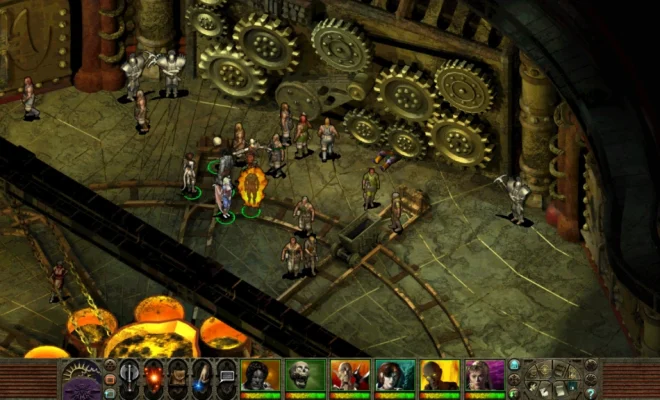
At the heart of Baldur’s Gate’s success lies a technological marvel that revolutionized the RPG genre: the Infinity Engine. This proprietary game engine, developed by BioWare, was more than just a tool for creating games; it was the foundation upon which some of the most beloved RPGs of all time were built.
The Infinity Engine was born out of necessity. When BioWare set out to create Baldur’s Gate, they needed a system that could handle the complex rules of Advanced Dungeons & Dragons while also providing a visually appealing and interactive world. The result was an isometric 2D engine that could render beautifully pre-rendered backgrounds and animate sprites in real-time.
One of the most innovative features of the Infinity Engine was its ability to seamlessly blend real-time gameplay with tactical pause-based combat. This system allowed players to pause the game at any time, assess the situation, and issue commands to their party members. This mechanic bridged the gap between the strategic depth of turn-based games and the immediacy of real-time action, creating a unique and engaging combat system.
The engine’s capabilities extended far beyond combat. It allowed for complex scripting, enabling developers to create intricate dialogue trees and branching storylines. This feature was crucial in bringing the rich, choice-driven narratives of Baldur’s Gate to life. Players could engage in meaningful conversations with NPCs, make decisions that affected the game world, and experience a level of narrative depth previously unseen in computer RPGs.
Another strength of the Infinity Engine was its modularity. The engine was designed to be flexible, allowing developers to create new content and modify existing assets with relative ease. This feature not only facilitated the rapid development of expansion packs and sequels but also laid the groundwork for a vibrant modding community that continues to create new content for these games to this day.
The visual style enabled by the Infinity Engine became iconic. The pre-rendered backgrounds, often hand-painted, provided a level of detail and atmosphere that was unmatched at the time. These backgrounds, combined with the engine’s lighting effects and spell animations, created a world that felt alive and magical.
The success of the Infinity Engine extended beyond Baldur’s Gate. It was used to create other classic RPGs such as Planescape: Torment, Icewind Dale, and Baldur’s Gate II: Shadows of Amn. Each of these games built upon the engine’s capabilities, pushing it to new heights and showcasing its versatility.
The impact of the Infinity Engine on the gaming industry was profound. It set new standards for what was possible in RPGs, influencing game design for years to come. Many modern RPGs, with their blend of real-time action and tactical depth, owe a debt to the innovations pioneered by the Infinity Engine.
Even as technology has advanced and fully 3D environments have become the norm, the games powered by the Infinity Engine have stood the test of time. Their enduring popularity is a testament to the engine’s ability to facilitate compelling gameplay and storytelling.
In recent years, enhanced editions of Infinity Engine games have been released, updating these classics for modern systems while preserving their original charm. These releases have introduced a new generation of players to these seminal works, ensuring that the legacy of the Infinity Engine lives on.
As we reflect on the Infinity Engine, we see more than just a piece of software. We see a tool that empowered developers to create worlds of unparalleled depth and interactivity. The Infinity Engine didn’t just power a game; it powered a revolution in RPG design, the effects of which are still felt to this day.