The Dawn of a New Era for Supernova 1987a
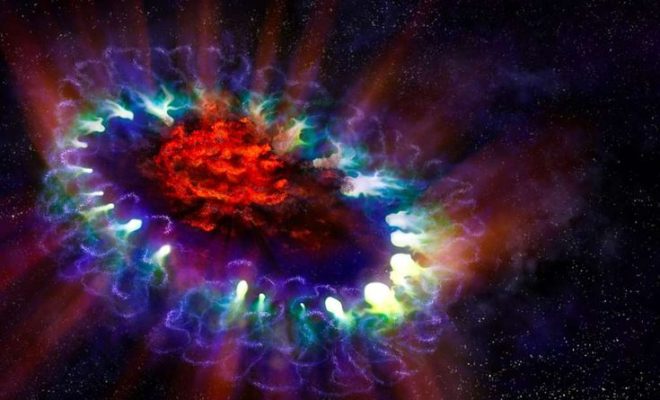
For over three decades, Supernova 1987a has captivated astronomers. This spectacular cosmic event, the closest supernova observed in centuries, has offered an unparalleled opportunity to study the death throes of a massive star. Now, a new era of research is dawning as the supernova’s remnant enters a crucial phase of evolution.
Recent observations reveal the supernova’s expanding shockwave is interacting with the star’s pre-existing circumstellar material. This interaction is creating a powerful shock front, heating the gas and emitting intense radiation, visible across the electromagnetic spectrum.
The new observations provide an unprecedented glimpse into the processes that occur during the late stages of a supernova’s evolution. They allow scientists to study the interplay between the expanding shockwave and the star’s ejected material, providing insights into the chemical enrichment of the interstellar medium and the formation of new stars.
Furthermore, the supernova’s remnant offers a unique laboratory for studying the physics of extreme environments. The high-energy radiation and powerful magnetic fields present in the remnant provide ideal conditions for probing the fundamental laws of nature.
With new telescopes and observational techniques coming online, the future of Supernova 1987a research looks brighter than ever. The upcoming years promise to unveil more secrets about this cosmic phenomenon, pushing the boundaries of our understanding of stellar evolution and the universe’s grand symphony of creation and destruction.