The Tech Edvocate

Top Menu

  • Advertisement
  • Apps
  • Home Page
  • Home Page Five (No Sidebar)
  • Home Page Four
  • Home Page Three
  • Home Page Two
  • Home Tech2
  • Icons [No Sidebar]
  • Left Sidbear Page
  • Lynch Educational Consulting
  • My Account
  • My Speaking Page
  • Newsletter Sign Up Confirmation
  • Newsletter Unsubscription
  • Our Brands
  • Page Example
  • Privacy Policy
  • Protected Content
  • Register
  • Request a Product Review
  • Shop
  • Shortcodes Examples
  • Signup
  • Start Here
    • Governance
    • Careers
    • Contact Us
  • Terms and Conditions
  • The Edvocate
  • The Tech Edvocate Product Guide
  • Topics
  • Write For Us
  • Advertise

Main Menu

  • Start Here
    • Our Brands
    • Governance
      • Lynch Educational Consulting, LLC.
      • Dr. Lynch’s Personal Website
      • Careers
    • Write For Us
    • The Tech Edvocate Product Guide
    • Contact Us
    • Books
    • Edupedia
    • Post a Job
    • The Edvocate Podcast
    • Terms and Conditions
    • Privacy Policy
  • Topics
    • Assistive Technology
    • Child Development Tech
    • Early Childhood & K-12 EdTech
    • EdTech Futures
    • EdTech News
    • EdTech Policy & Reform
    • EdTech Startups & Businesses
    • Higher Education EdTech
    • Online Learning & eLearning
    • Parent & Family Tech
    • Personalized Learning
    • Product Reviews
  • Advertise
  • Tech Edvocate Awards
  • The Edvocate
  • Pedagogue
  • School Ratings

logo

The Tech Edvocate

  • Start Here
    • Our Brands
    • Governance
      • Lynch Educational Consulting, LLC.
      • Dr. Lynch’s Personal Website
        • My Speaking Page
      • Careers
    • Write For Us
    • The Tech Edvocate Product Guide
    • Contact Us
    • Books
    • Edupedia
    • Post a Job
    • The Edvocate Podcast
    • Terms and Conditions
    • Privacy Policy
  • Topics
    • Assistive Technology
    • Child Development Tech
    • Early Childhood & K-12 EdTech
    • EdTech Futures
    • EdTech News
    • EdTech Policy & Reform
    • EdTech Startups & Businesses
    • Higher Education EdTech
    • Online Learning & eLearning
    • Parent & Family Tech
    • Personalized Learning
    • Product Reviews
  • Advertise
  • Tech Edvocate Awards
  • The Edvocate
  • Pedagogue
  • School Ratings
  • 100 Best Apps for Spaced Repetition

  • 100 Best Apps for Building a Second Brain

  • 100 Best Apps for Second Brain

  • A Casino Bonus Is Not Its Cash Value: How to Read Reviews Clearly

  • 100 Best Apps for Zettelkasten

  • 100 Best Apps for Bullet Journaling

  • 100 Best Apps for Getting Things Done

  • 100 Best Apps for GTD Method

  • 100 Best Apps for Overcoming Writer’s Block

  • 100 Best Apps for Beating Procrastination

Digital & Mobile Technology
Home›Digital & Mobile Technology›Mean Opinion Score (MOS): A Measure of Voice Quality

Mean Opinion Score (MOS): A Measure of Voice Quality
By Matthew Lynch
June 12, 2023
0
Spread the love

Mean Opinion Score (MOS) is a commonly used standardized method of measuring voice quality in telecommunication networks. It is used to assess and evaluate the quality of voice calls as perceived by human listeners.

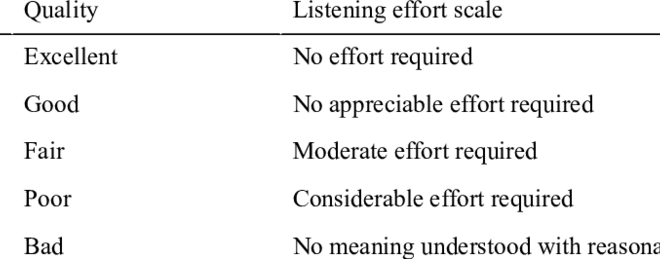
MOS is a subjective method, relying on human perception of voice quality. Typically, a sample of listeners is presented with a set of voice recordings, which are played back through a communication network. Listeners are then asked to rate the quality of each recording on a scale ranging from poor to excellent. The MOS is then calculated as an average of all the ratings, giving a single score that reflects the overall quality of the voice transmission.

MOS scores are typically reported on a scale of 1 to 5, with 1 being the lowest score and 5 being the highest. A score of 1 indicates that the voice quality is so poor that the communication is essentially unusable. A score of 5 indicates that the voice quality is excellent, and listeners can easily understand and follow the conversation.

MOS is used in a variety of applications, including voice over IP (VoIP) systems, cellular networks, and traditional landline telecommunication networks. In each of these situations, the MOS is used to evaluate the quality of voice transmissions and to identify potential problems or areas for improvement.

One of the benefits of using MOS is that it is a standardized method that can be used across different networks and technologies. This makes it easy to compare the quality of different voice communication systems and to identify best practices for ensuring good voice quality. Additionally, because MOS is based on human perception, it provides a measure of voice quality that is meaningful to end-users, who are ultimately the ones who benefit from good voice quality.

To ensure good voice quality and high MOS scores, it is critical to use high-quality networking equipment, including routers, switches and IP phones. Additionally, network administrators should monitor the network for issues such as packet loss, network congestion, and other factors that can degrade voice quality. By taking these steps, businesses and organizations can ensure that their voice communication systems provide high-quality voice transmissions that are easy to understand and follow.

In conclusion, MOS is a valuable tool for evaluating voice quality in telecommunication networks. By relying on human perception, MOS provides a measure of voice quality that is meaningful to end-users, helping to ensure that voice communication systems meet the needs and expectations of the people who rely on them. As businesses and organizations continue to rely on voice communication for critical functions, MOS will remain an important tool for ensuring that those communication systems provide high-quality, reliable voice transmissions that meet the needs of end-users.

Previous Article

How Ephemeral or Self-Destructing Messaging Works

Next Article

How to Reset a Windows 8 Password

Matthew Lynch

Related articles More from author

  • Digital & Mobile Technology

    How to Cast Netflix to Your TV

    June 13, 2023
    By Matthew Lynch
  • Digital & Mobile Technology

    Did you know your iPhone has a Built-In Noise Generator? Here’s How to Use It

    June 5, 2023
    By Matthew Lynch
  • Digital & Mobile Technology

    How to Transfer Music From iPhone to iPhone

    June 10, 2023
    By Matthew Lynch
  • Digital & Mobile Technology

    Face Yoga Apps to Ease Tension and Strengthen Your Facial Muscles

    June 15, 2023
    By Matthew Lynch
  • Digital & Mobile Technology

    Which Apple Watch Ultra Band Is Right for You?

    August 1, 2023
    By Matthew Lynch
  • Digital & Mobile Technology

    Social Workout Apps to Exercise With Friends and Meet Fitness Goals Together

    September 8, 2023
    By Matthew Lynch

Search

Login & Registration

  • Log in
  • Entries feed
  • Comments feed
  • WordPress.org

Newsletter

Signup for The Tech Edvocate Newsletter and have the latest in EdTech news and opinion delivered to your email address!

About Us

Since technology is not going anywhere and does more good than harm, adapting is the best course of action. That is where The Tech Edvocate comes in. We plan to cover the PreK-12 and Higher Education EdTech sectors and provide our readers with the latest news and opinion on the subject. From time to time, I will invite other voices to weigh in on important issues in EdTech. We hope to provide a well-rounded, multi-faceted look at the past, present, the future of EdTech in the US and internationally.

We started this journey back in June 2016, and we plan to continue it for many more years to come. I hope that you will join us in this discussion of the past, present and future of EdTech and lend your own insight to the issues that are discussed.

Newsletter

Signup for The Tech Edvocate Newsletter and have the latest in EdTech news and opinion delivered to your email address!

Contact Us

The Tech Edvocate
910 Goddin Street
Richmond, VA 23231
(601) 630-5238
[email protected]

Copyright © 2026 Matthew Lynch. All rights reserved.