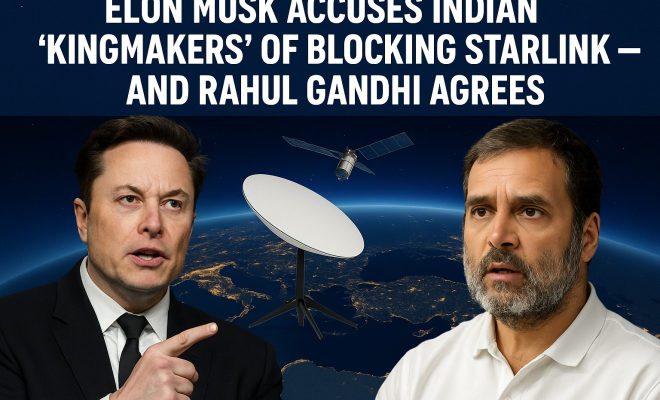
Elon Musk Accuses Indian ‘Kingmakers’ of Blocking Starlink — And Rahul Gandhi Agrees
“`html
When Elon Musk speaks, the world often listens – sometimes with bated breath, sometimes with a roll of the eyes. But when he points a finger at powerful business interests in a nation as significant as India, and then an opposition leader like Rahul Gandhi publicly throws his weight behind that accusation, you know you’ve got a story that transcends mere tech news. This isn’t just about satellite internet; it’s a dramatic saga weaving together technology, high-stakes politics, and the cutthroat world of international business. The core of the controversy? Musk’s assertion that Starlink, his ambitious satellite internet constellation, is being deliberately obstructed from entering the Indian market by entrenched players.
It’s a bold claim, one that immediately ignites questions about market fairness, regulatory hurdles, and even the very fabric of India’s economic landscape. For anyone tracking the global expansion of satellite broadband, or indeed, the often-turbulent journey of large foreign enterprises into complex markets, the unfolding situation with Elon Musk Starlink India is absolutely fascinating. It’s a testament to how even the most innovative technologies can crash headfirst into powerful, long-established forces.
The Genesis of the Gridlock: Elon Musk’s Allegations
Musk didn’t mince words. His accusation wasn’t vague or hinted at; it was direct and pointed: “powerful business interests in India” are, in his view, actively working to keep Starlink out. Now, who exactly are these interests? While Musk didn’t name names in his initial broad stroke, the context strongly suggests a rivalry with domestic telecom giants who stand to lose significant market share if a global, low-latency satellite internet service were to gain a foothold. Think about it: a country with a vast, often underserved rural population, where traditional fiber and mobile infrastructure can be costly and slow to deploy. Starlink, with its promise of high-speed internet beamed down from space, represents a formidable threat to existing providers.
This isn’t a new playbook in the world of global commerce. Foreign companies, particularly those offering disruptive technologies, frequently encounter resistance from local incumbents who benefit from the status quo. These incumbents often wield considerable influence, not just economically but politically, making market entry a bureaucratic and often bruising battle. Musk’s frustration seems to stem from what he perceives as an unfair playing field, where genuine innovation is stifled by those protecting their turf. The implications for India’s digital future, and its global image as an open market, are considerable.
Rahul Gandhi’s Unexpected Endorsement: A Political Alliance?
Perhaps the most intriguing twist in this whole saga is the public support offered by Rahul Gandhi. A prominent figure in Indian politics, and a scion of the Nehru-Gandhi dynasty, Gandhi’s backing of Musk’s claims adds a significant political dimension. It elevates the discussion from a mere business dispute to a matter of national debate, questioning the transparency and fairness of India’s economic policies. When a leading opposition figure aligns with a foreign billionaire against unnamed but implied powerful domestic entities, it sends a clear signal: this isn’t just about Starlink’s business model; it’s about who holds power and influence within India.
Gandhi’s endorsement suggests that he views Musk’s allegations as more than just corporate gripes. He likely sees them as symptomatic of broader issues within the Indian economy – perhaps concerns about monopolistic practices, crony capitalism, or a system that favors certain players over others. For Musk, having a powerful political voice validate his concerns, even if indirectly, lends credibility to his narrative and puts pressure on the Indian government to address the perceived roadblocks. It’s a strategic alignment that few would have predicted, and it certainly ratchets up the tension in the Elon Musk Starlink India narrative.
The Shadow of Mukesh Ambani and Jio Platforms
While Musk might not have explicitly named names, the elephant in the room, or rather, the billionaire in the room, is Mukesh Ambani. His conglomerate, Reliance Industries, through its telecom arm Jio Platforms, is a colossal force in India’s digital landscape. Jio revolutionized the Indian telecom market with its aggressive pricing and widespread network, essentially democratizing internet access for hundreds of millions. Now, Jio Platforms itself is eyeing the satellite internet space, awaiting its own clearances. This sets up a direct, high-stakes rivalry between two of the world’s most ambitious and wealthy entrepreneurs.
The competition isn’t just theoretical; it’s deeply personal and intensely strategic. Musk’s pledge to price Starlink affordably in India can be seen as a direct challenge to Jio’s market dominance and its strategy of offering low-cost data. If Starlink enters and offers competitive pricing, it could disrupt Jio’s nascent satellite ambitions and even impact its existing wireless business in areas where traditional infrastructure struggles. This isn’t just about market share; it’s about the future of connectivity in a nation of 1.4 billion people, and the titans who want to define that future.
India’s Stance: Security, Approvals, and the Rule of Law
On the other side of the fence, the Indian government has maintained a firm, consistent position: Starlink, like any other telecom operator, needs to complete all necessary security assessments and regulatory approvals. They’ve explicitly rejected any allegations of unfair treatment or deliberate obstruction. From the government’s perspective, this isn’t about favoring one company over another; it’s about adhering to established legal frameworks, ensuring national security, and maintaining a level playing field for all potential entrants.
India is a sovereign nation with robust regulatory processes, particularly in strategic sectors like telecommunications. These processes often involve multiple layers of review, including spectrum allocation, licensing, and rigorous security checks. Given the nature of satellite internet, which involves beaming data across international borders and potentially bypassing traditional national infrastructure, security concerns are paramount. The government’s argument is that these are standard procedures, not targeted barriers. However, the perception of bureaucracy as a weapon, wielded to protect entrenched interests, is a narrative that powerful figures like Musk and Gandhi are keen to challenge.
The Ghost of Lasers in Space: Resurfaced Messages and Misinterpretations
Adding a layer of viral intrigue to the whole affair, old private messages from Elon Musk about “10,000 lasers in space” have resurfaced. These messages, initially about the technical capabilities and inter-satellite links of the Starlink constellation, were quickly seized upon by some online commentators and media outlets, with wild speculation about their implications. Some even went as far as to suggest they hinted at election interference or other nefarious uses. It’s a classic example of how out-of-context information can be amplified and distorted in the digital age, especially when a polarizing figure like Musk is involved. (See: Starlink satellite internet service.)
It’s crucial to understand the actual context here. Starlink satellites use laser links to communicate with each other in orbit, creating a mesh network that reduces reliance on ground stations and improves latency. This is a fundamental part of the technology’s design and a significant engineering feat. The “10,000 lasers” refers to these inter-satellite links, not some kind of weaponized space platform. While the resurfacing of these messages doesn’t prove anything about election interference or market obstruction, it certainly adds to the public drama surrounding Elon Musk Starlink India, fueling speculation and providing fodder for critics and conspiracy theorists alike.
The Broader Implications for India’s Digital Ambitions
Beyond the immediate clash of personalities and corporations, the struggle over Starlink’s entry has significant implications for India’s broader digital ambitions. The Indian government has championed initiatives like “Digital India,” aiming to connect every citizen and foster a digitally empowered society. Achieving this goal requires robust, widespread, and affordable internet access, particularly in rural and remote areas where traditional infrastructure deployment is challenging. Satellite internet, by its very nature, is uniquely positioned to bridge these digital divides. For more context, see Sam Altman’s OpenAI Reign: The Untold Story Behind AI's Reckless Frontier.
If Starlink, or indeed other global satellite players, face insurmountable hurdles, it could slow down the pace of digital inclusion. It raises questions about whether India is truly open to global innovation that can accelerate its development goals, or if protectionist tendencies will ultimately prevail. The outcome of this particular battle with Elon Musk Starlink India will send a powerful signal to other international tech companies considering investment and expansion in India, potentially shaping the future of its digital economy for years to come.
Navigating the Regulatory Maze: A Global Challenge
This isn’t just an India-specific issue; it’s a global challenge faced by many governments grappling with the rapid pace of technological change. Satellite internet, particularly constellations like Starlink, operates on a different paradigm than traditional terrestrial telecom. It involves international spectrum coordination, orbital slot management, and unique security considerations. Regulators worldwide are trying to adapt their frameworks to these new realities, often playing catch-up.
For Starlink, navigating these diverse and often complex regulatory environments is a key part of its global expansion strategy. Each country presents its own set of rules, cultural nuances, and political sensitivities. What works in one nation might be a non-starter in another. The friction in India highlights the ongoing tension between a global technology company seeking rapid, widespread deployment and national governments asserting their sovereign right to regulate their airwaves and ensure national interests are protected. It’s a dance between innovation and control that is playing out in various forms across the globe.
The High Stakes of a High-CPC Niche: Telecom and Investment
For those tracking the financial pulse of the internet, this entire controversy is a goldmine. The telecom and investment niches are notoriously high-CPC (Cost Per Click) sectors, meaning advertisers pay a premium for targeted traffic. News and analysis around Elon Musk Starlink India, particularly with its blend of tech, politics, and business intrigue, hits all the right notes for monetization. Investors are keen to understand the market dynamics, the potential for disruption, and the regulatory risks involved. Telecom industry watchers are analyzing the competitive landscape and the strategies of major players.
The emotional charge of the subject – the David vs. Goliath narrative, the accusations of unfair play, the promise of affordable internet for the masses – makes it incredibly engaging. This isn’t just a dry business report; it’s a compelling story that draws in a wide audience, from tech enthusiasts to political observers to potential investors. The sheer volume of search interest and the high value of related advertising keywords make this a particularly lucrative area for content creators and news organizations.
What’s Next for Elon Musk Starlink India?
So, where does this leave Elon Musk Starlink India? The situation remains fluid, a fascinating deadlock between ambition and regulation, innovation and incumbency. Musk is unlikely to back down, given his track record of pushing boundaries and challenging established norms. Rahul Gandhi’s public support adds a layer of political pressure that the Indian government can’t easily dismiss, even if they maintain their current stance.
Ultimately, a resolution will likely require a delicate balance. Starlink will need to demonstrate its willingness to fully comply with India’s regulatory requirements, including security protocols and licensing procedures. The Indian government, in turn, will need to ensure that its processes are transparent, efficient, and not unduly influenced by domestic commercial interests. The stakes are too high – for India’s digital future, for Starlink’s global expansion, and for the principle of fair competition – for this issue to simply fade away. We’re watching a real-time test of whether a disruptive global technology can find a way to thrive in one of the world’s most complex and promising markets.
The Economic Impact of Broadband Access in India
Let’s zoom out a bit and consider the sheer economic power broadband access unlocks, especially in a country like India. The World Bank and various economic studies consistently show a direct correlation between internet penetration and economic growth. We’re talking about increased GDP, job creation, and improved access to education and healthcare. For India, a nation aiming to become a global economic powerhouse, widespread, affordable high-speed internet isn’t a luxury; it’s foundational infrastructure.
Starlink’s proposition, with its ability to reach remote villages and isolated communities without the need for extensive ground infrastructure, could be a game-changer. Imagine a farmer in a rural district suddenly having access to real-time market prices, weather forecasts, and agricultural best practices. Or a student in a remote area being able to participate in online learning, bridging the educational gap. These aren’t just feel-good stories; they translate into tangible economic benefits. The debate around Elon Musk Starlink India, therefore, isn’t just about one company’s market entry; it’s about the pace and equity of India’s economic development.
When you consider that a significant portion of India’s population still lacks reliable internet, the potential impact of a service like Starlink becomes even clearer. The digital divide isn’t just about urban versus rural; it’s about opportunity. Closing that gap means empowering millions, fostering entrepreneurship, and integrating more people into the formal economy. Any perceived roadblocks to technologies that can achieve this quickly deserve intense scrutiny.
Comparisons to Other Markets: Starlink’s Global Footprint
It’s helpful to look at how Starlink has fared in other challenging markets. While India presents its unique set of complexities, Starlink has successfully launched in dozens of countries, often navigating diverse regulatory landscapes. In some nations, it’s been welcomed as a critical infrastructure provider, especially in areas hit by natural disasters or those with poor existing connectivity. In others, it has faced similar scrutiny regarding licensing, spectrum, and data sovereignty. (See: BBC coverage on satellite internet.)
For example, in countries like Ukraine, Starlink became a vital communication lifeline during conflict, showcasing its resilience and rapid deployment capabilities. In parts of Africa and Latin America, it’s providing essential connectivity to underserved communities, often partnering with local governments or NGOs. This global track record suggests that Starlink is generally adept at working within established frameworks, even if its aggressive expansion sometimes pushes boundaries. The Indian situation, however, seems to be a particularly tough nut to crack, perhaps due to the sheer scale of the market and the deeply entrenched domestic players with significant political sway. The contrast highlights that while Starlink is a global player, each market has its own unique political and economic ecosystem that demands a tailored approach.
The Role of Spectrum Allocation in the Starlink Debate
A critical technical and regulatory hurdle in the Elon Musk Starlink India saga is spectrum allocation. For any wireless communication service, access to radio frequency spectrum is non-negotiable. Governments worldwide manage this finite resource, and typically, spectrum is auctioned off to telecom operators for substantial sums. Starlink, like other satellite internet providers, needs specific frequency bands to operate its ground terminals and communicate with its satellites. For more context, see The UK’s Cyber Security Is On The Brink.
The debate often centers on whether spectrum for satellite broadband should be auctioned or allocated administratively. Traditional telecom players, who’ve invested billions in auctioning 5G and other mobile spectrum, often argue that satellite providers should also go through the auction process to ensure a level playing field. Starlink, and others in the satellite industry, typically advocate for administrative allocation, arguing that their service complements, rather than directly competes with, terrestrial mobile networks, especially in underserved areas. They also point to the global nature of satellite operations, where spectrum usage isn’t confined to national borders in the same way terrestrial networks are.
This technical detail becomes a major political football. If the Indian government decides to auction the necessary spectrum, it could significantly increase Starlink’s cost of entry, potentially making its services less affordable and less competitive against domestic players who already hold vast spectrum licenses. This is a common point of contention globally and a key reason for the “regulatory maze” Starlink faces.
Expert Perspectives: Telecom Analysts Weigh In
When you talk to telecom industry analysts and policy experts, there are often diverging viewpoints on the Elon Musk Starlink India situation. Some argue that India’s government is rightly protecting national interests and ensuring that any foreign player adheres to strict security and regulatory norms. They emphasize that India has a thriving domestic telecom sector that has invested heavily, and it’s fair to ensure a level playing field for all.
Others express concern that overly stringent regulations or perceived protectionism could stifle innovation and slow down the pace of digital inclusion. They point out that satellite broadband offers a unique solution for areas where fiber or mobile rollout is economically unfeasible. Many experts believe that India needs a combination of technologies – fiber, mobile, and satellite – to achieve its ambitious “Digital India” goals. The challenge, they say, is to create a regulatory framework that encourages all forms of connectivity without unduly favoring one technology or player over another. The consensus is that while competition is healthy, genuine market access for disruptive technologies ultimately benefits consumers.
Potential for Collaboration Over Confrontation
Is there a middle ground for Elon Musk Starlink India? Many observers hope for a path that leads to collaboration rather than continued confrontation. Could Starlink partner with existing Indian telecom providers like Jio or Airtel to leverage their distribution networks and local expertise? Such partnerships could potentially smooth regulatory hurdles, reduce deployment costs, and accelerate market penetration for Starlink.
For Indian telecom giants, a partnership could offer a way to expand their own service offerings, particularly in rural and remote areas where their traditional infrastructure might be lacking. It could also provide them with access to cutting-edge satellite technology. This kind of strategic alliance isn’t unheard of in the global telecom space. It represents a win-win scenario where foreign innovation meets local market knowledge, potentially sidestepping the current deadlock and delivering the benefits of advanced connectivity to Indian citizens faster. The question is whether the current atmosphere of rivalry will allow for such an arrangement to take shape.
FAQ: Understanding Elon Musk Starlink India
Q1: What exactly are Elon Musk’s allegations regarding Starlink’s entry into India?
Elon Musk has stated that “powerful business interests in India” are actively working to obstruct Starlink’s entry into the Indian market. He implies that these entrenched players are using their influence to create regulatory hurdles and prevent fair competition, ultimately stifling innovation.
Q2: Why is Rahul Gandhi’s support significant in this context?
Rahul Gandhi, a prominent opposition leader in India, publicly backing Musk’s claims adds a major political dimension. It elevates the issue from a corporate dispute to a national debate about market fairness, potential monopolistic practices, and the transparency of India’s economic policies. His support lends credibility to Musk’s narrative and puts pressure on the government. For more context, see Your Cyber Defenses Are Already Under Attack by AI. (See: New York Times article on Musk and India.)
Q3: Which “powerful business interests” are believed to be behind the obstruction?
While Musk hasn’t explicitly named them, the context strongly points to domestic telecom giants, particularly Mukesh Ambani’s Jio Platforms. Jio is a dominant player in India’s digital landscape and is also developing its own satellite internet capabilities, setting up a direct competitive rivalry with Starlink.
Q4: What is the Indian government’s official stance on Starlink’s entry?
The Indian government maintains that Starlink, like any other telecom operator, must complete all necessary security assessments and regulatory approvals. They deny any allegations of unfair treatment or deliberate obstruction, emphasizing that they are adhering to established legal frameworks and ensuring national security.
Q5: What are the main regulatory hurdles Starlink faces in India?
Starlink faces several regulatory challenges, including obtaining appropriate licenses, completing security assessments, and securing spectrum allocation. The debate around spectrum often involves whether it should be auctioned (as traditional telecom players advocate) or administratively allocated (as satellite providers prefer).
Q6: How could Starlink benefit India’s digital ambitions?
Starlink’s satellite internet service could significantly boost India’s “Digital India” initiative by providing high-speed, affordable internet access to rural and remote areas where traditional fiber and mobile infrastructure is costly and difficult to deploy. This can help bridge the digital divide, foster economic growth, and improve access to education and healthcare.
Q7: What is the significance of the “10,000 lasers in space” messages?
Old private messages from Elon Musk about “10,000 lasers in space” resurfaced, causing some speculation. In context, these refer to the inter-satellite laser links that Starlink uses to communicate between its satellites in orbit, creating a mesh network. It’s a technical aspect of the system, not related to nefarious uses or election interference, but it added to the public drama.
Q8: Are there other global examples of Starlink facing similar challenges?
Yes, Starlink has faced varying regulatory challenges in many countries as it expands globally. Each nation has its own unique rules for spectrum allocation, licensing, and security. While it has successfully launched in many markets, the friction in India highlights the ongoing tension between a global tech company and national governments asserting their sovereign right to regulate.
Q9: What are the potential economic implications if Starlink is blocked from India?
If Starlink faces insurmountable hurdles, it could slow down the pace of digital inclusion in India, particularly for underserved populations. It might also send a signal to other international tech companies about the challenges of entering the Indian market, potentially impacting foreign investment and innovation that could contribute to India’s digital economy.
Q10: What might a potential resolution look like for Elon Musk Starlink India?
A resolution would likely involve Starlink fully complying with India’s regulatory requirements, including security protocols and licensing. The Indian government, in turn, would need to ensure its processes are transparent and efficient. Collaboration, such as partnerships between Starlink and existing Indian telecom providers, could also be a path forward to leverage mutual strengths and accelerate connectivity.
“`
Trending Now
- ¿Preordenar GTA VI? Esto Es Lo Que Nadie Te Dice Sobre los Precios y el Escándalo
- read the full story
- this guide on why your next gaming console might cost a fortune – and 9 budget alternatives for 2026
- Is the Xbox Series X or PS5 a Complete Rip-Off in 2026? The Uncomfortable Truth About Console Value
Frequently Asked Questions
Why did Elon Musk accuse India of blocking Starlink?
Elon Musk accused India of blocking Starlink due to what he described as 'powerful business interests' actively working to prevent the satellite internet service from entering the Indian market. This accusation suggests a rivalry with domestic telecom companies that could lose market share to Starlink's innovative technology.
What was Rahul Gandhi's reaction to Musk's accusations?
Rahul Gandhi publicly supported Elon Musk's accusations against powerful business interests in India, indicating that he agrees with the concerns about market fairness and the challenges faced by foreign companies trying to enter the Indian telecommunications landscape.
How does Starlink's entry affect India's telecommunications market?
Starlink's entry into the Indian market could significantly disrupt the telecommunications landscape by providing high-speed satellite internet, particularly in underserved rural areas. This poses a threat to traditional telecom companies that rely on existing infrastructure and may lead to increased competition and innovation.
What are the regulatory challenges for Starlink in India?
Starlink faces various regulatory challenges in India, including obtaining necessary licenses and navigating complex policies that govern telecommunications. These hurdles are compounded by opposition from established telecom players who may resist the entry of a foreign competitor that could alter the market dynamics.
What is the significance of Musk's claims about Starlink in India?
Musk's claims highlight the intersection of technology, politics, and business interests in India. They raise important questions about market access, regulatory fairness, and the potential for innovation in a country with a large, underserved population reliant on improved internet connectivity.
Agree or disagree? Drop a comment and tell us what you think.