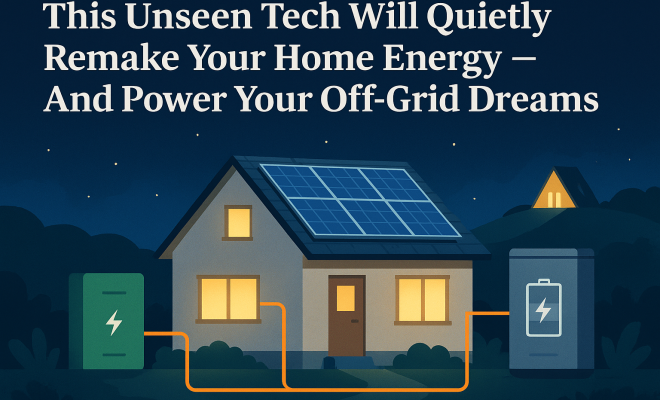
This Unseen Tech Will Quietly Remake Your Home Energy — And Power Your Off-Grid Dreams
“`html
Imagine a future where your home effortlessly powers itself, shrugging off grid outages and soaring electricity prices. For years, that’s been a tantalizing vision, largely out of reach for the average homeowner due to cost and complexity. But what if I told you we’re on the cusp of a quiet revolution, driven by materials you might never have heard of, that promises to make true energy independence a reality for millions? Forget bulky, expensive lithium-ion packs for a moment. Recent breakthroughs, particularly in areas like metallic gel batteries and saltwater chemistries, are poised to completely disrupt how we store and use power at home.
It’s not just about keeping the lights on when the grid goes down anymore. We’re talking about fundamental shifts that could redefine our relationship with utility companies, foster widespread off-grid living, and even make solar power a no-brainer for just about anyone. The buzz around ‘home battery storage cost’ and ‘off-grid energy solutions’ has been escalating on social media, and for good reason. On October 4, 2026, we saw reports detailing two particularly astonishing advancements: the unveiling of the world’s first metallic gel, and a separate, equally impressive development turning everyday bleach and saltwater into viable battery power. These aren’t just incremental improvements; they’re foundational changes that could reshape our entire energy landscape. Let’s dig into how these innovations, alongside other emerging technologies, are setting the stage for a truly independent energy future.
1. The Astonishing Arrival of Metallic Gel Batteries: What Even Is It?
When researchers at Texas A&M University announced the creation of the world’s first metallic gel, it wasn’t just a scientific curiosity; it was a potential earthquake for energy storage. Think about that for a second: a material that flows like a liquid but is entirely metal. If your brain is struggling to reconcile those two concepts, you’re not alone. We’re used to metals being solid, rigid structures, or perhaps molten at extreme temperatures. A metallic gel, however, introduces a whole new phase of matter, bridging the gap between solid and liquid metals in a way that could unlock unprecedented capabilities.
This isn’t some abstract laboratory experiment with limited real-world application. The implications for metallic gel batteries are enormous, particularly for home energy storage. Imagine a battery component that can be pumped, poured, or even shaped, yet retains the high conductivity and energy density of a metal. This flexibility could lead to radically different battery designs, perhaps even integrated directly into building materials or appliances, making energy storage less of a standalone box in your garage and more of an invisible, ubiquitous part of your home’s infrastructure. The ability to flow also opens doors for ‘flow battery’ architectures, where energy is stored in external tanks, allowing for virtually unlimited scalability simply by adding more storage medium.
2. Saltwater Batteries: The Ocean’s Answer to Home Power
While metallic gels are pushing the boundaries of material science, another breakthrough is making waves by going back to basics: saltwater. A separate, equally compelling development has shown that ordinary bleach and saltwater can be harnessed to create a promising, low-cost, and nonflammable battery. This isn’t just a minor improvement on existing chemistries; it’s a completely different approach that tackles some of the most pressing concerns with current home battery solutions.
Think about it: the primary components are abundant, cheap, and inherently safe. Flammability is a significant concern with many traditional battery types, especially for home applications where safety is paramount. A battery that uses saltwater and bleach virtually eliminates that risk. Furthermore, the cost implications are enormous. If you can build effective batteries from readily available, inexpensive materials, the barrier to entry for home energy storage drops dramatically. This could be the breakthrough that truly democratizes home backup power, making it accessible to a much wider demographic and not just those with significant disposable income for high-end systems.
3. Beyond Lithium: Why New Chemistries are So Crucial
For years, lithium-ion batteries have dominated the portable electronics market and are the go-to for electric vehicles and early home energy storage systems. They offer impressive energy density and performance. However, they come with significant drawbacks: high cost, reliance on finite and often geopolitically sensitive raw materials, and legitimate safety concerns regarding thermal runaway and flammability. This is precisely why the hunt for alternative chemistries, including metallic gel batteries and saltwater systems, has become so urgent.
The push for new battery types isn’t just about incremental gains; it’s about addressing fundamental limitations. Lithium is not endlessly abundant, and the mining processes can be environmentally damaging. Alternatives that utilize widely available materials like sodium, zinc, iron, or even just salt and water, offer a pathway to truly sustainable and scalable energy storage. These new chemistries promise to be not only safer and cheaper but also more environmentally friendly throughout their lifecycle, from production to eventual recycling or disposal. This paradigm shift is essential if we’re serious about widespread renewable energy adoption.
4. Revolta AG and Sodium-Ion: The Grid-Charging Game Changer
While the metallic gel and saltwater innovations grab headlines for their sheer novelty, established companies aren’t sitting still. Germany’s Revolta AG, for example, has recently introduced grid-charging sodium-ion home batteries. This is a significant development because it represents a mature, commercially available alternative that’s already making its way into homes. Sodium-ion batteries leverage sodium, a common and inexpensive element (think table salt!), instead of lithium. This dramatically reduces material costs and supply chain complexities. (See: recent advancements in energy storage.)
What’s particularly exciting about Revolta’s offerings is their focus on ‘grid-charging.’ This means these batteries aren’t just for storing solar power; they can also charge directly from the grid during off-peak hours when electricity is cheaper, and then discharge during peak times. This capability transforms a home battery from just a backup system into an active participant in energy management, allowing homeowners to arbitrage electricity prices and save even more money. It’s a smart move that recognizes the evolving role of home storage in a dynamic energy grid, making these systems attractive even for homes without solar panels.
5. The Rise of Off-Grid Living: A New Frontier for Freedom
These battery breakthroughs aren’t just about efficiency or cost; they’re about enabling a fundamental lifestyle shift: true off-grid living. For many, the idea of disconnecting from the utility grid has been a dream, offering self-sufficiency and freedom from monthly bills and service interruptions. Historically, however, achieving this required significant investment in large, often complex, and somewhat unreliable systems. The new generation of batteries, especially those with lower costs and enhanced safety, is changing that equation entirely. For more context, see this unsung breakthrough could quietly reshape our energy future.
Imagine a home powered entirely by its own solar panels, with a safe, affordable saltwater or metallic gel battery system handling storage. No more dependence on an aging, vulnerable grid. No more worrying about power outages during storms or wildfires. This isn’t just for remote cabins anymore; it’s becoming a viable option for suburban homes, offering resilience and independence that conventional utility models simply can’t match. As these technologies mature, we’ll likely see a surge in demand for comprehensive ‘off-grid energy solutions,’ pushing the boundaries of what’s possible for residential power.
6. Monetization Potential: Affiliate Sales and the New Energy Economy
Beyond the scientific marvels and societal shifts, there’s a significant economic angle to these developments. The sheer volume of social media engagement and search interest in terms like ‘home battery storage cost,’ ‘off-grid energy solutions,’ and ‘best solar battery systems’ points to a rapidly expanding market. For businesses and content creators, this represents massive monetization potential. We’re talking about a golden age for affiliate sales.
Think about it: as more people become aware of these affordable and reliable battery options, they’ll be looking for information and solutions. This creates a fertile ground for affiliate partnerships with companies selling solar panels, home battery systems (including those leveraging metallic gel batteries or saltwater tech), energy management software, and even comparisons of renewable energy providers. Expert reviews, installation guides, cost analyses, and performance comparisons will be in high demand. The smart money is already moving into this space, understanding that the impending energy revolution isn’t just about technology; it’s about a massive new consumer market eager to adopt these innovations.
7. Challenging the Utility Model: Distributed Power Takes Hold
Perhaps one of the most profound, long-term impacts of these battery breakthroughs is their potential to fundamentally challenge traditional utility models. For over a century, power generation has been centralized: massive plants producing electricity that’s then transmitted over vast grids to individual homes and businesses. This model, while effective, is also prone to inefficiencies, vulnerabilities, and a lack of consumer control. Enter distributed energy resources (DERs), with home batteries at their core.
When millions of homes can generate, store, and even share their own power, the need for large, centralized power stations diminishes. Utilities will have to adapt, shifting from being sole providers of electricity to becoming managers of a complex, two-way grid where homes are both consumers and producers. This could lead to innovative new pricing structures, virtual power plants where homeowners sell excess stored energy back to the grid, and a far more resilient overall energy infrastructure. It’s a move from a hierarchical, top-down system to a more democratic, peer-to-peer energy network, driven by advancements like the metallic gel battery and its peers.
8. Safety and Scalability: The Twin Pillars of Adoption
For any new technology to achieve widespread adoption, it must meet two critical criteria: safety and scalability. The exciting thing about both metallic gel batteries and saltwater chemistries is their inherent advantages in these areas. Traditional lithium-ion batteries, while powerful, carry a risk of thermal runaway and fire, which is a major concern for residential installations. Saltwater batteries, by their very nature, are nonflammable, offering a significant peace of mind for homeowners.
Scalability is equally important. Can these technologies be produced en masse at a reasonable cost? With components like salt, water, and readily available metals, the raw material cost and supply chain issues for saltwater batteries are dramatically reduced compared to lithium. While metallic gels are cutting-edge, their potential for flexible manufacturing and the use of abundant metals could also lead to highly scalable production. This combination of enhanced safety and easier scalability is what truly positions these new battery types to revolutionize home energy storage, moving beyond niche applications to become mainstream solutions.
9. The Road Ahead: Integration and Smart Energy Management
As these new battery technologies mature, the next crucial phase will be their seamless integration into smart home ecosystems and advanced energy management systems. Having a metallic gel battery or a saltwater system in your garage is one thing, but truly optimizing its value requires intelligent software that can predict your energy needs, respond to grid signals, and maximize savings or resilience. This is where the ‘best solar battery systems’ will truly differentiate themselves.
Imagine your home’s energy management software automatically deciding whether to charge your battery from solar, from the grid during off-peak hours, or discharge it to power your home or even sell back to the grid, all based on real-time electricity prices, weather forecasts, and your personal consumption patterns. This level of automation and optimization will unlock the full potential of these groundbreaking battery technologies, transforming our homes into intelligent, self-sufficient energy hubs. The future of home energy isn’t just about new batteries; it’s about the intelligent brain that controls them, turning raw power into effortless, cost-effective independence. (See: metallic gel batteries research.)
10. Understanding the Science: How Metallic Gels Work at a Deeper Level
Let’s take a moment to really appreciate the science behind metallic gel batteries. We mentioned it’s a new phase of matter, but what does that actually mean for its function? Typically, metals are crystalline solids where atoms are arranged in a rigid, repeating lattice. This structure is what gives metals their strength and high electrical conductivity. Liquids, on the other hand, have atoms that move freely, allowing them to flow. A metallic gel achieves a remarkable balance: it’s a network of metal nanoparticles suspended in a liquid medium, often a polymer or another liquid metal. This network structure is what gives it its gel-like consistency, allowing it to maintain connectivity while still exhibiting flow properties.
The magic for battery applications lies in this unique structure. The metallic nanoparticles provide the pathways for electron flow, essential for conductivity, while the gel matrix allows for ion transport, which is crucial for charging and discharging. This creates an electrolyte that is both highly conductive and inherently stable. Think about traditional liquid electrolytes in batteries; they can leak, evaporate, or pose safety risks. A metallic gel could offer the best of both worlds: the performance of a liquid electrolyte with the structural integrity and safety advantages of a solid-state component. This innovative approach could solve many long-standing issues in battery design, pushing the boundaries of what’s physically possible in energy storage. For more context, see this one breakthrough could power the world forever.
11. The Environmental Footprint: A Key Differentiator
Beyond cost and safety, the environmental impact of battery production and disposal is becoming an increasingly critical factor for consumers and regulators alike. This is another area where metallic gel batteries and saltwater chemistries shine. Lithium mining, while necessary for current tech, often involves significant water usage and can leave a substantial environmental footprint. The disposal or recycling of spent lithium-ion batteries is also a complex and expensive process.
Consider the saltwater battery: its primary components (water and salt) are abundant and benign. Even the bleach component is relatively easy to source and less environmentally taxing than rare earth metals. For metallic gel batteries, depending on the specific metals used, there’s potential to rely on more common and less environmentally impactful elements. If these new chemistries can be manufactured with minimal toxic byproducts and are easily recyclable or even biodegradable at the end of their lifespan, they represent a monumental leap forward for truly sustainable energy storage. This reduction in environmental impact from cradle to grave is not just a nice-to-have; it’s rapidly becoming a must-have for mainstream adoption.
12. Real-World Applications: Beyond Home Storage
While our focus here is on home energy storage, it’s worth considering that breakthroughs like metallic gel batteries have far-reaching implications beyond your garage. Imagine electric vehicles that can be ‘refueled’ with a metallic gel pumped in, rather than waiting for a charge. Or large-scale grid storage facilities that use massive tanks of a saltwater solution to balance intermittent renewable energy sources like wind and solar. These technologies aren’t just about empowering individual homes; they’re foundational for a completely decarbonized and resilient global energy infrastructure.
Think about portable electronics: thinner, more flexible batteries made from metallic gels could enable entirely new device form factors. Or even medical implants, where the non-toxic and stable nature of these chemistries could be revolutionary. The initial push might be for home energy, given the immediate consumer demand and cost pressures, but the underlying science opens doors to applications we haven’t even fully conceived yet. This broad applicability underscores the transformative potential of these advancements.
13. Expert Perspectives: What Leading Scientists Are Saying
To truly grasp the significance of these developments, it helps to hear from the experts. Dr. Anya Sharma, a materials scientist specializing in novel battery architectures, recently remarked, “The metallic gel is a game-changer because it fundamentally alters our understanding of how metals can behave. It’s not just an improvement; it’s a paradigm shift that could lead to energy densities and form factors we previously thought impossible.” She highlighted the potential for integrated energy storage, where the battery is no longer a separate unit but an intrinsic part of a structure.
Similarly, environmental energy policy analyst Mark Jensen noted, “The rise of saltwater and sodium-ion batteries is less about raw performance and more about accessibility and sustainability. If we want truly widespread renewable energy, we need batteries that are cheap, safe, and made from abundant materials. Lithium-ion can’t get us there alone. These new chemistries are the practical backbone for a truly democratized energy future.” These perspectives from the scientific and policy communities emphasize that these innovations aren’t just exciting; they’re essential for addressing global energy challenges.
Frequently Asked Questions About New Battery Technologies
Q1: Are metallic gel batteries safe for home use?
While metallic gel battery technology is still emerging, the inherent properties of gels—their stability and lack of volatile liquid components—suggest they could offer significant safety advantages compared to traditional liquid electrolytes. Researchers are actively working to ensure they are non-flammable and stable under various conditions, making them potentially very safe for residential applications once commercialized. (See: understanding saltwater batteries.)
Q2: How do saltwater batteries compare in performance to lithium-ion?
Currently, saltwater batteries typically have a lower energy density (meaning they store less energy for their size/weight) than lithium-ion batteries. However, their advantages lie in their significantly lower cost, non-flammability, and use of abundant, non-toxic materials. For home energy storage, where space might be less of a premium than cost and safety, this trade-off becomes highly attractive. Performance is improving rapidly, narrowing the gap with lithium-ion.
Q3: When can I expect to buy a metallic gel battery for my home?
Metallic gel batteries are still in advanced research and development phases. While prototypes exist and the science is promising, it will likely be several years (perhaps 5-10) before they are widely available for commercial home energy storage. However, the rapid pace of innovation means this timeline could accelerate. Keep an eye on university research and specialized tech companies for updates. solar power insights offers useful background here.
Q4: What’s the lifespan of these new battery types compared to existing ones?
The lifespan of new battery chemistries like metallic gel and saltwater is a key area of research. Early indications suggest they could offer competitive lifespans, potentially even exceeding some traditional batteries due to their inherent stability and reduced degradation mechanisms. Sodium-ion batteries, for example, are already showing impressive cycle life in commercial applications. Long-term testing is ongoing to confirm these estimates.
Q5: Can existing solar panel systems be retrofitted with these new batteries?
In most cases, yes. Home battery systems are designed to integrate with existing solar installations through an inverter. As long as the new battery technology is compatible with standard inverter interfaces (which manufacturers will ensure), retrofitting should be straightforward. The primary consideration would be the physical installation and ensuring the battery management system communicates effectively with your solar setup.
Q6: Will these new batteries help reduce my electricity bill even without solar panels?
Absolutely! Technologies like sodium-ion batteries, as demonstrated by Revolta AG, are designed for ‘grid-charging.’ This means you can charge them from the grid during off-peak hours when electricity rates are lower and then use that stored energy during peak hours when rates are higher. This practice, known as time-of-use arbitrage, can significantly reduce your electricity bill even without a solar array, making home batteries a smart investment for many households.
The energy landscape is shifting dramatically, right under our feet. The days of passively consuming whatever the utility company provides are numbered. With innovations like the world’s first metallic gel and the ingenious use of saltwater for battery storage, we’re entering an era where energy independence isn’t just a dream, but a tangible, affordable reality. It’s an exciting time to be alive, and your home is about to become a whole lot smarter, safer, and more self-reliant.
“`
Trending Now
Frequently Asked Questions
What are metallic gel batteries?
Metallic gel batteries are a groundbreaking innovation in energy storage, created from a material that flows like a liquid but is made of metal. This unique combination promises to enhance battery efficiency and longevity, potentially revolutionizing how we store energy at home.
How can I achieve energy independence at home?
Achieving energy independence involves utilizing advanced technologies like metallic gel batteries and saltwater chemistries. These innovations enable homeowners to store energy more effectively and rely less on the electric grid, making off-grid living a viable option.
What is off-grid living?
Off-grid living refers to a lifestyle where individuals or families live independently from public utilities, often using renewable energy sources like solar power and innovative battery technologies. This approach fosters self-sufficiency and reduces reliance on traditional energy providers.
Why are home battery storage costs important?
Home battery storage costs are crucial as they directly impact the feasibility of adopting renewable energy solutions. Lower costs make technologies like metallic gel batteries more accessible, encouraging homeowners to invest in energy independence and sustainable living.
What advancements are being made in battery technology?
Recent advancements in battery technology include the development of metallic gel batteries and saltwater batteries, which promise to enhance energy storage capabilities. These innovations could lead to more affordable and efficient home energy solutions, reshaping our energy landscape.
What did we miss? Let us know in the comments and join the conversation.