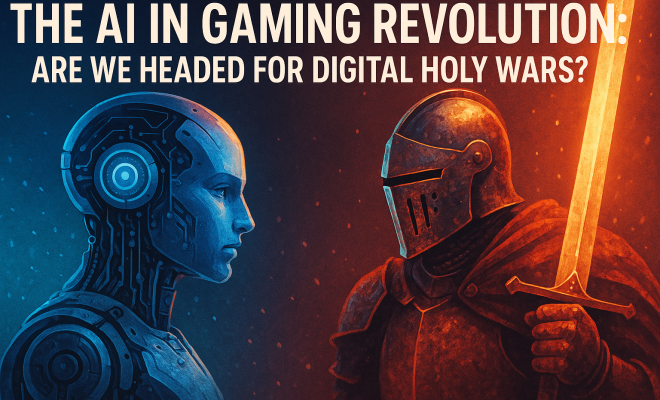
The AI in Gaming Revolution: Are We Headed for Digital Holy Wars?
“`html
The gaming world is buzzing, and not always with excitement. We’re standing on the precipice of an Artificial Intelligence revolution, and while the potential for innovation is electrifying, a growing chorus of voices is sounding the alarm about what we might be losing. It’s a conversation that touches on everything from the very nature of creativity to the future of human connection, and it’s happening right now, whether we’re ready for it or not. The integration of AI in gaming isn’t just about better graphics or smarter NPCs; it’s about fundamentally reshaping the interactive experiences we cherish, and with that comes a complex web of ethical dilemmas and unforeseen consequences.
Think about it: for decades, game development has been a deeply human endeavor. Artists, writers, designers, programmers – their collective genius has brought countless virtual worlds to life. Now, generative AI tools are capable of producing everything from character models to entire narratives, sometimes in a fraction of the time. This shift is creating a palpable tension, a feeling that something precious might be at stake. Is this a new dawn for creativity, or are we simply automating away the soul of our games? This isn’t just a theoretical debate for academics; it’s a very real, very viral, and emotionally charged subject that’s dividing communities and prompting urgent questions about our collective digital future.
The Ethical Minefield of Generative AI in Gaming
One of the most pressing concerns surrounding AI in gaming revolves around its ethical implications. A recent review has really brought this to the forefront, highlighting the moral trade-offs inherent in generative AI. We’re not just talking about whether an AI can write a compelling questline; we’re talking about the profound cultural impact these technologies could have on future generations. The review suggests a rather unsettling future, one where hyper-specific ‘microfetishes’ could become the norm, driven by AI’s ability to cater to incredibly niche desires. Imagine a game world custom-tailored to your exact, perhaps even subconscious, preferences. While that might sound appealing on the surface, it raises questions about shared cultural experiences, about the serendipitous discovery that often defines our engagement with art and entertainment.
Beyond these highly personalized experiences, there’s also the very real possibility of ‘holy wars’ erupting over AI-generated content. We’ve already seen glimpses of this in online communities, where debates rage over whether AI art truly counts as art, or if an AI-written story holds the same value as one crafted by a human. As generative AI becomes more sophisticated and ubiquitous, these ideological battles are only likely to intensify. Will players distinguish between human-made and AI-made content? Will they care? And what happens when the lines blur completely? These aren’t easy questions, and the answers will undoubtedly shape the social fabric of our gaming communities for years to come.
The Urgency of Responsible AI Practices: A 2026 Wake-Up Call
This isn’t just speculation; the alarm bells are already ringing. A comprehensive 2026 report, a joint effort by KPMG and the UNLV’s International Gaming Institute, really hammered home the urgent need for responsible AI practices within the gaming industry. It wasn’t just a theoretical exercise; the report pointed to a sharp and concerning increase in AI-related incidents since 2023. We’re talking about real-world problems with tangible consequences, not just abstract philosophical debates. This isn’t some distant future scenario; it’s happening now, impacting players, developers, and even the broader societal landscape.
One particularly chilling example cited in the report involved the use of deepfakes for illegal gambling operations. This isn’t just a minor glitch; it’s a clear demonstration of how sophisticated AI tools, when wielded maliciously, can have serious legal and financial repercussions. It underscores the fact that while AI offers incredible potential, it also opens new avenues for exploitation and crime. The report serves as a stark reminder that the ethical considerations aren’t just about artistic integrity; they’re about safeguarding against fraud, protecting intellectual property, and ensuring fair play. The industry simply cannot afford to drag its feet on this.
The Alarming Gap in AI Governance
Despite the growing risks and the clear warnings, the gaming industry seems to be lagging in its implementation of responsible AI practices. The KPMG and UNLV report painted a rather grim picture: only about 70% of gaming companies even report having some form of responsible AI practices in place. Now, that might sound okay on the surface, but when you dig a little deeper, the reality is far more concerning. Less than 5% of these companies have actually managed to fully embed these practices into their core operations and development pipelines. That’s a massive gap, a chasm between recognition and actual, tangible implementation.
What does this mean in practical terms? It means that a significant portion of the industry is operating without robust safeguards, without clear ethical guidelines, and without the proper infrastructure to manage the risks associated with AI. It’s like building a high-speed vehicle without bothering to install proper brakes or airbags. The potential for accidents, for ethical breaches, and for the misuse of AI technologies is alarmingly high. This isn’t just a matter of good corporate citizenship; it’s a critical business imperative. Companies that fail to address this gap risk not only reputational damage but also legal challenges and a loss of player trust, which, let’s be honest, is the lifeblood of any successful game. (See: AI's impact on video game development.)
AI’s Impact on Creative Jobs: A Looming Crisis?
Perhaps one of the most visceral and emotionally charged aspects of the AI in gaming debate is its potential impact on creative jobs. For artists, writers, voice actors, and even game designers, the rise of generative AI feels less like a helpful tool and more like an existential threat. Imagine spending years honing your craft, developing a unique artistic style, only to see an AI produce similar results in seconds. It’s a terrifying prospect, and it’s leading to widespread anxiety within the creative communities that form the backbone of the gaming industry.
We’ve already seen examples of artists fighting back against AI models trained on their work without consent or compensation. The core question here isn’t just about efficiency; it’s about value. Does AI devalue human creativity? Will the demand for human artists diminish as AI becomes more proficient? While some argue that AI will simply free up human creatives for more complex, conceptual tasks, others fear a race to the bottom, where the unique spark of human artistry is replaced by algorithmically generated content. This isn’t just about jobs; it’s about the identity and livelihood of countless individuals who pour their hearts and souls into creating the games we love. For more context, see the impact of monetization trends in gaming.
The Murky Waters of Intellectual Property and Copyright
If the impact on jobs is an emotional flashpoint, then intellectual property (IP) and copyright are the legal minefield that companies are struggling to navigate. The current legal frameworks were simply not designed for a world where AI can generate new content based on vast datasets of existing human-created work. Who owns the copyright to an image or a piece of music generated by an AI? Is it the AI’s developer? The person who prompted the AI? Or does it belong to the original artists whose work was used to train the model?
These questions are far from settled, and the lack of clarity is creating significant legal risks for game developers. Imagine pouring millions into a game, only to face a lawsuit claiming that your AI-generated assets infringe on someone else’s copyright. It’s a nightmare scenario, and it’s one that many companies are genuinely worried about. This legal ambiguity isn’t just a hurdle; it’s a fundamental challenge to the way intellectual property has been understood for centuries. Without clear guidelines and new legal precedents, the industry risks a flood of litigation that could stifle innovation and create massive financial headaches.
Quality Control: From AAA to AI-Assisted Mediocrity?
Beyond the ethical and legal complexities, there’s also a very practical concern about content quality. While generative AI can produce impressive results, there’s a lingering question about whether it can consistently match the nuance, depth, and artistry of human-made content. Will the pursuit of efficiency and cost-cutting via AI lead to a deluge of generic, algorithmically bland games?
Think about the games that truly resonate with you – the ones with unforgettable characters, innovative mechanics, and deeply emotional stories. Often, these are the product of countless hours of human iteration, artistic vision, and passionate dedication. While AI can certainly assist in various stages of development, relying too heavily on it might strip games of that unique human touch. There’s a fine line between using AI as a powerful tool to augment human creativity and allowing it to dictate the creative process. The challenge for developers will be to leverage AI’s capabilities without sacrificing the quality, originality, and soul that make games truly special.
Monetizing the AI Revolution: New Opportunities Emerge
Despite the challenges, it’s not all doom and gloom. The AI in gaming revolution is also creating significant new monetization opportunities for savvy businesses. This isn’t just about selling more games; it’s about building an entirely new ecosystem around AI development and risk management. For those willing to adapt and innovate, there’s considerable potential for growth and profit in this shifting landscape.
One obvious area is in ‘software’ for AI development tools. As more companies adopt AI, they’ll need sophisticated platforms, engines, and plugins to integrate these technologies into their workflows. Think of companies building specialized generative AI tools for character design, environmental generation, or even procedural storytelling. There’s a huge market for robust, user-friendly solutions that empower developers to harness AI effectively and ethically. This isn’t just about the big players; even smaller studios and indie developers will be looking for accessible tools to enhance their creative output.
Building a Secure Future: Cybersecurity and Legal Services
With great power comes great responsibility, and in the case of AI, that responsibility often translates into a demand for robust ‘cybersecurity’ solutions. As the KPMG and UNLV report highlighted, AI-related risks, like deepfakes used for illegal gambling, are already a reality. This means there’s a growing need for specialized cybersecurity services designed to detect, prevent, and mitigate AI-specific threats. Companies will need to protect their AI models from adversarial attacks, safeguard sensitive data used for training, and ensure the integrity of AI-generated content. This isn’t just an IT department’s problem; it’s a critical component of responsible AI implementation across the board. (See: Ethics of AI in creative industries.)
Hand-in-hand with cybersecurity, ‘legal services’ are also seeing a boom. The murky waters of copyright, intellectual property, and ethical guidelines surrounding AI in gaming require expert navigation. Law firms specializing in technology and IP will find a ready market in advising game developers on how to use AI responsibly, draft appropriate contracts for AI-generated assets, and defend against potential infringement claims. As the legal landscape evolves, these services will become indispensable, helping companies stay compliant and avoid costly litigation. It’s about providing the guardrails for an exciting, but potentially chaotic, new frontier.
Education as the Cornerstone: Responsible AI Training
Finally, and perhaps most importantly, there’s a massive opportunity in ‘online education’ for courses focused on responsible AI in game development. The industry desperately needs to upskill its workforce, and this isn’t just about programmers. Artists, designers, producers, and even executives need to understand the capabilities, limitations, and ethical considerations of AI. Think of courses that cover everything from prompt engineering for generative art to the legal implications of using AI-trained models, or best practices for bias mitigation in AI algorithms. For more context, see the ethical implications of AI in creative fields.
These educational offerings cater to both B2B audiences – companies looking to train their teams – and individual professionals seeking to future-proof their careers. As AI becomes increasingly integrated into game development, a deep understanding of responsible AI practices will become a critical skill, separating the forward-thinking professionals from those left behind. This isn’t just about learning new tools; it’s about cultivating a new mindset, one that prioritizes ethical innovation and sustainable growth in the age of AI. The future of AI in gaming, for better or worse, will be shaped by the knowledge and wisdom of the people building it.
The Evolution of NPCs: Beyond Scripted Responses
One of the most tangible and exciting impacts of AI in gaming is the radical transformation of Non-Player Characters (NPCs). For years, NPCs have been largely predictable, operating on pre-scripted dialogue trees and limited behavioral patterns. While some games achieved impressive illusions of intelligence, the underlying mechanics were often quite rigid. Modern AI, particularly through techniques like reinforcement learning and natural language processing (NLP), is shattering these limitations. Imagine NPCs that don’t just react to your actions but genuinely learn from them, developing unique personalities and memories over time. This could mean a shopkeeper remembering your last purchase and offering a personalized discount, or an enemy AI adapting its combat strategy based on your fighting style. This level of dynamic interaction creates a far more immersive and believable game world, where every encounter feels unique rather than a repeat of a predetermined script. It moves us closer to virtual worlds that feel truly alive, where characters aren’t just props but active participants in an unfolding narrative.
Procedural Generation on Steroids: Infinite Worlds
Procedural generation isn’t new to gaming; titles like Minecraft have showcased its power for creating vast, explorable environments. However, AI takes procedural generation to an entirely new level. Instead of simply stitching together pre-defined assets or following basic algorithms, AI can generate content that is truly novel and contextually aware. Think about an AI that doesn’t just create a forest, but designs a biome that makes ecological sense, complete with unique flora and fauna, intricate cave systems, and even emergent weather patterns. This isn’t just about scale; it’s about depth and coherence. Developers could use AI to generate entire quest lines on the fly, crafting narratives that adapt to player choices and world events, ensuring that no two playthroughs are ever quite the same. This capability has profound implications for replayability, offering potentially infinite content and truly personalized adventures, pushing the boundaries of what a game world can offer.
AI-Driven Game Testing and Development Optimization
Behind the scenes, AI is already revolutionizing how games are made, particularly in areas like testing and optimization. Manual testing is notoriously time-consuming and prone to human error, especially for complex open-world games. AI-driven testing agents can explore vast game environments, identify bugs, stress-test systems, and even analyze player behavior patterns at speeds and scales impossible for human testers. These AI agents can learn optimal paths, exploit glitches, and provide detailed reports, drastically reducing development cycles and improving game stability before release. Furthermore, AI can optimize game performance by analyzing code, suggesting efficiencies, and even automating certain mundane development tasks, freeing up human developers to focus on creative problem-solving and innovative design. This integration of AI into the development pipeline isn’t just about saving money; it’s about creating higher-quality, more polished games more efficiently.
Expert Perspectives: Balancing Innovation and Responsibility
The conversation around AI in gaming isn’t happening in a vacuum. Industry leaders, ethicists, and academics are weighing in, offering diverse perspectives on how to navigate this transformative era. Dr. Anya Sharma, a leading AI ethicist at the Institute for Digital Policy, recently commented, “The allure of AI’s efficiency is powerful, but we must consciously prioritize human agency and artistic integrity. The goal shouldn’t be to replace creators, but to empower them with new tools that enhance their vision, not dilute it.” Meanwhile, veteran game designer Marcus Thorne, known for his narrative-driven RPGs, expressed a more cautious optimism: “AI can be a phenomenal assistant, generating background art or drafting initial quest outlines. But the spark, the soul, the core emotional beats – those still need a human touch. The real challenge is finding that sweet spot where AI elevates, rather than diminishes, our creative output.” These perspectives highlight a common thread: while the technological capabilities are undeniable, the human element, both in creation and consumption, remains paramount. The consensus leans towards a future where AI serves as a powerful co-pilot, not the sole pilot, of game development.
Comparing Approaches: Western vs. Eastern AI Integration
It’s also worth noting that the approach to AI integration in gaming isn’t uniform across the globe. In Western markets, particularly in North America and Europe, there’s a strong emphasis on ethical guidelines, data privacy, and the protection of creative labor, often driven by existing regulations like GDPR and a more vocal artist community. Discussions frequently center on transparency regarding AI-generated content and ensuring fair compensation for data used in training models. Conversely, in some Eastern markets, particularly in Asia, the adoption of AI in gaming often prioritizes efficiency, rapid content generation, and new monetization models. While ethical considerations are present, the cultural and regulatory landscapes can lead to faster and more widespread deployment of AI tools in areas like character customization, live-service content, and even AI-driven esports commentary. This divergence in approaches presents both challenges and opportunities for global game companies, requiring a nuanced understanding of local expectations and legal frameworks when deploying AI-powered features. For more context, see the role of AI in transforming industries. (See: The future of AI in entertainment.)
FAQ: Your Burning Questions About AI in Gaming Answered
Q1: Will AI completely replace human game developers?
A: While AI will undoubtedly automate many repetitive tasks and assist in content generation, it’s highly unlikely to completely replace human developers. AI lacks true creativity, emotional intelligence, and the ability to understand nuanced human desires and cultural contexts – all crucial for designing compelling games. Instead, AI is expected to become a powerful tool, augmenting human capabilities and allowing developers to focus on higher-level creative and strategic challenges.
Q2: How can players tell if game content is AI-generated?
A: Currently, it can be difficult to tell definitively, especially as AI improves. However, some developers are exploring watermarking AI-generated assets or including disclaimers. As responsible AI practices become more widespread, we might see industry standards emerge for transparency. Players might notice subtle signs like generic dialogue, repetitive patterns, or a lack of unique artistic flair if AI is used without careful human oversight.
Q3: Is AI in gaming safe for children?
A: The safety of AI in gaming for children is a significant concern. Personalized content driven by AI could expose children to inappropriate themes or create addictive feedback loops. The use of deepfakes, as mentioned in the article, also poses risks. Responsible AI practices, including age-gating, content filtering, and strict ethical guidelines, are essential to ensure a safe environment for younger players. Parents should remain vigilant about the types of AI-powered games their children interact with.
Q4: What are the biggest benefits of AI for gamers directly?
A: For gamers, AI promises more dynamic and personalized experiences. This includes smarter, more reactive NPCs; procedurally generated worlds that offer endless replayability; adaptive difficulty that caters to individual skill levels; and even AI-powered game masters that can create unique narratives on the fly. Essentially, AI aims to make games more engaging, immersive, and tailored to each player’s preferences.
Q5: How can individual artists and creators protect their work from AI training without consent?
A: This is a complex and rapidly evolving legal area. Currently, artists are advocating for stronger copyright protections and exploring legal challenges against AI models trained on their work without permission. Tools are also emerging that can “poison” datasets or add metadata to images, making them less suitable for AI training. Supporting legislation that requires explicit consent and fair compensation for training data is also a key strategy. It’s an ongoing battle for intellectual property rights in the digital age.
“`
Trending Now
Frequently Asked Questions
What is the impact of AI on the gaming industry?
The impact of AI on the gaming industry is profound, as it reshapes how games are developed and experienced. AI tools can generate character models, narratives, and enhance gameplay, potentially leading to faster development times. However, this raises concerns about creativity, ethics, and the future of human connection in gaming.
Are AI-generated games less creative?
Many argue that AI-generated games may lack the unique creativity that human developers bring to the table. While AI can produce content quickly, it risks automating away the emotional and artistic aspects that define engaging gaming experiences, leading to debates about the soul of games.
What ethical concerns are associated with AI in gaming?
The ethical concerns surrounding AI in gaming include the potential for cultural impact, the loss of human creativity, and moral trade-offs in content creation. As AI technologies evolve, they may shape narratives and experiences in ways that could have lasting implications for society.
How is AI changing game development?
AI is changing game development by streamlining processes and introducing new ways to create content. Developers can use generative AI for tasks like designing characters and writing storylines, which can enhance productivity but also lead to debates about the authenticity and emotional depth of games.
Will AI replace human game developers?
While AI is transforming aspects of game development, it is unlikely to fully replace human developers. Instead, it may serve as a tool that complements their creativity, allowing for new forms of storytelling and gameplay, but the emotional and artistic elements of gaming still rely on human input.
What did we miss? Let us know in the comments and join the conversation.