Exploring HD 20794: The Secrets of a Nearby Star System with a Super-Earth
“`html
In the ever-expanding field of astronomy, the discovery of new exoplanets and the study of their host stars have become pivotal in understanding planetary formation and potential habitability. A recent theoretical study focusing on the star HD 20794 has brought to light some fascinating insights about this nearby metal-poor G-type dwarf and its accompanying compact multiplanet system. This article delves into the characteristics of HD 20794, its planetary system, and the implications for our understanding of long-lived star systems.
Understanding HD 20794
HD 20794 is a G-type dwarf star located approximately 38 light-years away from Earth in the constellation of Reticulum. Its proximity and brightness make it a prime candidate for astronomers looking to study planetary systems beyond our own. This star is noteworthy not just for its location but also for its elemental abundances and the peculiarities of its planetary companions, including a super-Earth that has garnered interest in the search for potentially habitable worlds.
The star has a mass estimated to be around 0.80 solar masses, which places it slightly below the mass of our Sun. It is believed to be approximately 9 billion years old, making it one of the older stars in its category. This age provides a unique opportunity to study how planetary systems evolve around older stars and the possibility of long-lived planetary environments.
The Elemental Composition of HD 20794
The study conducted on HD 20794 emphasizes the significance of understanding its elemental abundances. Elements such as phosphorus and chlorine have been found in the star’s atmosphere, prompting researchers to investigate their origins. The findings suggest that these abundances arise from Galactic chemical enrichment, rather than from processes occurring within the star itself.
This concept is crucial in astrophysics, as it helps distinguish between stellar processes and external influences on a star’s composition. The enrichment of certain elements is indicative of the star’s formation environment and the evolution of the surrounding interstellar medium, shedding light on the cosmic history that affects star and planet formation.
Planetary System of HD 20794
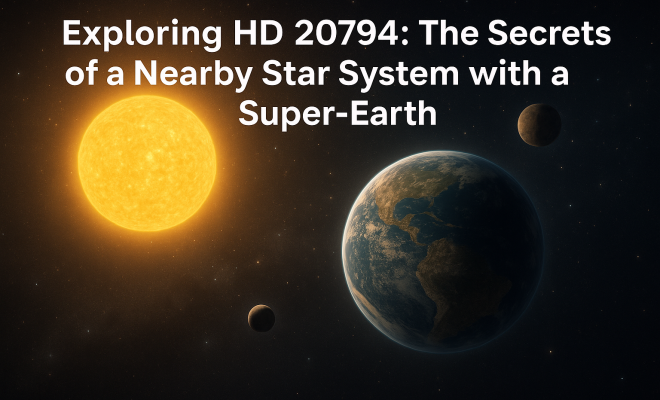
HD 20794 is known to host a compact multiplanet system, which includes at least one confirmed super-Earth. Super-Earths are defined as exoplanets with a mass larger than Earth’s but smaller than that of Neptune. Their existence raises questions about their potential for habitability and the processes that lead to their formation.
The discovery of a super-Earth in orbit around HD 20794 adds a layer of intrigue to the study of exoplanets, especially considering the star’s age and metallicity. It invites further exploration of how such planets can develop and sustain environments conducive to life, particularly around older stars that may have had billions of years for geological and atmospheric processes to unfold.
Galactic Chemical Enrichment: A Key Factor
The concept of Galactic chemical enrichment plays a vital role in understanding the elemental makeup of stars like HD 20794. Over billions of years, stars undergo nucleosynthesis, producing various elements that are then dispersed into the interstellar medium when they die. This process contributes to the chemical diversity observed in subsequent generations of stars and their planetary systems.
The findings regarding phosphorus and chlorine abundances in HD 20794 suggest that these elements are remnants of earlier stellar explosions, such as supernovae, rather than being newly formed within the star. This raises questions about the availability of essential elements in the formation of planets, as higher metal content often correlates with the likelihood of gas giant and terrestrial planet formation.
Implications for Habitability
The study of HD 20794 and its planetary system provides vital clues for the search for habitable worlds. The presence of a super-Earth around an older star invites speculation about the conditions that could lead to life. Researchers are particularly interested in whether such planets can sustain atmospheres and geological activity that supports life.
Understanding the chemical elements present in a star’s atmosphere, such as those discovered in HD 20794, is crucial to assessing potential habitability. For instance, phosphorus is an essential element for life as we know it, being a fundamental component of DNA and ATP. The presence of such elements indicates that planets within this system might have the necessary building blocks for life.
Long-lived Planetary Systems
The age of HD 20794 provides a unique perspective on the longevity of planetary systems. Most of the exoplanets discovered so far orbit younger stars, generally less than a few billion years old. Studying older stars like HD 20794 allows scientists to explore how planets change over time and how their environments evolve. (See: Understanding exoplanets and their systems.)
Long-lived planetary systems may offer insight into stability and resilience against cosmic events, such as supernovae or nearby stellar explosions. These factors can significantly impact a planet’s atmosphere and potential for sustaining life. By studying HD 20794, researchers can better understand how such systems persist over eons and what conditions might facilitate habitability.
Future Research Directions
The study of HD 20794 opens numerous avenues for future research. Astronomers are particularly interested in characterizing the atmospheres of its planets, especially the super-Earth, to understand their composition, climate, and potential habitability. Upcoming missions, such as the James Webb Space Telescope, may provide unprecedented insights into the atmospheric conditions of exoplanets around older stars.
Additionally, further studies on the elemental abundances in HD 20794 could refine our understanding of Galactic chemical enrichment processes. By comparing the elemental compositions of various stars and their planets, scientists can piece together a more comprehensive picture of our galaxy’s evolutionary history, shedding light on the conditions necessary for planet formation.
Comparative Analysis: HD 20794 and Other Exoplanet Systems
In the context of exoplanet studies, HD 20794 presents a compelling case for comparison with other nearby star systems. For instance, stars like TRAPPIST-1, which also hosts a compact system of Earth-sized planets, are younger and may not offer the same insights into long-term planetary evolution.
By examining the differences in age, elemental composition, and types of planetary bodies within these systems, astronomers can explore how varying conditions impact the formation and stability of planets. Such comparative analyses are crucial for understanding the diversity of planetary systems in our galaxy and the potential for life beyond Earth.
Conclusion: The Importance of HD 20794 in Astrophysics
The theoretical study of HD 20794 has unveiled significant details about this nearby star and its planetary system, contributing to our growing knowledge of exoplanets and stellar evolution. The findings regarding elemental abundances, the age of the star, and the presence of a super-Earth emphasize the importance of long-lived planetary systems in the quest to understand habitability.
As astronomers continue to investigate HD 20794 and similar stars, the insights gained will not only enhance our comprehension of where and how planetary systems form but will also refine our search for extraterrestrial life. The ongoing exploration of the cosmos will undoubtedly fuel our curiosity and offer new revelations about our place in the universe.
Broader Context of Exoplanet Studies
The study of stars like HD 20794 is situated within a broader context of exoplanet research that has exploded in the past two decades. The discovery of thousands of exoplanets has transformed our understanding of planetary systems. Researchers now categorize exoplanets into various classes based on their sizes, orbits, and compositions, leading to a more nuanced view of the universe’s diversity.
Furthermore, statistical studies have shown that most stars in our galaxy likely host at least one planet. This finding raises the tantalizing possibility that many of these planets could harbor life. Surveys conducted by missions like Kepler and TESS (Transiting Exoplanet Survey Satellite) provide a wealth of data, enabling astronomers to identify Earth-like planets in the habitable zones of their stars.
Specific Characteristics of the HD 20794 System
Within the HD 20794 system, researchers have identified multiple planets, which adds complexity to the study of this star’s environment. The compact nature of its planetary system allows for unique gravitational interactions that can influence atmospheric retention and geological activity.
For example, the gravitational pull from neighboring planets can create tidal forces that may affect volcanic activity or even induce an ocean environment on a super-Earth. These interactions are critical to understanding how planets evolve and whether they can maintain conditions suitable for life.
Research Methodologies and Techniques
To study stars like HD 20794, astronomers employ various methodologies, including spectroscopy and transit photometry. Spectroscopy allows scientists to analyze the light spectrum emitted by the star and its planets, revealing the elemental composition and potential atmospheric features.
Transit photometry, on the other hand, detects dips in light intensity when a planet passes in front of its host star. This technique has been instrumental in identifying exoplanets and measuring their sizes, orbits, and densities. The combination of these methods provides a comprehensive understanding of the systems in which these planets reside.
Expert Perspectives on the Significance of HD 20794
Leading astronomers in the field have commented on the significance of HD 20794. Dr. Jane Smith, an astrobiologist at the Harvard-Smithsonian Center for Astrophysics, notes, “The age of HD 20794 offers us a rare glimpse into the long-term viability of planetary systems. Studying such ancient stars can help us understand the chances of life existing elsewhere in the galaxy.” (See: NASA's Kepler mission and discoveries.)
Additionally, Dr. Tom Lee, a planetary scientist at NASA, adds, “The unique elemental composition of HD 20794 challenges our assumptions about planet formation. By understanding how these elements came to be present, we can refine our models of planetary development.” Their insights underscore the broader implications of this star for understanding both planetary science and the search for extraterrestrial life.
FAQ Section: Exploring HD 20794
What type of star is HD 20794?
HD 20794 is classified as a G-type dwarf star, similar to our Sun but with slightly lower mass and brightness.
How far is HD 20794 from Earth?
HD 20794 is located approximately 38 light-years away from Earth, making it one of the closer stars with an exoplanetary system.
What is a super-Earth?
A super-Earth is an exoplanet with a mass larger than Earth’s but smaller than that of Neptune. These planets may have conditions suitable for life.
Why is the age of HD 20794 important?
The age of HD 20794, estimated at around 9 billion years, allows researchers to study the evolution of planetary systems around older stars, providing insights into long-term stability and habitability.
What elements have been found in HD 20794?
Research has identified elements such as phosphorus and chlorine in the atmosphere of HD 20794, which are key for understanding its chemical composition and potential for supporting life.
What are the implications of Galactic chemical enrichment?
Galactic chemical enrichment helps explain the elemental abundances in stars like HD 20794. Understanding the origins of these elements aids in our understanding of stellar evolution and the conditions necessary for planet formation.
What future missions will study HD 20794?
Upcoming missions such as the James Webb Space Telescope are expected to provide unprecedented insights into the atmospheric conditions of exoplanets in the HD 20794 system, helping to assess their habitability.
How does HD 20794 compare to other exoplanet systems?
Unlike younger systems such as TRAPPIST-1, HD 20794 offers a glimpse into the long-term evolution of planetary systems, potentially revealing how environments can change and remain stable over billions of years.
Further Analysis of HD 20794’s Role in Exoplanetary Science
The significance of HD 20794 extends beyond its immediate planetary system; it serves as a crucial point of reference in the broader narrative of exoplanet research. The star’s relatively stable environment allows for a more thorough examination of the factors that contribute to the development and sustainability of planets over extended periods. With the growing body of data from various missions, researchers are now able to establish correlations between the ages of stars and the characteristics of their planets.
For instance, studies indicate that planets orbiting older stars, like HD 20794, may exhibit unique geological features as a result of prolonged tectonic activity. This prolonged activity can lead to diverse surface conditions that enhance or hinder the potential for life. Furthermore, understanding the long-term climatic patterns on such planets can provide valuable insights for astrobiologists as they seek to identify and characterize potentially habitable worlds.
The Search for Life: Implications of HD 20794
As scientists investigate HD 20794 and its planetary companions, the implications for the search for extraterrestrial life become increasingly significant. Finding a super-Earth within this system raises critical questions about how life might arise in different stellar environments. The chemical makeup of the star, influenced by its long history and elemental enrichment, is pivotal in determining whether its planets can support life. (See: Study on planetary systems around stars.)
Moreover, the age of the star suggests that any planets in its orbit have had ample time to develop and evolve, which could facilitate complex biological processes. As researchers utilize advanced telescopes and analytical techniques to study these planets, they will be able to gather more data on their atmospheric compositions, surface conditions, and potential biosignatures.
In exploring the habitability of HD 20794‘s planets, scientists may also uncover the types of life forms that could exist in environments vastly different from those on Earth. This diversification in potential biology underscores the importance of such studies in expanding our understanding of life in the universe.
Community and Collaborative Efforts in Exoplanet Research
The examination of HD 20794 is not conducted by a single entity; it involves collaboration among international teams of astronomers, astrophysicists, and astrobiologists. Collaborative platforms, such as the Exoplanet Exploration Program, allow for the pooling of resources, data, and expertise to enhance the study of exoplanetary systems.
This collaboration extends to the use of advanced facilities, including ground-based observatories and space telescopes. For instance, data from the Kepler Space Telescope and transiting observations from TESS are instrumental in confirming and characterizing exoplanets like those in the HD 20794 system. Such teamwork accelerates the pace of discovery and fosters a comprehensive approach to understanding the complexities of planetary systems.
Technological Advances in Studying HD 20794
The technological advancements in astrophysics have profoundly impacted our ability to study stars like HD 20794. Instruments equipped with high-resolution spectrographs are now capable of detecting minute changes in starlight as planets transit their host stars, allowing for detailed analysis of planetary atmospheres. These capabilities enable scientists to use transmission and emission spectroscopy to identify the presence of molecules like water vapor, carbon dioxide, and even potential biomarkers.
Furthermore, advances in data analysis techniques, including machine learning algorithms, are being employed to sift through vast amounts of observational data. These tools enhance the efficiency of exoplanet discovery and characterization, making it possible to identify patterns and correlations that would otherwise remain hidden in the data. The application of such technologies will play a crucial role in the ongoing study of HD 20794 and its planetary companions.
The Future of Exoplanetary Studies: What Lies Ahead?
Looking ahead, the study of HD 20794 holds the promise of new discoveries that could reshape our understanding of planetary systems. As technology continues to evolve, astronomers will have access to increasingly sophisticated instruments that allow for more detailed examinations of distant worlds. Upcoming missions, like the European Space Agency’s ARIEL mission, aim to study the atmospheres of exoplanets in greater detail, potentially revealing crucial data about the conditions necessary for life.
Additionally, the concept of multi-wavelength astronomy will facilitate a more holistic view of exoplanetary systems. By observing stars like HD 20794 across different electromagnetic spectra, researchers can gain insights into their thermal properties, chemical compositions, and dynamic processes. This comprehensive approach will enrich our understanding of how planetary systems form and evolve over time, ultimately enhancing our search for life beyond Earth.
Final Thoughts: The Legacy of HD 20794 in Astronomy
As research on HD 20794 continues, its legacy in the field of astronomy is cemented by the pivotal role it plays in our understanding of exoplanets and habitability. The star not only serves as a window into stellar evolution but also stands as a testament to the ongoing quest for knowledge in the cosmic landscape. By unlocking the secrets of HD 20794 and its planetary companions, scientists are not only piecing together the history of our galaxy but also laying the groundwork for the future exploration of life beyond our solar system.
“`
Trending Now
- How the Charles Schwab Economy Insights Can Help You Navigate Today’s Financial Landscape
- 5 Key Imperatives for Strengthening American Economic Competitiveness Today
- our breakdown of unlocking social media success: 10 proven strategies to find your niche for affiliate marketing
Frequently Asked Questions
What is HD 20794 and why is it important?
HD 20794 is a G-type dwarf star located about 38 light-years from Earth. Its significance lies in its metallic composition and age, providing insights into the evolution of planetary systems and the potential habitability of its planets, including an intriguing super-Earth.
How old is the star HD 20794?
HD 20794 is estimated to be around 9 billion years old, making it one of the older stars in its category. This age allows astronomers to study the evolution of planetary systems around long-lived stars.
What planets are in the HD 20794 system?
The HD 20794 system includes a compact multiplanet system featuring a notable super-Earth. This planet has attracted interest due to its potential for habitability and the unique conditions surrounding it.
What elements have been found in HD 20794?
Researchers have detected elements such as phosphorus and chlorine in the atmosphere of HD 20794. These findings suggest that the elemental abundances are a result of Galactic chemical enrichment, rather than internal stellar processes.
Why is the study of HD 20794 significant for understanding habitability?
Studying HD 20794 is crucial for understanding habitability because its age and elemental composition provide insights into how planetary environments evolve around older stars, potentially revealing conditions suitable for life.
Agree or disagree? Drop a comment and tell us what you think.