The Tech Edvocate

Top Menu

  • Advertisement
  • Apps
  • Home Page
  • Home Page Five (No Sidebar)
  • Home Page Four
  • Home Page Three
  • Home Page Two
  • Home Tech2
  • Icons [No Sidebar]
  • Left Sidbear Page
  • Lynch Educational Consulting
  • My Account
  • My Speaking Page
  • Newsletter Sign Up Confirmation
  • Newsletter Unsubscription
  • Our Brands
  • Page Example
  • Privacy Policy
  • Protected Content
  • Register
  • Request a Product Review
  • Shop
  • Shortcodes Examples
  • Signup
  • Start Here
    • Governance
    • Careers
    • Contact Us
  • Terms and Conditions
  • The Edvocate
  • The Tech Edvocate Product Guide
  • Topics
  • Write For Us
  • Advertise

Main Menu

  • Start Here
    • Our Brands
    • Governance
      • Lynch Educational Consulting, LLC.
      • Dr. Lynch’s Personal Website
      • Careers
    • Write For Us
    • The Tech Edvocate Product Guide
    • Contact Us
    • Books
    • Edupedia
    • Post a Job
    • The Edvocate Podcast
    • Terms and Conditions
    • Privacy Policy
  • Topics
    • Assistive Technology
    • Child Development Tech
    • Early Childhood & K-12 EdTech
    • EdTech Futures
    • EdTech News
    • EdTech Policy & Reform
    • EdTech Startups & Businesses
    • Higher Education EdTech
    • Online Learning & eLearning
    • Parent & Family Tech
    • Personalized Learning
    • Product Reviews
  • Advertise
  • Tech Edvocate Awards
  • The Edvocate
  • Pedagogue
  • School Ratings

logo

The Tech Edvocate

  • Start Here
    • Our Brands
    • Governance
      • Lynch Educational Consulting, LLC.
      • Dr. Lynch’s Personal Website
        • My Speaking Page
      • Careers
    • Write For Us
    • The Tech Edvocate Product Guide
    • Contact Us
    • Books
    • Edupedia
    • Post a Job
    • The Edvocate Podcast
    • Terms and Conditions
    • Privacy Policy
  • Topics
    • Assistive Technology
    • Child Development Tech
    • Early Childhood & K-12 EdTech
    • EdTech Futures
    • EdTech News
    • EdTech Policy & Reform
    • EdTech Startups & Businesses
    • Higher Education EdTech
    • Online Learning & eLearning
    • Parent & Family Tech
    • Personalized Learning
    • Product Reviews
  • Advertise
  • Tech Edvocate Awards
  • The Edvocate
  • Pedagogue
  • School Ratings
  • Big Walk developer House House Confirms ‘Sparing’ Use of Gen AI – Press Start

  • Baffling: How a Cyber Breach at South Korea’s Top Security Watchdog Exposed Millions

  • Wenn Ordnung den Bildschirm beruhigt: Warum klare Abläufe Casino-Unterhaltung einladender machen

  • Reddit AI Reviews: The Quiet Reshaping of Online Opinion

  • The Chilling Truth: Iran Cyberattacks Europe’s Food and Blood Supplies

  • Anthropic’s $3.4 Billion Bet on Gas: The Unseen Cost of AI’s Future

  • Tribit FlyBuds C3 Earbuds: Premium Features at a Budget-Friendly Price

  • Is AuraCam Pro’s Emotional AI a Privacy Nightmare or Security Breakthrough?

  • Unprecedented: N-able’s Global Shutdown After 30+ Zero-Days Revealed

  • The Urgent Truth: Your AI Tools for Financial Advisors Could Be a Compliance Nightmare

Uncategorized
Home›Uncategorized›27 Tatooine-Like Planets Found Orbiting Dual Stars in 2026

27 Tatooine-Like Planets Found Orbiting Dual Stars in 2026
By Matthew Lynch
May 10, 2026
0
Spread the love

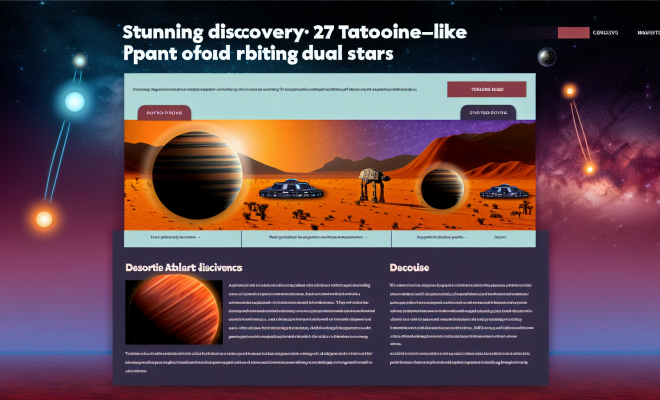
In a groundbreaking discovery that has captivated both the scientific community and Star Wars fans alike, astronomers have identified 27 potential Tatooine-like planets orbiting two stars. This remarkable finding brings to life the fictional world of Tatooine, where Luke Skywalker grew up under the glow of dual suns, and raises intriguing questions about the nature of planetary systems in multi-star environments.

The Discovery Unveiled

The announcement was made on May 5, 2026, when researchers from prestigious institutions, including the University of Cambridge, revealed their findings. Utilizing advanced telescope data, they meticulously analyzed the characteristics of these exoplanet candidates, which are now part of a newly compiled catalog that highlights the habitable zones in binary star systems. This represents a significant advancement in our understanding of how planetary systems can form and evolve around two suns.

Challenges to Previous Assumptions

Traditionally, astronomers believed that planets orbiting binary stars faced numerous challenges that could hinder their stability and formation. However, the findings from this new research challenge those assumptions, suggesting that a significant percentage of planets in such systems could indeed be rocky worlds capable of supporting life. Statistical models indicate that up to 40% of these celestial bodies might have the right conditions for life as we know it.

Why Tatooine-Like Planets Matter

The concept of Tatooine-like planets is particularly fascinating not just for its pop culture implications, but also for the scientific insights it provides into the conditions necessary for life. The existence of planets in habitable zones around binary stars suggests that life could be more common in the universe than previously thought, opening up new avenues for exploration and study.

Public Interest and Cultural Impact

This discovery has ignited a fervor on social media platforms like TikTok and Twitter, where users are sharing memes, fan theories, and engaging in discussions about the possibility of living on a planet similar to Tatooine. The excitement is palpable, amplified by growing public interest in space exploration and recent breakthroughs in astronomical research.

  • Social media discussions have included:
  • Speculation about the potential for extraterrestrial life.
  • Creative interpretations of what life might be like on such planets.
  • Comparisons to other fictional worlds in science fiction.

This viral interest underscores not only the allure of space exploration but also the deep connections between science and pop culture that resonate with a wide audience.

The Role of Advanced Telescopes

The discovery of these Tatooine-like planets was made possible by advanced telescopes that have enhanced our ability to observe and analyze distant stellar systems. The data collected from these telescopes allows astronomers to identify subtle gravitational effects and light variations that indicate the presence of planets. As technology continues to improve, the potential for discovering even more intriguing celestial bodies increases exponentially.

Future Implications for Research

The catalog of Tatooine-like planets is just the beginning. Researchers plan to conduct further studies to better understand the composition and atmospheres of these exoplanets, as well as their potential for habitability. The findings could lead to future missions aimed at exploring these worlds, making the dream of discovering life beyond Earth a tangible goal.

Conclusions

The identification of 27 potential Tatooine-like planets orbiting dual stars is not just a triumph in astronomy; it is a testament to humanity’s unending quest to understand the universe and our place within it. As we continue to explore and uncover the mysteries of the cosmos, the dream of finding life on other planets becomes ever more plausible. The connection to a beloved pop culture phenomenon like Star Wars adds a layer of excitement and wonder, reminding us that the adventure of exploration is as much a part of our cultural narrative as it is a scientific pursuit.

In this new era of discovery, who knows what other astonishing revelations await us in the distant reaches of space?


Previous Article

Medicaid Changes 2026: 7 Key Insights Everyone ...

Next Article

Is the Universe Finely Tuned for Life? ...

Matthew Lynch

Related articles More from author

  • Uncategorized

    The Astonishing Truth: Is an Online MBA Worth It in 2026?

    August 3, 2026
    By Matthew Lynch
  • Uncategorized

    2025 Best School Districts in Bellflower, California

    November 13, 2024
    By Matthew Lynch
  • Uncategorized

    Nostalgija kot oblikovalski jezik sodobnih spletnih igralniških iger

    October 12, 2026
    By Matthew Lynch
  • Uncategorized

    Best Places to Live in Eden Prairie, Minnesota

    November 14, 2024
    By Matthew Lynch
  • Uncategorized

    The Billion-Dollar Space Race: Axiom vs. Blue Origin — Which Bet Pays Off?

    September 21, 2026
    By Matthew Lynch
  • Uncategorized

    Abilene Christian Baseball Team Wraps Up Fall Season

    November 16, 2024
    By Matthew Lynch

Search

Login & Registration

  • Log in
  • Entries feed
  • Comments feed
  • WordPress.org

Newsletter

Signup for The Tech Edvocate Newsletter and have the latest in EdTech news and opinion delivered to your email address!

About Us

Since technology is not going anywhere and does more good than harm, adapting is the best course of action. That is where The Tech Edvocate comes in. We plan to cover the PreK-12 and Higher Education EdTech sectors and provide our readers with the latest news and opinion on the subject. From time to time, I will invite other voices to weigh in on important issues in EdTech. We hope to provide a well-rounded, multi-faceted look at the past, present, the future of EdTech in the US and internationally.

We started this journey back in June 2016, and we plan to continue it for many more years to come. I hope that you will join us in this discussion of the past, present and future of EdTech and lend your own insight to the issues that are discussed.

Newsletter

Signup for The Tech Edvocate Newsletter and have the latest in EdTech news and opinion delivered to your email address!

Contact Us

The Tech Edvocate
910 Goddin Street
Richmond, VA 23231
(601) 630-5238
[email protected]

Copyright © 2026 Matthew Lynch. All rights reserved.